WordPress in 2026: How to Build a Composable Website Architecture for Modern Businesses

WordPress remains a major force on the modern web. As of September 2026, WordPress powers 40.2% of all websites and accounts for 58.7% of websites with a known content management system, according to W3Techs. But the way businesses should build with WordPress is changing. Modern organizations increasingly need websites that connect content, commerce, customer data, search, analytics, AI experiences, and third-party platforms without turning the website into a tightly coupled technical system. That is where a composable WordPress website architecture becomes valuable. Instead of treating WordPress as the entire technology stack, businesses can use it as a flexible content and publishing layer within a broader digital ecosystem.
Table of Contents
Use AI to summarize this article
What Is a Composable Website Architecture?
A composable website architecture is an approach to web development where different parts of a digital experience are built as modular, replaceable components rather than as one tightly connected application.
In a traditional WordPress website, the CMS, theme, plugins, templates, business logic, integrations, and front end can become deeply interconnected. This can work well for smaller websites, but as a business grows, the architecture may become increasingly difficult to maintain. Changing one component can affect several others, while adding a new platform may require extensive custom development.
A composable approach separates these responsibilities.
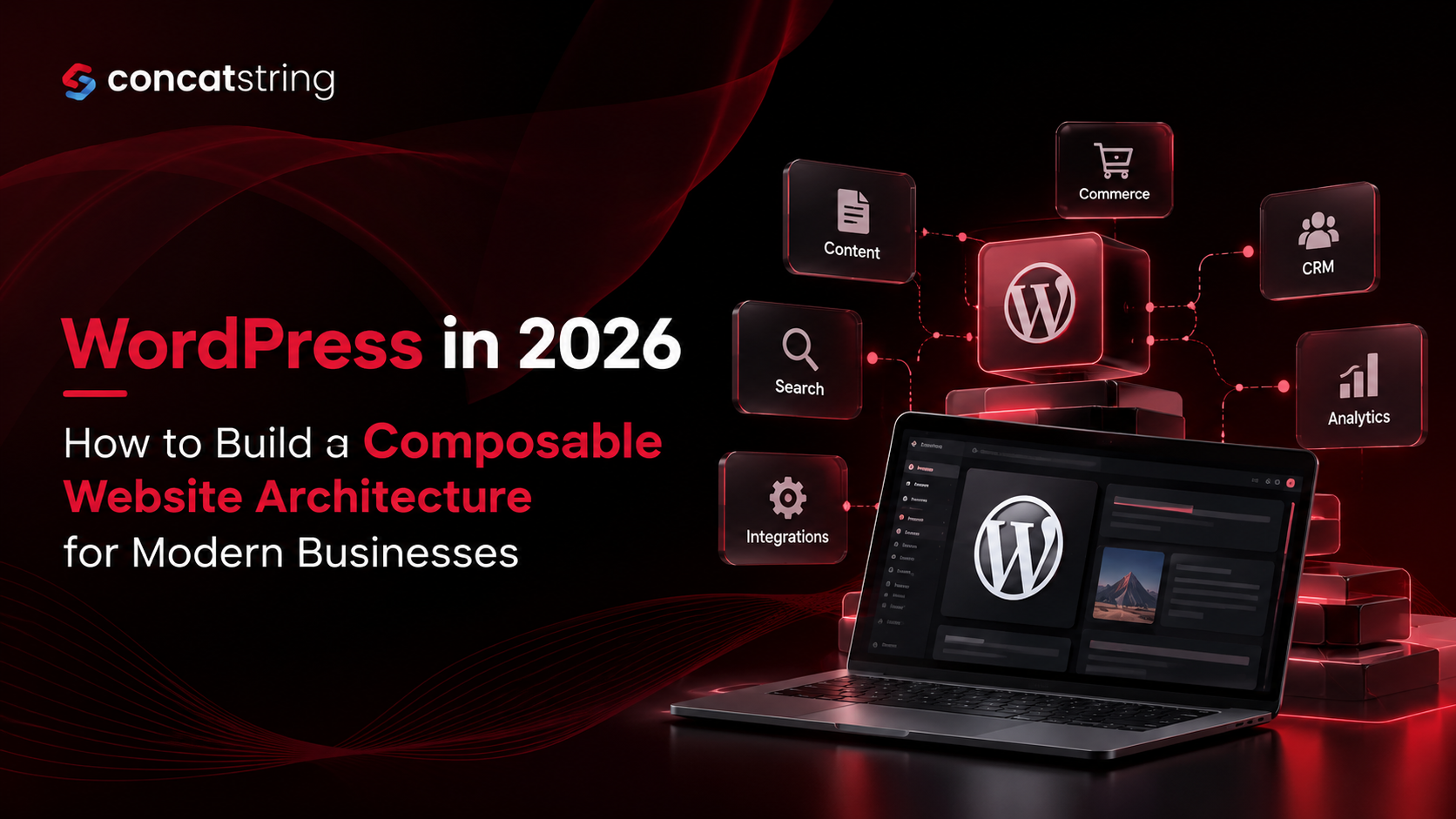
WordPress can manage editorial content and structured information, while a separate front-end framework can control the customer-facing experience. Search can be handled by a dedicated search platform, commerce can connect through an ecommerce API, customer information can live in a CRM, and analytics can be managed through a dedicated data layer.
The important concept is not simply using more technologies. It is creating clear boundaries between technologies.
For a modern business, this means the website becomes an ecosystem rather than a monolithic application.
WordPress already provides a strong foundation for this model. Its REST API allows applications to interact with WordPress content using JSON, including posts, pages, taxonomies, custom post types, and metadata. WordPress specifically documents the REST API as a way to bring WordPress content into separate applications and front-end experiences.
That makes WordPress capable of functioning as more than a conventional theme-driven CMS.
Why Should Businesses Consider Composable WordPress in 2026?
The business case for composable architecture starts with a simple problem: digital requirements change faster than traditional website architectures.
A company may begin with a corporate WordPress website containing pages, blogs, case studies, and contact forms. A few years later, the same organization may need personalization, multiple regional websites, ecommerce functionality, customer portals, marketing automation, advanced search, product information management, AI-powered experiences, and integrations with internal systems.
If all of these capabilities are implemented directly inside one WordPress installation, complexity can grow quickly.
A composable architecture provides another path.
Instead of forcing WordPress to perform every job, businesses can allow each platform to specialize. WordPress manages content. A front-end application manages presentation. An ecommerce platform handles transactions. A CRM manages customer relationships. A search service manages discovery. An analytics platform manages behavioral data.
This separation can make individual systems easier to evolve.
It also creates an important strategic advantage: the business is less dependent on one technology for every digital function.
That does not mean every business needs a headless WordPress website. For many organizations, a well-built traditional WordPress architecture is still the right choice. The goal of composability is not complexity for its own sake. It is flexibility where flexibility creates measurable business value.
WordPress and the Rise of the Composable CMS
WordPress has traditionally been associated with themes, plugins, templates, and PHP-based websites. That model remains relevant, but WordPress has also evolved into a more modular publishing platform.
The WordPress Block Editor is built around modular blocks that can be combined to create page layouts and content experiences. WordPress describes blocks as the fundamental elements of its editor, while its Block API allows developers to create and extend custom blocks.
This matters for composable architecture because modularity can exist at several levels.
There is content modularity, where information is structured into reusable content entities.
There is component modularity, where the user interface is built from reusable design components.
There is application modularity, where separate systems handle specialized business functions.
And there is integration modularity, where APIs connect those systems without requiring every platform to understand the internal implementation of every other platform.
A strong WordPress architecture combines these layers rather than treating composability as simply "headless WordPress."
Traditional WordPress vs. Composable WordPress Architecture
A traditional WordPress website generally follows a relatively direct structure. WordPress stores the content, the theme determines the presentation, plugins add functionality, and the browser receives the resulting HTML.
This architecture can be efficient, affordable, and easy for teams to operate.
A composable WordPress website introduces more separation. WordPress becomes the content management layer while other systems can consume that content through APIs.
For example, a modern business website might look conceptually like this:
WordPress CMS → API layer → Front-end application → CDN → User
Around that core flow, additional services can connect to the system:
CRM + Ecommerce + Search + Analytics + Marketing Automation + DAM + Personalization
The result is a digital platform where individual components can evolve without requiring the entire website to be rebuilt.
The right architecture depends on the organization's requirements. A company with a relatively simple marketing website may gain little from a fully decoupled stack. A multinational organization with multiple brands, markets, applications, and digital channels may gain considerably more.
The architecture should follow the business problem, not the technology trend.
How to Design a Composable WordPress Website Architecture
Start With Content Architecture, Not Technology
One of the most common mistakes in modern website development is choosing the technology stack before defining the content model.
A composable WordPress website should begin with a clear understanding of what the business actually publishes.
Instead of thinking only in terms of pages, identify reusable content entities.
For example, a B2B technology company might have products, industries, solutions, case studies, authors, resources, events, and locations. Each entity can contain structured attributes and relationships.
A case study may belong to a specific industry, reference a particular solution, identify measurable outcomes, and connect to one or more products.
This structure makes content reusable.
The same case study could appear on a solution page, an industry page, a search result, a resource hub, or a personalized experience without creating multiple copies of the content.
This is particularly important for SEO and GEO because search engines and AI systems benefit from content that is clearly organized and understandable.
Use WordPress as a Structured Content Layer
The next step is to configure WordPress around structured content rather than relying exclusively on visual page layouts.
Custom post types, taxonomies, custom fields, blocks, and APIs can create a structured content foundation.
For example, rather than placing every product detail inside a large page editor, product information can be modeled as structured fields. The front end can then determine how those fields should be displayed.
This approach creates a useful separation:
Content describes what something is.
Components describe how something looks.
Applications determine where and when something is presented.
That separation is one of the foundations of a maintainable composable website architecture.
Build a Reusable Design System
A composable architecture should not result in every page having its own unique design.
The opposite should happen.
Modern businesses should create a reusable design system containing typography, spacing, colors, buttons, cards, forms, navigation patterns, content sections, and interactive components.
WordPress's block architecture supports this type of modular development. Developers can create custom blocks and extend the editor to provide controlled content-building experiences.
The advantage is not just visual consistency.
A design system also makes development more efficient. If the company changes its button style, for example, the change can be implemented through the component system rather than manually editing hundreds of pages.
For enterprise websites, this can dramatically improve governance.
Marketing teams gain flexibility while development teams retain control over the underlying experience.
Decide Whether You Need Headless WordPress
Headless WordPress is often discussed as though it is automatically the future of WordPress development. In reality, it is an architectural option rather than a universal requirement.
In a headless setup, WordPress manages content while another technology renders the front end. WordPress's REST API can support this type of architecture by exposing content to separate applications.
A headless approach can make sense when a business needs highly customized front-end experiences, multiple digital channels, application-like interactions, or a front end built independently from the CMS.
It can also make sense when development teams want to use technologies outside the traditional WordPress theme ecosystem.
However, headless architecture introduces additional engineering responsibilities. Developers must manage API communication, caching, deployments, previews, authentication, routing, hosting, monitoring, and potentially more complex SEO implementation.
For a standard corporate website, those trade-offs may not be worthwhile.
The better question is not "Should we use headless WordPress?"
The better question is:
Which parts of our digital experience actually need to be decoupled?
That question produces a much more practical architecture.
Connect WordPress With Business Systems Through APIs
The real power of composability appears when WordPress becomes part of a larger business ecosystem.
Imagine a B2B company where the website needs information from a CRM, product catalog, marketing automation platform, customer database, and analytics system.
Rather than embedding every function directly into WordPress, the website can communicate with those systems through APIs.
For example, a product page might retrieve structured product information from a product information system while WordPress supplies editorial content around the product.
A lead form can send information to a CRM.
A marketing automation platform can track engagement.
A search service can index structured website content.
An analytics platform can collect behavioral information.
The website becomes the experience layer connecting these capabilities together.
This architecture is particularly useful for businesses that expect their technology stack to evolve.
If the CRM changes, the website does not necessarily need to be rebuilt. If the search provider changes, the content model can remain intact. If the front-end technology changes, the content stored in WordPress can continue to serve the business.
That is the practical value of composability.
Make Performance Part of the Architecture
Website performance should not be treated as a final optimization step.
It needs to be considered when the architecture is designed.
Google's Core Web Vitals currently focus on loading performance, interactivity, and visual stability through LCP, INP, and CLS. Google's recommended thresholds include an LCP of 2.5 seconds or less, INP of 200 milliseconds or less, and CLS of 0.1 or less, measured at the 75th percentile.
A composable website therefore needs an intentional performance strategy.
APIs should not create unnecessary latency. Images should be optimized. JavaScript should be loaded carefully. Caching should exist at appropriate layers. Content delivery networks can reduce geographic latency, while server-side or edge caching can reduce repeated backend requests.
A common mistake is to create a technically sophisticated composable architecture that performs worse than the simpler website it replaced.
Composability should improve flexibility without sacrificing user experience.
Build SEO Into the Architecture From the Beginning
SEO should not be added after development.
A modern WordPress website architecture needs to support search engines from its foundation.
That includes crawlable URLs, logical information architecture, internal linking, canonicalization, XML sitemaps, metadata, structured data where appropriate, accessible HTML, optimized media, and indexable content.
Google's current guidance for AI features makes an important point: the fundamental SEO practices that support traditional Search also remain relevant to AI-powered search experiences. Google specifically recommends ensuring that pages are crawlable and indexable, important content is available in textual form, internal linking helps discovery, and structured data matches visible page content.
This is where the distinction between SEO, AEO, and GEO becomes useful.
SEO helps search engines discover, understand, and rank content.
AEO focuses on producing clear answers that can satisfy direct questions and conversational searches.
GEO focuses on making information understandable and useful within generative search experiences.
The underlying requirement is similar: create clear, authoritative, well-structured information that humans and machines can understand.
Design WordPress Content for AEO and GEO
A modern website should not only answer "What keyword should this page rank for?"
It should also answer:
"What question does this page resolve?"
"Which entities are related to this topic?"
"What facts should an AI system be able to extract?"
"What context would a person need before making a decision?"
This changes the way content should be written.
Instead of creating a page filled with repetitive keyword variations, create a genuinely useful resource.
For example, a page targeting "composable WordPress architecture" should explain what composable architecture means, how it works, when it makes sense, what the implementation trade-offs are, and how businesses can approach it.
Google's 2026 guidance for generative AI search explicitly emphasizes valuable, unique, non-commodity content and recommends organizing information clearly with paragraphs and sections.
That aligns closely with a paragraph-driven content strategy.
AI search does not eliminate the need for SEO. Instead, it increases the importance of clarity, context, authority, and useful information.
Use Internal Linking to Build Topical Authority
Internal linking is another important part of a composable website architecture.
A modern business website should not consist of isolated pages targeting unrelated keywords. Its content should form a connected knowledge structure.
For example, a website discussing WordPress architecture could connect its core architecture page to related resources about WordPress development, headless CMS, website performance, technical SEO, API integrations, enterprise WordPress, and website maintenance.
These relationships help users navigate the website while also providing search engines with additional context about how topics relate to one another.
The same principle applies to AI retrieval.
When related pages are logically connected, the website creates a clearer topical graph. An individual article becomes part of a broader knowledge system rather than an isolated piece of content.
Create a Secure and Maintainable Architecture
Composability introduces flexibility, but flexibility must be controlled.
Every additional integration creates another dependency that needs to be maintained.
Businesses should therefore establish clear ownership for APIs, credentials, environments, deployments, monitoring, backups, and security.
WordPress core, themes, plugins, and custom code should also be maintained as part of an ongoing lifecycle rather than treated as a one-time project.
As of September 2026, WordPress 7.1.2 is the latest listed 7.1 maintenance release, with WordPress 7.2 planned for December 10, 2026 according to the official WordPress version documentation.
The broader lesson is that a website architecture needs an upgrade strategy.
A website that cannot be safely updated eventually becomes a business risk.
A Practical Composable WordPress Architecture
For many modern businesses, a practical architecture might consist of WordPress as the central content platform, a reusable component or block system for content creation, a modern front end where justified, a CDN and caching layer for delivery, APIs for external integrations, and dedicated systems for CRM, analytics, search, ecommerce, or customer data.
The important part is that these components have clearly defined responsibilities.
WordPress should not become the place where every business process is implemented.
Likewise, the front end should not become responsible for business logic that belongs in another system.
This separation makes the architecture easier to understand.
It also makes future changes less disruptive.
If a business later introduces a new customer portal, mobile application, regional website, or AI-powered interface, the existing content infrastructure can potentially support those experiences without rebuilding the underlying content platform.
Common Mistakes When Building a Composable WordPress Website
One of the biggest mistakes is adopting composable architecture simply because it sounds modern.
Technology should solve a business problem. If a conventional WordPress architecture can deliver the required experience with less cost and complexity, it may be the more appropriate choice.
Another mistake is creating an overly complicated API landscape. APIs are valuable, but every additional service increases operational responsibility. The goal should be deliberate separation, not maximum separation.
Poor content modeling is another common issue. If the content structure is weak, a sophisticated front end cannot fix the underlying problem.
Performance is also frequently overlooked. A website can have a modern JavaScript framework, multiple APIs, and a sophisticated deployment pipeline while still delivering a slow experience.
Finally, businesses sometimes focus so heavily on technical architecture that they forget the actual customer journey. Architecture exists to support the experience, not replace it.
How concatstring Can Approach Composable WordPress Development
For modern businesses, WordPress development should be treated as a digital architecture exercise rather than simply a theme-development project.
concatstring can help businesses think about the website as a flexible platform: defining structured content models, creating reusable components, integrating external systems, strengthening technical SEO, and building an architecture that can evolve as business requirements change.
The objective is not to make every WordPress website headless or introduce unnecessary technology.
It is to build the appropriate architecture for the business.
For a growing company, that could mean a carefully engineered WordPress website with a modular block system.
For a larger organization, it could mean a decoupled front end connected to WordPress through APIs.
For an enterprise with multiple digital products, it could mean using WordPress as one part of a broader composable digital experience platform.
The right solution depends on content complexity, traffic, integrations, team capabilities, performance requirements, governance, and long-term business goals.
The Future of WordPress Is More Modular, Not Necessarily More Complicated
WordPress has remained relevant because it has continued to evolve while preserving its role as a flexible publishing platform. Its current block architecture and REST API provide foundations for modular content and separate digital experiences.
In 2026, the opportunity is to use those capabilities strategically.
A composable website architecture can allow businesses to separate content from presentation, connect WordPress with specialized platforms, reuse content across channels, and create digital experiences that are easier to evolve.
But composability should never become an excuse for unnecessary complexity.
The strongest architecture is the one that gives a business the flexibility it actually needs while keeping performance, security, maintainability, SEO, and user experience at the center.
As search continues to evolve toward AI-generated answers and conversational discovery, that principle becomes even more important. Google's current guidance emphasizes people-first content, clear technical structures, crawlability, useful information, and strong page experiences rather than special tricks for AI visibility.
In other words, the future-ready WordPress website is not simply the one with the newest technology.
It is the one with the clearest architecture, strongest content foundations, and most useful experience for its audience.
Conclusion
A composable WordPress website architecture gives modern businesses a way to build for change rather than simply building for launch.
Instead of connecting every business requirement directly to one WordPress installation, organizations can separate content, presentation, commerce, search, customer data, analytics, and other capabilities into purposeful components.
That approach can make a website easier to evolve, integrate, scale, and maintain when it is implemented thoughtfully.
The key is balance. Not every company needs headless WordPress, multiple APIs, or a complex frontend stack. What every modern business needs is an architecture that supports its customers today without making tomorrow's requirements unnecessarily expensive to implement.
For businesses evaluating WordPress in 2026, composability is therefore less about abandoning traditional WordPress and more about using WordPress intelligently within a broader digital ecosystem.
Build a Future-Ready WordPress Website With concatstring
If your business needs a WordPress website that is scalable, SEO-ready, performance-focused, and prepared for future integrations, concatstring can help you plan and build the right architecture.
From structured WordPress development and reusable components to API integrations, technical SEO, modern front-end experiences, and scalable website architecture, the focus should be on creating a digital platform that supports measurable business growth.
The goal isn't simply to build a website that works today. It's to build one that can keep working as your business evolves.
FAQs