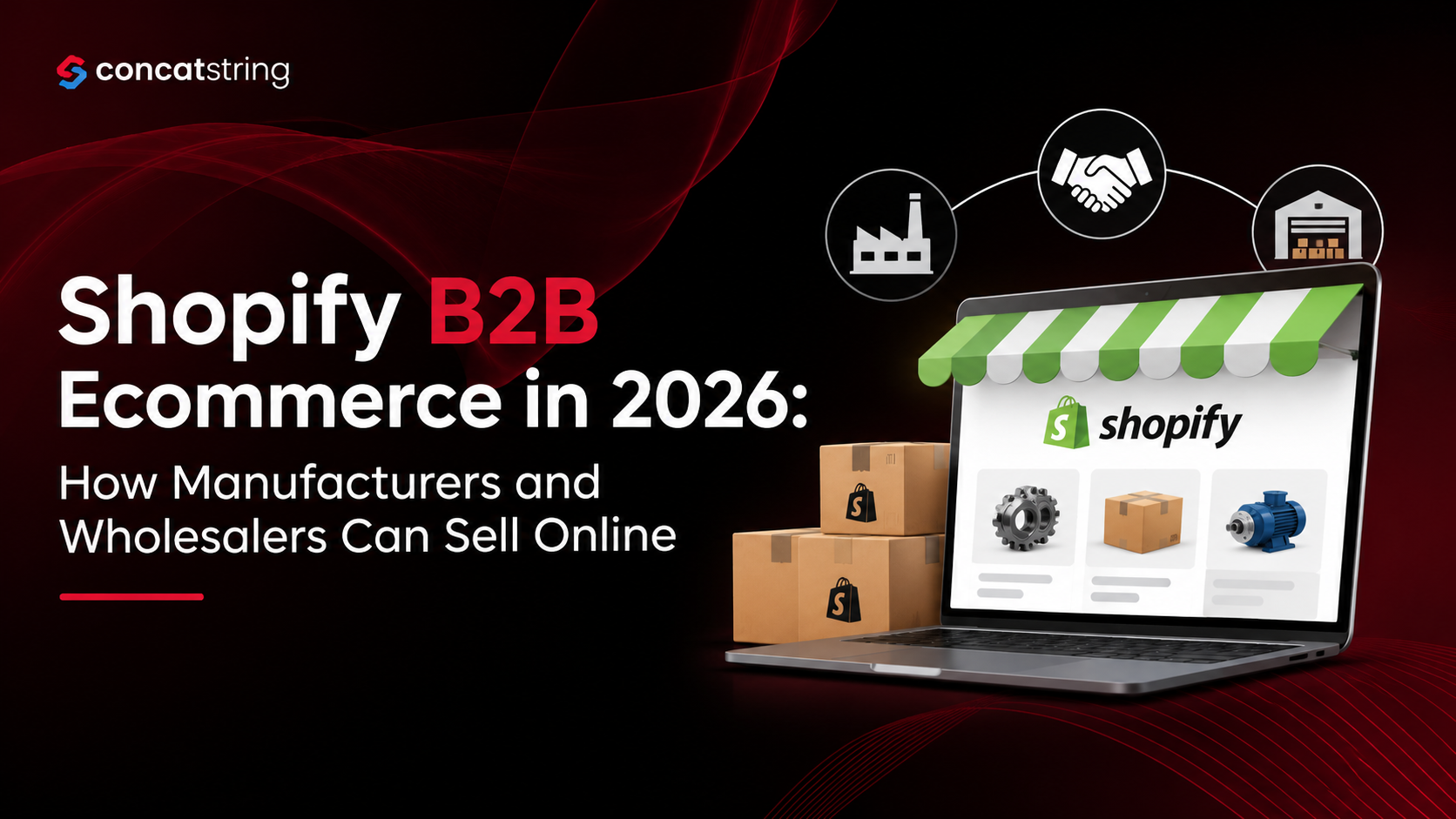
Shopify B2B Ecommerce in 2026: How Manufacturers and Wholesalers Can Sell Online

Manufacturers and wholesalers are moving beyond traditional sales processes as B2B buyers increasingly expect the same speed and convenience they experience in consumer ecommerce. McKinsey's 2026 Global B2B Pulse Survey found that 71% of B2B companies now offer ecommerce, with roughly one-third of revenue flowing through digital channels among those businesses. Shopify has also expanded native B2B capabilities beyond Shopify Plus, making online wholesale commerce more accessible to businesses of different sizes. For manufacturers and wholesalers, Shopify B2B ecommerce can provide a practical way to centralize products, pricing, customers, orders, and payments while reducing dependence on manual sales processes.
Table of Contents
Use AI to summarize this article
What Is Shopify B2B Ecommerce?
Shopify B2B ecommerce is Shopify's native system for selling products and services to other businesses rather than individual consumers. It allows manufacturers, distributors, wholesalers, and other B2B companies to create business customer profiles, assign catalogs and pricing, manage payment terms, support self-service ordering, and operate B2B sales through the Shopify platform. Shopify states that businesses can run B2B and D2C sales from one store or operate a dedicated B2B storefront.
This matters because B2B ecommerce is fundamentally different from standard retail ecommerce. A wholesale buyer may have negotiated pricing, minimum order quantities, multiple employees placing orders, purchase orders, credit terms, location-specific requirements, and recurring purchasing patterns. A successful Shopify B2B store needs to accommodate these requirements rather than simply display products and accept credit cards.
Why Manufacturers and Wholesalers Are Moving Online
Traditional B2B sales often depend heavily on sales representatives, phone calls, spreadsheets, emails, PDF catalogs, and manually created quotations. These processes can work at a smaller scale, but they become difficult to manage as product catalogs, customers, locations, and order volumes increase.
Buyer expectations are also changing. Gartner reported in 2026 that 67% of B2B buyers preferred a sales-rep-free experience and 70% preferred a completely digital, self-service buying experience. At the same time, buyers still want human assistance when they need validation or support for important decisions.
For manufacturers and wholesalers, the opportunity is therefore not to eliminate sales teams. It is to move repetitive purchasing activities online while allowing sales representatives to focus on relationships, negotiations, strategic accounts, and complex requirements.
How Shopify B2B Features Support Wholesale Selling
Company Profiles and Buyer Management
Shopify allows businesses to create company profiles and company locations for B2B customers. These profiles can contain information such as payment terms, shipping addresses, customer permissions, catalogs, and checkout settings. Multiple people can therefore purchase on behalf of the same business without treating every buyer as an unrelated customer.
For a manufacturer selling through distributors, for example, one distributor could have several purchasing locations while different employees have different purchasing responsibilities. This structure creates a more organized buying experience and gives the supplier greater control over customer relationships.
Custom B2B Catalogs and Pricing
Wholesale businesses rarely use one price for every customer. Pricing may depend on order quantity, customer type, territory, contract terms, or product category. Shopify B2B catalogs allow businesses to control which products customers can purchase and what prices they see. Shopify also supports quantity rules and volume pricing, allowing businesses to establish minimums, maximums, increments, and quantity-based price breaks.
This is particularly useful for manufacturers and distributors selling cases, cartons, bulk quantities, or products with minimum order requirements. Instead of asking customers to email a salesperson for every price, the ecommerce platform can present the appropriate commercial rules during the buying process.
Payment Terms and Wholesale Checkout
Payment flexibility is another major difference between B2C and B2B commerce. Many business customers purchase using negotiated terms rather than immediate payment.
Shopify supports B2B payment terms such as Net 7, Net 15, Net 30, Net 45, Net 60, and Net 90, depending on the setup. Businesses can also configure payment reminders and other B2B payment workflows.
This means a manufacturer can create an online purchasing experience that better reflects how its existing wholesale customers already operate rather than forcing every buyer into a standard retail checkout.
Should You Use Shopify or Shopify Plus for B2B?
The answer depends on the complexity of the business rather than simply the number of products.
As of 2026, Shopify B2B is available on Basic, Grow, Advanced, and Shopify Plus plans. Basic, Grow, and Advanced support core capabilities such as companies, catalogs, payment terms, quantity rules, volume pricing, reorders, and self-service ordering. However, Shopify Plus provides additional capabilities including unlimited B2B catalog assignments, direct catalog assignment to specific companies or locations, deposits, and partial payments.
A smaller wholesaler with a relatively straightforward customer structure may be able to start with a standard Shopify plan. A manufacturer serving hundreds of accounts with highly customized pricing, multiple locations, complex payment arrangements, and advanced workflows may benefit from Shopify Plus.
The important point is to design the B2B operating model first and then choose the Shopify plan and technical architecture that support it.
What a Successful Shopify B2B Store Should Include
A strong Shopify B2B ecommerce implementation should go beyond simply uploading a product catalog. The storefront should make it easy for buyers to find products, understand commercial requirements, reorder frequently purchased items, and complete purchases without unnecessary interaction.
Product data is especially important for manufacturers. Product specifications, dimensions, technical documents, certifications, compatibility information, case quantities, downloadable resources, and clear product images can reduce the number of questions that sales teams receive.
The store should also connect with the systems already running the business. Depending on the organization, this may include an ERP, CRM, inventory system, accounting platform, shipping software, or other internal tools. Shopify supports APIs and integrations with external systems, making it possible to build a more connected B2B commerce operation.
For businesses with complicated workflows, custom Shopify development can also be used to extend the standard B2B experience instead of forcing internal processes into a rigid ecommerce model.
Looking to move your wholesale operation online? Concatstring can help manufacturers and wholesalers plan, design, develop, and optimize Shopify B2B ecommerce experiences around their actual sales and operational requirements.
Common Shopify B2B Ecommerce Mistakes to Avoid
One common mistake is treating B2B ecommerce like a normal consumer store. A wholesale buyer may need account-level pricing, minimum quantities, purchase orders, payment terms, and repeat ordering. Ignoring these requirements can create a storefront that looks modern but does not actually improve the purchasing process.
Another mistake is migrating products without improving product information. If customers cannot understand specifications, pack sizes, pricing rules, or availability, they will continue contacting sales teams for basic information.
Businesses should also avoid automating every part of the buying journey. Complex negotiations, large strategic accounts, custom manufacturing, and unusual orders may still require sales involvement. The goal should be to automate repetitive purchasing activities while preserving human support where it creates value.
How to Build a Shopify B2B Ecommerce Strategy
The best approach is to begin with the existing wholesale process. Identify how customers currently discover products, request prices, place orders, receive invoices, reorder products, and communicate with sales teams. Then determine which parts can be moved into Shopify and which require integrations or custom development.
Next, organize customers into logical groups and define pricing, catalogs, payment terms, quantity rules, and permissions. Product data should then be structured around how B2B buyers actually search and purchase.
Finally, measure the performance of the new ecommerce channel. Useful indicators include online order volume, repeat purchase rate, average order value, customer adoption, sales-assisted orders, conversion rate, and the reduction in manual order-processing work.
Conclusion
Shopify B2B ecommerce has become a practical option for manufacturers and wholesalers that want to modernize their sales process without abandoning the commercial structures that make B2B different from retail. Native company profiles, catalogs, wholesale pricing, payment terms, quantity rules, and self-service ordering provide a strong foundation, while integrations and custom development can support more complex operations.
The real opportunity is not simply to put a wholesale catalog online. It is to create a digital purchasing experience that makes buying easier for customers and gives sales teams more time to focus on high-value relationships.
Build Your Shopify B2B Ecommerce Store With Concatstring
If your manufacturing or wholesale business is ready to move from manual ordering and disconnected systems to a scalable B2B ecommerce experience, Concatstring can help. From Shopify development and B2B storefront architecture to integrations, custom functionality, SEO, and ongoing optimization, the goal is to build a system that supports how your business actually sells.
FAQs