Webflow Localization in 2026: How to Build Websites for Multiple Markets and Languages

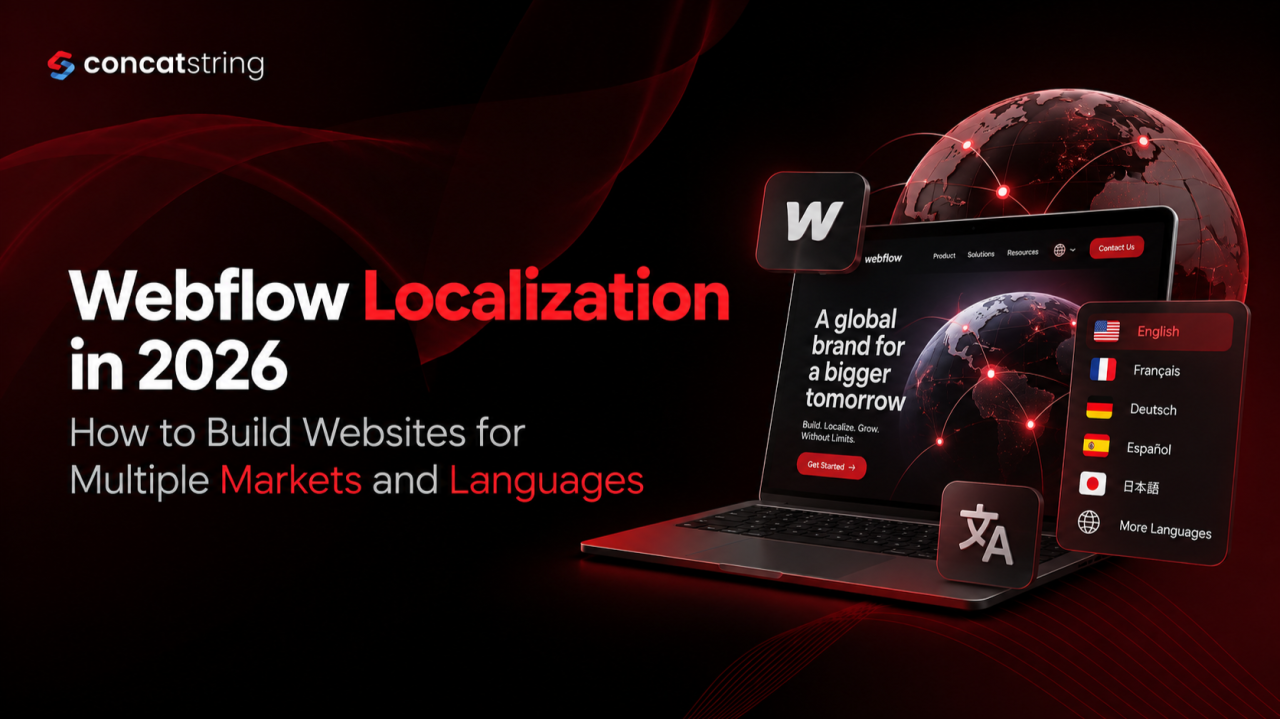
Going global with a website is no longer as simple as translating English copy into another language. Customers expect websites to feel native to their market, from language and URLs to messaging, imagery, SEO, and user experience. Research from CSA Research found that 76% of online shoppers prefer product information in their own language, while 40% said they would never buy from websites in other languages. Webflow Localization makes it possible to build multilingual and multi-market experiences within the Webflow ecosystem, giving businesses a more structured way to expand internationally. In 2026, the opportunity is not simply to translate a website, but to build a genuinely localized digital experience.
Table of Contents
Use AI to summarize this article
What Is Webflow Localization?
Webflow Localization is Webflow's approach to adapting websites for different languages and regions. Instead of maintaining completely separate websites for every market, businesses can create a primary website and then customize content, SEO settings, URLs, styles, assets, and other experiences for individual locales.
Webflow defines a locale as a language, or a combination of a language and country, designed around the needs of a particular audience. For example, a business could create English as its primary locale and then add French, German, Spanish, or more specific combinations such as English-US and English-UK.
That distinction matters because localization is broader than translation.
Imagine a SaaS company expanding from the United States into Germany. A basic translation would convert the English website into German. A localized website goes further. It may use German-specific page titles and URLs, adapt calls to action, change imagery, display locally relevant customer stories, adjust terminology, and create SEO metadata that reflects how German users actually search.
That is the difference between a website that has been translated and one that feels like it was created for the market.
Why Does Website Localization Matter in 2026?
International expansion has changed the role of a company website. A website is often the first place a potential customer evaluates whether a business understands their market.
A visitor may understand English perfectly well but still feel more comfortable researching, comparing, and purchasing in their preferred language. CSA Research's study of 8,709 consumers across 29 countries found that 76% preferred to buy products with information in their own language, while 40% said they would never buy from websites in other languages.
This creates a practical business opportunity.
If two companies offer similar products and one provides a website experience that feels native to the visitor, the localized experience can reduce friction during research and decision-making.
Localization also matters for organic search. Google recommends using separate URLs for different language versions instead of relying exclusively on cookies or browser settings to dynamically change the language. Google also recommends using hreflang annotations to help search engines understand the relationship between language and regional versions.
For businesses investing in international SEO, that makes localization part of the technical SEO strategy rather than simply a translation project.
Webflow Localization vs. Simple Website Translation
Translation changes language.
Localization changes the experience.
That distinction is one of the most important concepts for companies planning a multilingual Webflow website.
A translation workflow might take an existing English headline such as "Grow Your Business Faster" and convert it word-for-word into another language. A localization workflow asks whether the message itself makes sense for the target audience, whether the terminology matches the local industry, whether the CTA sounds natural, and whether the surrounding content reflects the market.
Webflow Localize allows secondary locales to inherit content and styles from the primary locale. Teams can then override specific content and presentation elements for individual markets.
This inheritance model can make localization more manageable because teams don't necessarily need to rebuild every page from scratch.
For example, a global technology company might maintain the same core page structure across five markets while customizing:
- Headlines and supporting copy
- Images and illustrations
- Customer testimonials
- Navigation labels
- SEO titles and descriptions
- Page slugs
- Open Graph metadata
- Local offers and messaging
The result is a consistent global brand with enough flexibility to feel relevant locally.
How Does Webflow Localization Work?
The foundation of a localized Webflow website is the primary locale.
This is the core version of the website from which other locales can inherit content, styles, and presentation. Once additional locales are configured, teams can switch between locale views and make market-specific changes.
A typical Webflow localization architecture looks something like this:
Primary locale → Secondary locales → Localized content → Localized SEO → Localized URLs → Localized user experience
The important point is that localization isn't limited to translating visible text.
Webflow currently allows businesses to localize page names, slugs, SEO titles, SEO descriptions, Open Graph settings, and custom code for individual locales.
That opens up much more control for international SEO and market-specific experiences.
Locales, Languages, and Regions
Choosing the right locale structure is one of the first strategic decisions.
A business targeting French-speaking customers in multiple countries might need to consider whether one French locale is sufficient or whether markets such as France and Canada require separate experiences.
The answer depends on how different the markets are.
If pricing, legal requirements, terminology, customer expectations, products, or messaging differ significantly, creating separate regional experiences may make more sense.
Webflow supports language-only locales as well as language-and-country combinations. For example, a locale can represent English generally or English for a particular country.
This should be decided before building dozens of localized pages because changing the architecture later can create unnecessary SEO and content-management work.
How to Build a Multilingual Webflow Website
Start With Your Market Strategy
Before opening the Webflow Designer and adding languages, define where the website actually needs to operate.
A common mistake is launching six or eight languages simply because the company plans to "go global." More languages do not automatically create better international growth.
Instead, look at where customers are located, where sales teams are active, which markets have meaningful search demand, and where the business can actually support customers.
A localized website creates an expectation. If the website is available in German but customer support only operates in English, the experience needs to communicate that clearly.
Localization works best when it reflects the company's actual ability to serve the market.
Build the Primary Experience First
Your primary locale should be more than a rough template.
It should establish the design system, content structure, navigation, CMS architecture, components, responsive behavior, and conversion paths that secondary locales will build upon.
This is particularly important because Webflow's localization system uses the primary locale as the foundation for secondary locales.
Webflow notes that secondary locales inherit content and styles from the primary locale by default. Teams can then override those elements when the target market requires something different.
A strong primary structure makes localization easier later.
Define Your URL Structure
URL architecture is one of the most important parts of multilingual SEO.
Google recommends using different URLs for different language versions of a page. It also recommends using hreflang annotations to help search engines understand relationships between localized versions.
For example, a business might use a structure such as:
example.com/
example.com/fr/
example.com/de/
example.com/es/
Subdirectories can provide a straightforward way to organize language versions under one domain.
The important thing is consistency. Avoid creating a localization system where some languages use subdirectories, others use unrelated domains, and others rely on browser-based redirects without a clear SEO architecture.
Localize the Content, Not Just the Words
This is where human expertise becomes especially important.
Machine translation can help accelerate the first draft, but a translated page should still be reviewed for natural language, terminology, cultural context, and search intent.
Consider a software company targeting the United States and the United Kingdom. Both markets use English, but terminology, spelling, examples, pricing expectations, and customer language can differ.
Now imagine translating that same page into German, Japanese, or French. Literal translation becomes even less appropriate.
The localized copy should sound as though it was originally written for the target audience.
This is also important for SEO. People in different markets may search for the same solution using completely different phrases. Translating an English keyword literally does not guarantee that it represents the actual search behavior of users in another country.
Webflow Localization and International SEO
International SEO should be designed into the website architecture rather than added after translation.
Webflow's current localization features provide several SEO-related mechanisms, including HTML language tags, page-level localization signals, and sitemap hreflang information. Webflow states that localized versions can be connected through page-level hreflang tags or sitemap entries.
Use Localized SEO Titles and Meta Descriptions
Every important localized page should have metadata appropriate to its target market.
Webflow allows page-level SEO titles and descriptions to be localized independently for secondary locales.
This means you should not automatically copy the English meta title into every language and call the job complete.
Instead, research the target market and create metadata around the way people actually search.
For example, the primary English page might target:
Webflow development services
The French version should not simply translate the English phrase mechanically. The keyword strategy should be validated against French search behavior before the localized title and content are written.
Use Hreflang Correctly
hreflang helps search engines understand which version of a page is intended for which language or region.
Webflow's current localization system can automatically generate hreflang information at the page or sitemap level depending on configuration.
The goal is not to create hundreds of technical tags simply because the website has multiple languages. The goal is to clearly establish relationships between equivalent localized pages.
Google also warns that dynamically changing content based on browser language or location can make it harder for Googlebot to discover every variation. Separate URLs provide a clearer structure for multilingual websites.
Pay Attention to the HTML Language Attribute
Language declaration is another small technical detail with a meaningful role.
Webflow automatically assigns language codes based on the locale configuration.
The lang attribute helps browsers, search engines, translation tools, and assistive technologies understand the language of page content.
The W3C recommends declaring the default language using the lang attribute on the HTML element.
This is a good example of how international SEO and accessibility can overlap.
How to Localize Webflow CMS Content
Multilingual websites often become difficult to manage when they contain a large CMS.
Think about a company with hundreds of blog posts, case studies, events, resources, and landing pages. Creating separate collections for every language can quickly become difficult to maintain.
Webflow's localization capabilities allow Collection items and fields to be adapted for different locales. Businesses can translate existing CMS content or create locale-specific content where needed.
This creates an important strategic choice.
Not every piece of content needs to exist in every language.
Suppose a company has 300 English blog posts. Translating all 300 into five languages could create 1,500 localized articles. That may sound impressive, but it can also create a significant editorial and quality-control burden.
A better approach may be to identify the 30–50 pieces that generate meaningful organic traffic, leads, backlinks, or sales opportunities and localize those first.
International SEO should prioritize quality and relevance rather than simply multiplying page counts.
Should Every Market Have the Same Design?
Not necessarily.
Brand consistency matters, but localization can require visual changes.
Webflow allows secondary locales to override localized content and styles while maintaining the underlying site structure.
This can be useful when imagery, layout, promotional messaging, or other visual elements need to change for a specific market.
However, there is an important distinction between localization and redesign.
You do not need to rebuild the website for every country.
The strongest systems usually maintain a common design foundation while allowing controlled differences where those differences improve the local customer experience.
Think of it as one global brand with multiple local expressions.
How to Create a Better Locale Switching Experience
A multilingual website needs a clear way for visitors to change languages or regions.
A locale switcher should be easy to find without taking over the navigation.
More importantly, switching languages should take users to the equivalent page whenever that page exists.
Webflow's locale list and page-link functionality can support localized navigation. Webflow notes that page-level locale routing works with page and Collection page links, while direct URLs require additional consideration.
This matters because a visitor reading a German services page should ideally be able to switch to English and remain on the corresponding services page rather than being sent back to the homepage.
Small details like this can make a multilingual website feel significantly more polished.
Common Webflow Localization Mistakes to Avoid
The biggest mistake is treating localization as a one-time translation exercise.
International websites are living systems. Content changes, campaigns launch, products evolve, URLs change, and new markets become priorities.
A localization process should therefore include ongoing QA.
Another common mistake is translating every page without considering search demand. A translated page that nobody searches for does not automatically create organic growth.
Technical SEO problems can also appear when teams change URL structures without updating redirects, canonical signals, sitemap relationships, or localized page references.
There is also a temptation to make every locale identical. Consistency is useful, but forcing every market to use exactly the same copy, imagery, offers, and content can make the website feel generic.
Finally, don't assume that English is enough simply because your target customers can understand it. Consumer research consistently shows strong preferences for information and purchasing experiences in customers' own languages.
Webflow Localization in 2026: What Has Changed?
Webflow's localization capabilities have continued to develop significantly in 2026.
Webflow introduced a dedicated Localize panel in June 2026, bringing localization workflows into a more centralized environment with areas for locales, glossary, URL routing, and SEO.
Current Webflow documentation also shows expanded controls for localized content, styles, CMS content, page settings, SEO, routing, and locale management.
For development teams, this means localization is becoming less of an external workaround and more of an integrated part of the Webflow workflow.
Webflow also provides API capabilities for localization. Developers can programmatically manage localized CMS content and static page content, which can be particularly useful for organizations managing large content libraries or integrating localization into broader content operations.
That matters for larger organizations because manual localization becomes increasingly difficult as the number of markets and pages grows.
How Concatstring Can Approach Webflow Localization
A successful multilingual Webflow website requires more than knowing where the localization settings are.
It requires coordination between UX, Webflow development, content, SEO, analytics, and market strategy.
At Concatstring, the practical approach should begin with understanding the business's target markets and then designing the Webflow architecture around those requirements.
That means thinking about the primary locale, secondary locales, CMS structure, URL strategy, localized SEO metadata, page templates, navigation, content workflows, and ongoing maintenance before the website becomes difficult to scale.
For a business entering one new market, the strategy may be relatively simple.
For a company expanding across Europe, Asia, North America, or multiple regional markets, the localization architecture needs to be much more deliberate.
The goal is to create a system where adding a new market does not mean rebuilding the website from scratch.
A Practical Webflow Localization Workflow
A reliable localization project can follow a straightforward sequence.
First, define the markets. Identify the countries and languages that matter commercially rather than trying to support every possible language.
Next, build the primary Webflow experience. Establish the design system, CMS structure, components, navigation, responsive layouts, and conversion paths before multiplying the experience across locales.
Then, configure locales and URL architecture. Decide which languages require language-only locales and which need country-specific versions.
After that, localize the content. Translate high-value pages while adapting terminology, messaging, imagery, and calls to action to the target audience.
Then, localize SEO. Review keyword intent, page slugs, title tags, meta descriptions, Open Graph information, internal links, and international SEO signals.
Finally, test every market. Review navigation, language switching, mobile layouts, forms, CTAs, URLs, indexing signals, analytics, and conversion paths before launch.
The final stage is particularly important. A website can look perfectly translated while still having broken forms, incorrect links, untranslated metadata, or inconsistent URLs.
Localization QA should therefore be treated as a launch requirement, not a final optional check.
The Future of Multilingual Web Design
The future of international websites is moving beyond translation.
Customers increasingly expect digital experiences to understand where they are, what language they use, and what information is relevant to their market.
For businesses, this creates a more sophisticated challenge.
The question is no longer simply, "How do we translate our website?"
It is:
"How do we create one scalable digital experience that feels relevant in every market we serve?"
Webflow Localization provides an increasingly capable foundation for answering that question. Its combination of locale management, localized content, CMS support, SEO controls, URL routing, and API capabilities gives businesses more control over how their websites operate internationally.
The companies that benefit most will be the ones that treat localization as part of their broader digital strategy rather than as a translation task.
Conclusion
Webflow Localization in 2026 gives businesses a practical way to expand websites across languages and markets without maintaining an entirely separate website for every audience. But the technology is only one part of the equation.
The real value comes from combining a scalable Webflow architecture with thoughtful localization, international SEO, culturally relevant content, accessible language declarations, clean URL structures, and ongoing quality control.
A successful multilingual website should feel consistent enough to belong to the same global brand while being specific enough to feel relevant to the person visiting it.
That is ultimately what good localization does: it removes the feeling that a visitor is using a website built for someone else.
Build a Scalable Multilingual Webflow Website With Concatstring
Expanding into new markets requires more than translating existing pages. Your Webflow website needs an architecture that can support new languages, localized SEO, CMS content, regional experiences, and long-term growth.
Concatstring can help businesses plan and build scalable Webflow experiences designed for multiple markets and languages. Whether you're launching your first localized website or restructuring an existing international site, the right localization strategy can make expansion easier to manage and more effective for users and search engines.
Explore your localization requirements, identify the markets that matter most, and build your Webflow website around long-term international growth.
FAQs