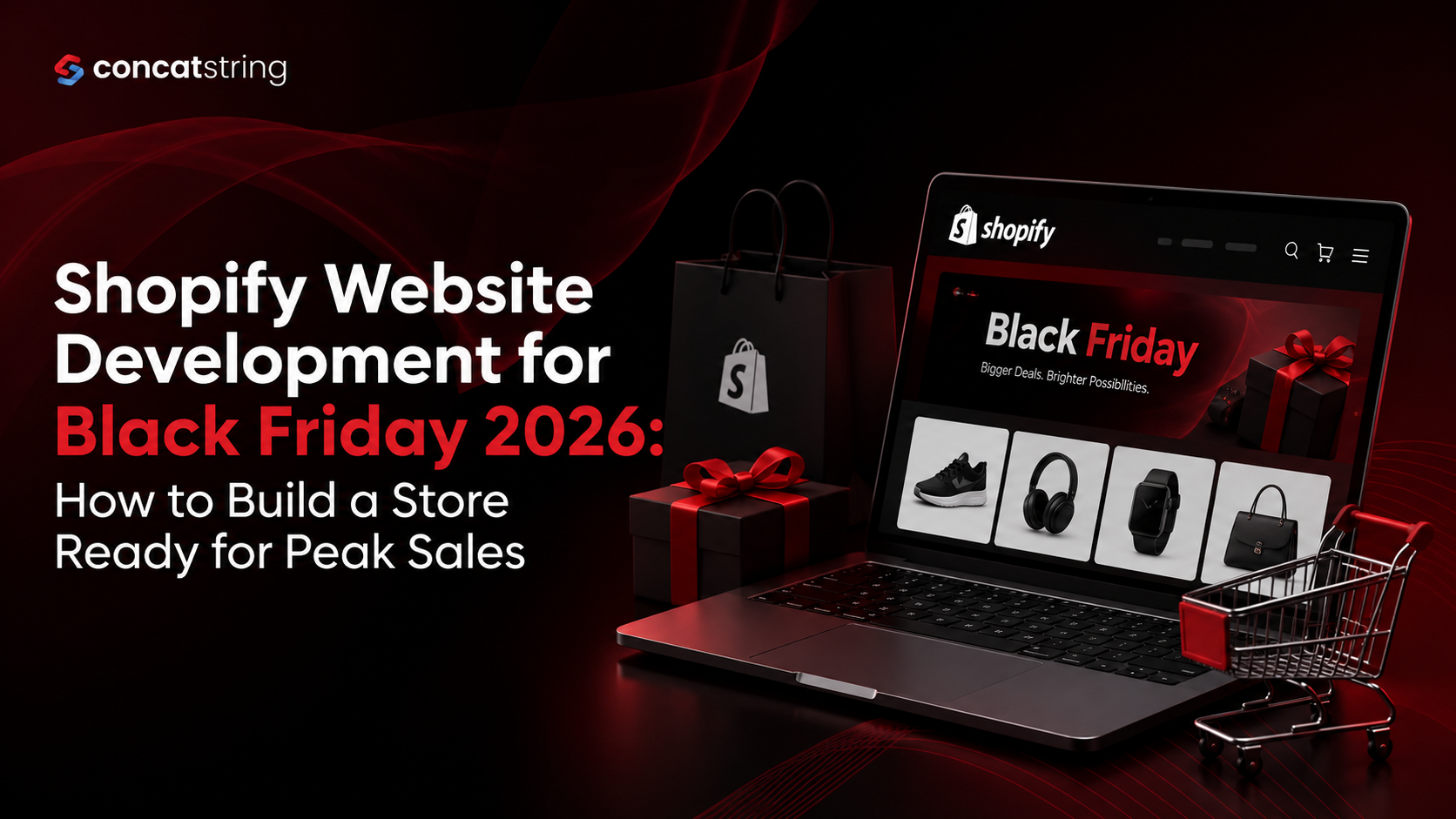
Shopify Website Development for Black Friday 2026: How to Build a Store Ready for Peak Sales

Black Friday 2026 falls on November 27, followed by Cyber Monday on November 30, creating one of the most commercially important periods of the ecommerce calendar. Shopify merchants generated a record $14.6 billion during Black Friday Cyber Monday 2025, up 27% from the previous year, with more than 81 million customers purchasing from Shopify-powered businesses. For brands preparing for this year's peak season, Shopify website development is no longer simply about creating an attractive storefront. It is about building a fast, scalable, mobile-first shopping experience that can handle increased traffic, simplify checkout, support promotions, and turn high-intent visitors into customers.
Table of Contents
Use AI to summarize this article
Why Black Friday 2026 Requires More Than a Standard Shopify Store
Black Friday has evolved from a single-day retail promotion into a highly competitive digital shopping period. Customers now compare prices, research products, watch for early deals, browse on mobile devices, and move between search, social media, marketplaces, email, and brand websites before making a purchase.
That creates a very different challenge for ecommerce businesses. A Shopify store that performs well during an average week may not necessarily be prepared for a sudden increase in traffic, promotional complexity, customer support requests, inventory changes, and checkout activity.
The scale of recent Shopify Black Friday performance demonstrates why preparation matters. During BFCM 2025, Shopify merchants collectively generated $14.6 billion in sales, while Shopify's infrastructure handled billions of requests and database operations during the event.
For merchants, this means the question is not simply whether Shopify can handle Black Friday demand. The bigger question is whether the individual store has been designed and configured to make the most of that demand.
A successful Black Friday store needs to remove friction at every important stage of the customer journey. Product discovery should be easy. Pages should load quickly. Offers should be immediately understandable. Product information should answer purchase objections. The cart should be straightforward. Checkout should require as little unnecessary effort as possible.
This is where working with experienced Shopify developers can make a meaningful difference.
What Does Shopify Website Development for Black Friday Actually Involve?
Shopify website development for Black Friday involves preparing the entire ecommerce experience for unusually high customer demand. This includes the storefront design, theme architecture, product pages, navigation, search, promotional components, cart experience, checkout integrations, analytics, mobile responsiveness, performance, third-party applications, and operational workflows.
It is important to understand that Black Friday preparation should not be treated as a last-minute visual redesign.
A new homepage banner alone will not make a store peak-season ready. In fact, adding too many promotional banners, countdown timers, tracking scripts, pop-ups, apps, animations, and widgets without considering performance can create the opposite result.
Shopify itself emphasizes performance as an important factor in storefront success and recommends minimizing unnecessary JavaScript, optimizing images, improving Liquid performance, and testing themes before deployment.
A well-planned Black Friday development project therefore starts with an audit. Developers should identify technical bottlenecks, unnecessary applications, slow-loading assets, theme issues, checkout friction, mobile usability problems, broken customer journeys, and opportunities for conversion optimization.
The goal is to create a store that is not only visually ready for Black Friday but technically and commercially ready as well.
Start With a Black Friday Shopify Store Audit
Before making major changes, your existing Shopify store should be evaluated from the perspective of a customer arriving with strong purchase intent.
Start with the homepage. Can a visitor immediately understand what the business sells, what the Black Friday offer is, and where they should go next?
Then examine category and collection pages. Are the best-selling products easy to find? Are filters useful? Can customers sort products based on price, popularity, availability, or other relevant attributes?
Product pages deserve particular attention because they are often where purchase decisions are made. Product descriptions, images, specifications, reviews, delivery information, returns policies, available variants, and promotional messaging should work together rather than compete for attention.
The same audit should continue through the cart and checkout journey. A customer who has already selected a product is highly valuable. Small points of friction at this stage can result in abandoned carts and lost revenue.
Your audit should also include installed Shopify apps. Third-party apps can add useful functionality, but every additional script can have an impact on storefront performance. Shopify recommends auditing unnecessary scripts and avoiding apps that negatively affect critical performance metrics.
For Black Friday, this matters even more because every additional second of friction can become more expensive when thousands of shoppers are arriving at the same time.
Build a Fast Shopify Store Before Traffic Peaks
Performance should be one of the highest priorities in your Black Friday development plan.
Customers do not visit an ecommerce store because they want to wait for a page to load. They arrive with a specific goal: find a product, understand the offer, and complete the purchase.
A slow storefront interrupts that journey.
Shopify's official development guidance identifies performance as a factor that can influence conversion rates, repeat business, and search visibility. It specifically recommends optimizing Largest Contentful Paint, reducing unnecessary JavaScript, avoiding inefficient Liquid loops, and serving images appropriately.
This makes technical optimization an important part of Black Friday preparation.
Your Shopify expert developer should review the theme's Liquid code, JavaScript, CSS, images, fonts, third-party scripts, app embeds, and tracking technologies. The objective should be to determine which resources are essential and which can be removed, deferred, or loaded only when needed.
Images are particularly important for ecommerce stores because large product photography and hero banners can become some of the largest assets on a page. Shopify recommends using its image optimization capabilities and ensuring that important above-the-fold images are not unnecessarily lazy-loaded.
A practical approach is to establish a performance baseline several weeks before Black Friday, optimize the store, and then test again. Do not wait until Black Friday week to discover that a promotional landing page is significantly slower than your normal storefront.
Make Mobile Shopping a First-Class Experience
Black Friday shopping is increasingly mobile.
Adobe projected that mobile devices would account for 56.1% of U.S. online holiday spending during the 2025 holiday season, representing $142.7 billion in online spend.
That trend has direct implications for Shopify development.
A desktop storefront simply compressed onto a smartphone is not a true mobile-first experience. Mobile navigation, product galleries, variant selectors, search, filters, sticky purchase controls, cart interactions, promotional banners, and checkout flows all need to work naturally on smaller screens.
Buttons should be easy to tap. Text should remain readable. Important product information should not disappear behind awkward accordions. Promotional messaging should be clear without taking over the entire screen.
Shopify's own development documentation notes that mobile devices account for the majority of Shopify storefront traffic and recommends responsive layouts, appropriate tap-target sizes, and content parity between mobile and desktop.
For Black Friday 2026, your development team should therefore test the store on multiple mobile devices and connection conditions rather than relying exclusively on a desktop browser.
Design Product Pages for High-Intent Black Friday Shoppers
Black Friday shoppers are often more price-conscious, but that does not mean price is the only factor influencing their decisions.
A strong product page should quickly communicate what the product is, why it matters, what the customer receives, how much they save, and what happens after the purchase.
This is where a professional Shopify web design company can contribute more than visual styling. Effective ecommerce design combines hierarchy, information architecture, usability, branding, and conversion psychology.
For example, a Black Friday product page could place the promotional price close to the original price, clearly communicate the savings, provide a concise value proposition, and display shipping or delivery information near the purchase area.
Customer reviews should be easy to find. Product images should provide enough detail to reduce uncertainty. Size guides, specifications, comparison information, warranty details, and returns policies should be accessible without making the page overwhelming.
The best product page is not necessarily the page with the most content. It is the page that answers the customer's most important questions at the right time.
Create Dedicated Black Friday Landing Pages
Your regular homepage should not have to do all the work during Black Friday.
Dedicated Black Friday landing pages can create focused experiences for specific campaigns, product categories, customer segments, or promotional offers.
For example, a fashion brand could create dedicated pages for "Black Friday Best Sellers," "Under $50," "Gift Sets," or "Buy More, Save More." A technology retailer might create category-specific pages for laptops, accessories, or smart-home products.
These pages also create useful destinations for paid advertising, email campaigns, social media promotions, affiliate traffic, and organic search.
From a development perspective, landing pages should be built using reusable Shopify sections rather than creating every page as a completely separate technical implementation. Shopify's theme architecture supports modular sections and blocks, allowing merchants to create flexible experiences while maintaining a manageable codebase.
This is one area where experienced expert Shopify developers can help businesses move faster. Instead of rebuilding the same components repeatedly, developers can create flexible sections that marketing teams can reuse and adapt.
Simplify the Navigation and Product Discovery Experience
During Black Friday, shoppers often arrive with very specific intentions.
Some know exactly which product they want. Others are browsing for gifts or looking for the best deal within a certain budget.
Your navigation should support both groups.
Search functionality should be prominent and useful. Collections should have logical categories. Filters should help shoppers narrow down large product catalogs. Best sellers and promotional collections should be easy to access.
Avoid making customers click through multiple layers of navigation simply to find popular products.
Search and discovery also become particularly important when inventory changes quickly. A product that was available in the morning may be sold out later in the day. The store should communicate availability clearly rather than allowing shoppers to repeatedly reach dead ends.
Optimize the Cart and Checkout Experience
Getting customers to add products to their cart is only part of the job. The next challenge is helping them complete the purchase.
A Black Friday cart should make the value of the order easy to understand. If a discount has been applied, the customer should be able to see it clearly. If free shipping is available above a certain threshold, the cart can communicate how close the shopper is to qualifying.
However, promotional features should be implemented carefully. Excessive cart upsells, pop-ups, cross-sells, and promotional widgets can make checkout feel complicated.
Checkout itself should be as frictionless as the Shopify platform and your configuration allow.
For Shopify Plus merchants using checkout customizations, Shopify provides Checkout UI Extensions for adding custom interface elements and functionality to checkout. These extensions can support tailored experiences while working within Shopify's checkout architecture.
The principle is simple: customization should solve a real customer or business problem. It should not exist merely because a feature is technically possible.
Be Careful With Shopify Apps Before Black Friday
Apps can dramatically expand what a Shopify store can do, but Black Friday is the wrong time to discover that several apps are competing for browser resources.
Review every installed application before peak season.
Ask whether each app is still necessary, whether it loads on every page, whether its scripts can be deferred, and whether it affects the product page, cart, or checkout experience.
Shopify recommends minimizing app impact on storefront performance and provides development guidance around theme app extensions and performance testing.
One particularly important issue is layout shift. Review widgets, payment displays, shipping estimates, promotional banners, and other injected components can cause visible content to move while a page is loading. Shopify specifically recommends reserving space for app-injected content to reduce cumulative layout shift.
A Shopify expert developer should therefore review your app stack as part of the Black Friday technical audit instead of treating apps as separate from the website.
Prepare Your Store for Promotional Complexity
Black Friday promotions are rarely as simple as "20% off everything."
Brands may use tiered discounts, bundles, free shipping thresholds, buy-one-get-one offers, product-specific discounts, early-access offers, customer-specific promotions, and different campaigns across different channels.
Your Shopify development strategy should account for this complexity before campaigns go live.
The important part is testing every promotion from the customer's perspective.
Test the discount code. Test automatic discounts. Test excluded products. Test sale items. Test multiple quantities. Test bundles. Test mobile checkout. Test edge cases.
A promotion that works correctly for one product can still fail when a customer combines multiple products or applies a different discount.
Black Friday should be treated as a controlled technical launch, not simply a marketing campaign.
Strengthen Inventory, Fulfillment, and Customer Experience
A successful Black Friday sale can create a second problem: too many orders.
Your Shopify store needs to communicate accurate inventory information and set realistic expectations around shipping and fulfillment.
If a product sells faster than expected, customers should not be left wondering whether their order will actually ship. Delivery estimates, fulfillment timelines, return policies, and stock information should be clear.
Shopify's guidance for seasonal sales emphasizes advance preparation for high-demand periods because increased order volume can affect inventory, processing, fulfillment, and customer service.
This is why Shopify website development should not happen in isolation from operations. Developers, marketers, fulfillment teams, customer support teams, and business owners should understand how the storefront communicates operational realities.
An attractive website cannot compensate for poor post-purchase communication.
Use Analytics to Understand What Happens During Black Friday
Black Friday generates an enormous amount of customer behavior data.
The goal should not simply be to measure total revenue. Your team should understand which products attracted visitors, which landing pages generated purchases, where customers abandoned the funnel, which devices converted best, which campaigns produced profitable traffic, and which offers increased average order value.
Establish your tracking before the event.
Make sure important events are being captured correctly and that analytics tools are not slowing down the storefront unnecessarily.
This data becomes valuable after Black Friday because it can influence product merchandising, campaign planning, website improvements, and customer retention throughout the following year.
The strongest ecommerce brands treat Black Friday as both a sales opportunity and a source of customer intelligence.
Plan the Black Friday 2026 Development Timeline
Black Friday 2026 falls on November 27, while Cyber Monday takes place on November 30.
That means development should begin well before November.
September is an appropriate period for auditing the existing store, reviewing performance, checking inventory-related functionality, analyzing the app stack, and identifying major development requirements.
October should focus on implementing the important improvements, building landing pages, preparing promotional components, optimizing product pages, testing mobile experiences, and finalizing campaign-related functionality.
By early November, the priority should shift toward testing rather than major experimentation. Promotion rules, checkout flows, analytics, landing pages, forms, email capture, inventory messaging, and mobile experiences should all be tested.
The closer you get to Black Friday, the less you should change.
A stable store is generally more valuable than a store receiving a last-minute redesign.
Why Experienced Shopify Developers Matter During Peak Season
Shopify is designed to make ecommerce easier, but building a high-performing store still requires technical judgment.
Experienced shopify developers understand that a storefront is a combination of theme code, Liquid templates, JavaScript, CSS, apps, APIs, integrations, analytics, and business logic.
They can identify when a problem belongs in the theme, when an app should be removed, when a custom solution is justified, and when Shopify's native functionality is sufficient.
That distinction matters because unnecessary customization can increase maintenance costs and introduce risks.
A strong Shopify development team also understands that performance and design are connected. A visually impressive feature that adds significant JavaScript may not be worthwhile if it slows down the shopping experience.
Likewise, a technically fast website that is difficult to navigate will not necessarily convert well.
The best results come from combining development, UX, SEO, analytics, merchandising, and business objectives.
How Concatstring Can Help Prepare Your Shopify Store for Black Friday 2026
For brands preparing for peak-season ecommerce, Concatstring can approach Shopify development as a growth and performance project rather than simply a website build.
The focus should be on creating a storefront that is fast, responsive, easy to navigate, conversion-focused, and flexible enough to support Black Friday campaigns without unnecessary technical complexity.
Whether the requirement is a Shopify redesign, custom theme development, performance optimization, landing page development, third-party integration, or broader ecommerce development, the right solution should be based on the store's business objectives and customer journey.
A capable Shopify web design company should not only make the website look better. It should help the business create a stronger path from traffic to purchase.
For Black Friday, that means thinking beyond the sale banner and preparing the entire digital shopping experience.
Common Black Friday Shopify Mistakes to Avoid
One of the most common mistakes is waiting until November to start development. Peak-season ecommerce preparation involves testing, revisions, campaign coordination, and operational planning. Leaving everything until the final weeks increases risk.
Another common mistake is installing too many apps to solve short-term problems. Apps can be useful, but unnecessary scripts and poorly optimized integrations can affect storefront performance. Shopify's performance documentation recommends auditing and removing unused scripts and avoiding unnecessary JavaScript.
Another mistake is designing primarily for desktop. With mobile accounting for a substantial share of holiday ecommerce spending, mobile UX should be treated as a primary experience rather than a secondary version of the desktop store.
Finally, many businesses focus so heavily on discounts that they overlook the complete customer journey. A great offer cannot rescue a confusing product page, slow website, unclear shipping policy, broken discount logic, or difficult checkout process.
Conclusion
Black Friday 2026 will create a concentrated period of ecommerce demand, but capturing that demand requires more than adding a promotional banner to a Shopify store.
The strongest preparation combines Shopify website development, performance optimization, mobile-first design, conversion-focused product pages, streamlined navigation, reliable promotions, efficient checkout, careful app management, analytics, and operational planning.
The opportunity is significant. Shopify merchants generated $14.6 billion during BFCM 2025, demonstrating the scale of demand already flowing through the platform. But competition for that demand is equally intense.
For businesses preparing for November 27, 2026, the smartest approach is to start early, audit what already exists, remove unnecessary friction, test every important customer journey, and make the store stable well before peak traffic arrives.
Black Friday should not be the moment you discover whether your Shopify store works. It should be the moment your preparation pays off.
Build a Black Friday-Ready Shopify Store With Concatstring
If your Shopify store needs to be faster, more conversion-focused, easier to manage, or better prepared for Black Friday 2026, Concatstring can help turn your ecommerce requirements into a practical development roadmap.
From Shopify design and custom development to performance optimization and conversion-focused improvements, the objective is simple: build a storefront that gives customers a smoother buying experience while giving your business a stronger foundation for peak-season growth.
If you are planning a Shopify redesign or need experienced Shopify developers for your Black Friday preparation, now is the time to start—not when the sale is already live.
FAQs