Shopify in 2026: How AI-Powered Commerce Is Changing the Way Online Stores Sell

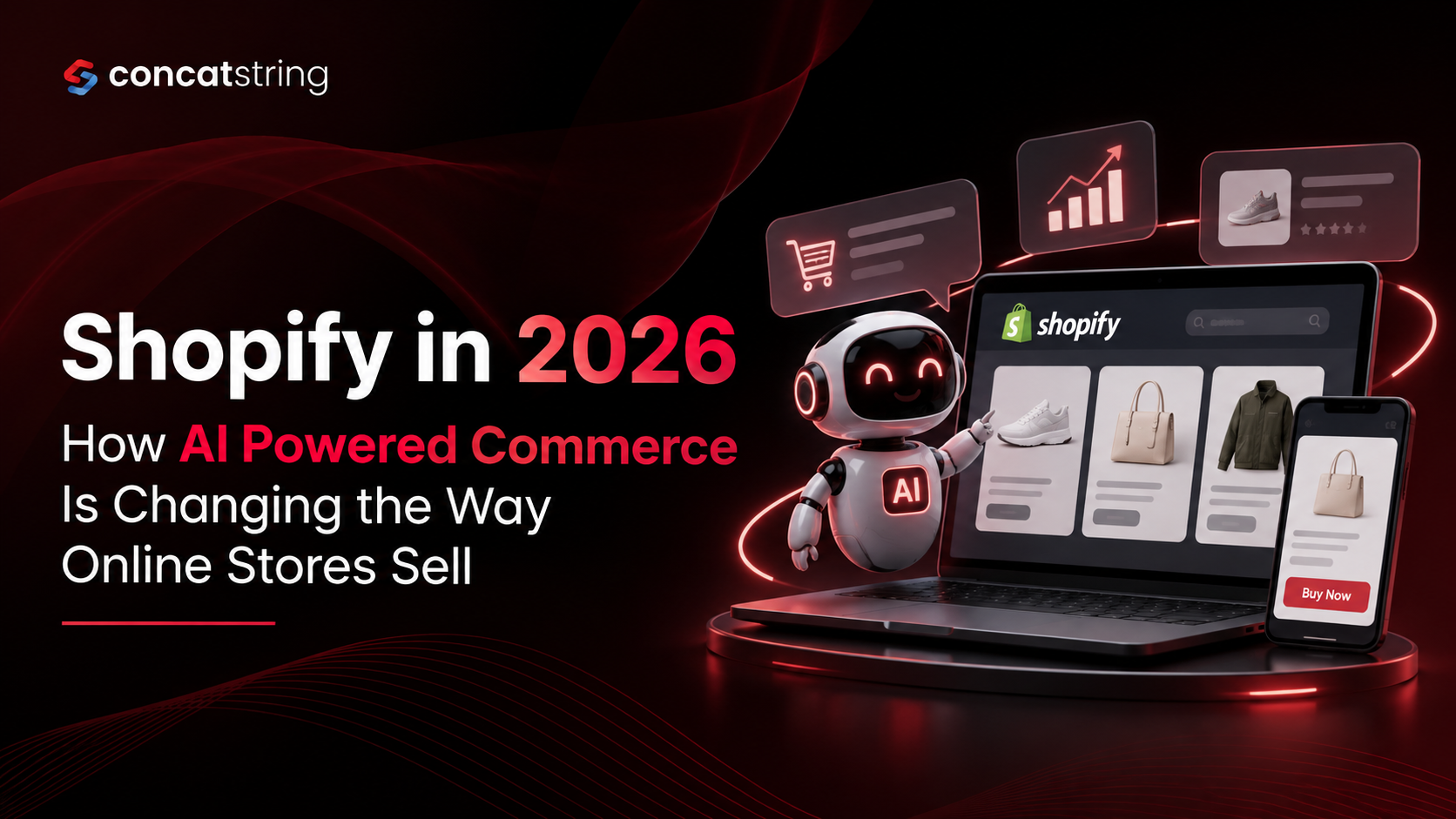
Shopify in 2026 is moving beyond traditional ecommerce and into an era where artificial intelligence can influence how customers discover, evaluate, and purchase products. Shopify reported that AI-driven traffic to Shopify stores grew 8× year over year in Q1 2026, while orders from AI-powered searches increased nearly 13×. At the same time, Google is expanding AI-assisted shopping across Search and Gemini. For online retailers, the opportunity is no longer simply to rank a product page—it is to make the entire store understandable, trustworthy, and actionable for both people and AI agents.
Table of Contents
Use AI to summarize this article
Shopify in 2026: Why AI Is Changing Ecommerce
For years, the conventional ecommerce journey looked relatively predictable. A customer searched Google, clicked a website, browsed categories, compared products, added an item to the cart, and completed checkout.
That journey is changing.
In 2026, a customer can ask an AI assistant a much more specific question such as, “Find me lightweight running shoes for under $120 that are suitable for rainy weather.” Instead of returning ten blue links, an AI-powered shopping experience can interpret the request, understand product attributes, compare options, and potentially guide the shopper toward a purchase.
This shift is commonly described as agentic commerce or AI-powered commerce.
Shopify is positioning its platform around this change. Its 2026 Agentic Storefronts infrastructure is designed to make merchant products discoverable across AI shopping experiences including ChatGPT, Google AI Mode, Gemini, and Microsoft Copilot, depending on channel and market availability.
The important point for merchants is that AI is not simply becoming another marketing tool. It is increasingly becoming part of the commerce interface itself.
What Is AI-Powered Commerce?
AI-powered commerce refers to the use of artificial intelligence across the ecommerce journey, including product discovery, personalization, customer service, merchandising, marketing, analytics, inventory management, and purchasing.
Agentic commerce takes the concept further. Instead of simply helping a customer find information, an AI agent can participate in shopping tasks such as discovering products, comparing options, answering questions, and, where supported, helping complete a transaction.
Shopify describes agentic commerce as a model where AI agents can help consumers discover, compare, and purchase products within conversational experiences.
This creates a fundamental change in how ecommerce stores need to think about visibility.
Previously, a brand primarily optimized for customers and search engines. Increasingly, it also needs to make its product catalog understandable to AI systems.
How Shopify Is Building for the AI Commerce Era
Shopify's 2026 product strategy shows that AI is becoming deeply integrated into its commerce infrastructure rather than remaining an optional add-on.
One of the most significant developments is Agentic Storefronts.
Agentic Storefronts allow eligible merchants to make their products available through AI shopping channels. Shopify says merchants can manage these channels from Shopify Admin, while Shopify Catalog structures product information so AI systems can discover and interpret products.
This matters because AI shopping depends heavily on structured and reliable information.
An AI system needs to understand what a product is, who it is for, how much it costs, what variants are available, whether it is in stock, and how it compares with alternatives.
A product page that looks visually attractive to a human but contains incomplete specifications, vague descriptions, or inconsistent information can therefore create problems beyond traditional SEO.
Shopify Catalog and AI Product Discovery
Shopify Catalog is becoming an important part of this ecosystem.
Shopify explains that its catalog infrastructure structures and distributes product information across AI channels. Its 2026 developer updates describe Catalog API as a discovery layer that makes Shopify product data structured and queryable across AI surfaces.
For merchants, this reinforces an increasingly important principle:
Product data is becoming a search asset.
Titles, descriptions, specifications, variants, categories, images, pricing, inventory information, shipping details, policies, and other product attributes can all influence how clearly an AI system understands an offering.
That means ecommerce SEO in 2026 is increasingly connected to product data quality.
From Search Results to AI Recommendations
Traditional SEO focuses heavily on ranking pages for specific search queries.
AI-powered discovery introduces another layer: being selected or mentioned within an AI-generated answer.
Imagine two ecommerce brands selling similar products.
Brand A has a short product title, minimal specifications, generic product copy, and unclear shipping information.
Brand B provides detailed specifications, clear use cases, accurate product attributes, transparent policies, helpful FAQs, and consistent structured data.
When an AI system is trying to answer a shopper's highly specific question, Brand B has more useful information available for interpretation.
This does not mean detailed content automatically guarantees an AI recommendation. AI systems use different retrieval, ranking, product, and quality signals. However, clear and accessible information gives machines a better basis for understanding what a product actually offers.
This is where SEO, AEO, and GEO begin to overlap.
SEO helps pages become discoverable in search engines.
AEO, or Answer Engine Optimization, focuses on providing clear answers that can be surfaced in direct-answer experiences.
GEO, or Generative Engine Optimization, focuses on making information useful and retrievable within generative AI experiences.
For Shopify merchants, these disciplines increasingly converge around one objective: make your store easy for humans and machines to understand.
How AI Is Changing the Shopify Customer Journey
The biggest change may not happen on the Shopify storefront itself.
It may happen before the customer reaches it.
A customer could start with a conversation in ChatGPT, Google AI Mode, Gemini, or another AI-powered shopping environment. The customer describes a need rather than typing a traditional keyword.
For example:
“I need a durable carry-on suitcase for frequent international travel. I want something lightweight, under $300, and with good organization.”
The AI system can potentially interpret those requirements and retrieve products based on attributes rather than relying on an exact keyword match.
Shopify's Agentic Storefronts initiative is designed to support this kind of discovery. Shopify reported in June 2026 that AI-driven traffic to Shopify stores had grown eight times year over year in Q1 2026, while orders from AI-powered searches increased nearly 13 times.
These numbers illustrate why AI visibility deserves attention from ecommerce teams.
The customer journey can increasingly look like:
Need → AI conversation → Product discovery → Comparison → Recommendation → Checkout → Fulfillment
rather than:
Keyword → Search results → Website → Category page → Product page → Checkout
The traditional funnel is not disappearing, but it is becoming more conversational and distributed.
Shopify Sidekick: AI for the Merchant, Not Just the Shopper
AI-powered commerce is also changing what happens behind the storefront.
Shopify Sidekick is an AI-enabled assistant inside Shopify Admin that can help merchants analyze information, generate content, manage products, work with store data, and complete certain administrative tasks. Shopify says Sidekick can work with third-party apps and can present changes for merchant review before they are applied.
This is significant because ecommerce businesses spend substantial time on repetitive operational work.
Instead of manually navigating multiple screens to investigate a store problem, a merchant can increasingly use natural-language instructions.
For example, a merchant might ask:
“Which products have low inventory but strong recent sales?”
Or:
“Analyze my shipping configuration and identify products that may have unusually high shipping costs.”
Or:
“Create a collection for our bestselling summer products.”
The value is not simply that AI can generate text. The larger opportunity is allowing merchants to interact with ecommerce infrastructure through natural language.
Shopify reported that weekly active shops using Sidekick increased four times year over year in Q1 2026.
Why Product Data Matters More Than Ever
One of the biggest mistakes ecommerce brands can make in the AI era is treating product descriptions as simple marketing copy.
Product information now has to perform multiple jobs.
It must persuade customers, support traditional search visibility, answer product questions, provide useful information to AI systems, and reduce uncertainty before purchase.
A strong Shopify product page should clearly communicate:
- What the product is
- Who it is designed for
- Key specifications
- Materials and dimensions
- Available variants
- Compatibility
- Use cases
- Pricing
- Availability
- Shipping information
- Returns and warranty policies
- Frequently asked questions
The goal is not to stuff every possible keyword into the page.
The goal is to provide complete, accurate, specific information.
For example, instead of writing:
“Premium headphones with amazing sound.”
A stronger description could explain the battery life, connectivity standards, noise-cancellation technology, weight, microphone configuration, compatibility, intended use cases, and warranty.
That information gives both customers and AI systems more context.
Google AI Shopping Is Changing Search Behavior
Shopify is not the only major platform responding to AI-powered shopping.
Google has been expanding AI within Search and shopping experiences. Google says AI Overviews and AI Mode are designed to handle more complex and conversational questions, while shopping experiences are increasingly connected to Google's product data and Gemini capabilities.
In April 2026, Google India described shopping features built around Gemini and its Shopping Graph, which Google says contains more than 50 billion products, with approximately 2 billion product listings updated every hour.
For ecommerce brands, this reinforces a broader trend: customers can increasingly begin shopping with questions instead of keywords.
This means content strategy should account for natural-language questions such as:
“Which running shoes are best for flat feet?”
“What should I buy for a minimalist home office?”
“Which moisturizer is suitable for dry skin?”
“What is the difference between Product A and Product B?”
The Shopify stores that provide strong answers to these questions are better positioned to participate in conversational discovery.
How to Make a Shopify Store Ready for AI Search
Preparing a Shopify store for AI-powered commerce does not mean publishing hundreds of AI-generated articles.
In fact, more content is not necessarily better.
The first priority should be information quality.
Start with product pages. Make sure product titles are descriptive, specifications are complete, variants are accurate, and inventory and pricing information remain current.
Next, improve supporting content. Create useful buying guides, comparison pages, product education, FAQs, sizing information, compatibility guides, and troubleshooting resources where they genuinely help customers.
Your website should also clearly explain important business policies.
Shipping, returns, refunds, warranties, delivery times, product guarantees, and contact information should be easy to find and written in straightforward language.
This is particularly important for AEO and GEO because AI systems need reliable context when answering questions about your brand.
Shopify's own guidance on agentic commerce recommends publishing policies and FAQs as dedicated, clearly structured pages rather than burying important information in difficult-to-access interface elements.
The Role of Structured Data in Shopify SEO
Structured data remains an important part of modern ecommerce SEO.
Product structured data can help search engines understand information such as product names, prices, availability, reviews, and other attributes.
For Shopify merchants, structured data should complement—not replace—high-quality visible content.
The strongest approach is to ensure that the information presented to customers is accurate and consistent with the structured information provided to search engines and other systems.
This consistency becomes even more important as commerce moves toward machine-readable experiences.
A product that says “in stock” on one system but is unavailable in another can create poor customer experiences and potentially reduce trust.
AI Commerce Requires Better Brand Trust
AI can make product discovery faster, but ecommerce still depends on trust.
Customers need confidence that the product exists, the specifications are accurate, the seller is legitimate, the price is correct, and the purchase will be fulfilled as promised.
This is where EEAT becomes particularly valuable.
Experience can be demonstrated through practical product guidance, original photography, demonstrations, customer experiences, and detailed use cases.
Expertise can be demonstrated through accurate explanations, comparisons, technical specifications, and genuinely useful advice.
Authoritativeness can be strengthened through credible references, expert contributors, industry recognition, and consistent brand expertise.
Trustworthiness requires accurate claims, transparent policies, accessible contact information, authentic reviews, and clear disclosures.
In an AI-driven shopping environment, these signals matter because AI recommendations are only useful when the underlying information is reliable.
What Shopify Merchants Should Do in 2026
The shift toward AI commerce does not mean merchants should abandon traditional ecommerce fundamentals.
Instead, brands should build on them.
A practical 2026 strategy starts with auditing the store's product information. Identify missing specifications, inconsistent titles, weak descriptions, outdated pricing, incomplete images, and unclear policies.
The next step is to build content around customer questions rather than simply around keywords.
For example, a furniture brand can create content around room measurements, material comparisons, care instructions, buying considerations, and product compatibility.
A technology brand can answer questions about compatibility, setup, performance, specifications, and use cases.
A fashion brand can provide sizing guidance, fabric information, fit explanations, care instructions, and outfit recommendations.
The content should answer real customer questions with enough detail that both people and AI systems can understand the context.
Finally, merchants should monitor where traffic and conversions are coming from. Shopify's 2026 Agentic Storefronts updates include reporting designed to help merchants understand AI-channel performance and identify searches where their products appear—or fail to appear.
What Does the Future of Shopify Ecommerce Look Like?
The future of Shopify is unlikely to be defined by a single AI feature.
Instead, AI is becoming a layer across the entire commerce ecosystem.
Customers will increasingly use AI to discover products. Merchants will use AI to analyze stores and manage operations. Developers will build AI-native commerce applications. Search engines will provide more conversational shopping experiences. And AI agents will increasingly interact with structured commerce systems.
Shopify's Universal Commerce Protocol, or UCP, is part of this transition. Shopify describes UCP as an open standard co-developed with Google to support agent-based commerce across discovery, cart, and checkout experiences. Its 2026 developer updates say the protocol has support from organizations including Amazon, Meta, Microsoft, Salesforce, Stripe, Etsy, Target, and Wayfair.
This points toward a future where ecommerce is less tied to a single storefront.
Your Shopify website will remain important, but customers may increasingly encounter your products through search engines, AI assistants, social platforms, marketplaces, apps, and other conversational interfaces.
The brands that adapt will need to think beyond “How do I rank my Shopify store?”
A more useful question is:
“How easily can customers—and the AI systems helping them—understand, trust, compare, and purchase my products?”
Common Shopify AI Commerce Mistakes to Avoid
One common mistake is assuming that adding AI-generated content automatically makes a store AI-ready.
It does not.
Low-quality, repetitive, inaccurate content can make a store harder to trust rather than easier to understand.
Another mistake is focusing entirely on informational blog content while neglecting product data. If your product titles, specifications, availability, pricing, and policies are incomplete, publishing dozens of articles will not solve the underlying problem.
A third mistake is treating AI visibility as a replacement for SEO.
Traditional search, branded discovery, marketplaces, social commerce, email, paid advertising, and direct traffic will continue to matter. AI is becoming another important discovery layer rather than eliminating every existing channel.
Finally, merchants should avoid assuming that AI recommendations are completely predictable. AI systems can change their results, sources, interfaces, and product-selection mechanisms. The right strategy is therefore to build a strong underlying information architecture rather than trying to manipulate one specific AI system.
Conclusion
Shopify in 2026 represents a broader transformation in ecommerce: the storefront is becoming more intelligent, product discovery is becoming more conversational, and AI is increasingly participating in the journey from product research to purchase.
Shopify's Agentic Storefronts, Catalog infrastructure, Sidekick, and Universal Commerce Protocol show how deeply AI is being integrated into the commerce ecosystem. Meanwhile, Google and other technology platforms are making AI-powered shopping a larger part of how consumers discover products.
For merchants, the practical lesson is straightforward. Build a store with accurate product data, useful content, clear policies, strong technical foundations, trustworthy brand information, and a customer experience designed around real questions.
The future of ecommerce will not simply belong to stores with more products or more content. It will increasingly favor businesses whose products and expertise are easy for both people and intelligent systems to understand.
Build an AI-Ready Shopify Store With Concatstring
AI is changing how customers discover and buy online, and Shopify merchants need a commerce strategy that is ready for that shift. Concatstring can help businesses build, optimize, and scale Shopify experiences with strong technical foundations, search visibility, user experience, and AI-ready content.
If you're looking to turn your Shopify store into a more discoverable, conversion-focused, and future-ready ecommerce experience, connect with Concatstring to explore the right strategy for your business.
FAQs