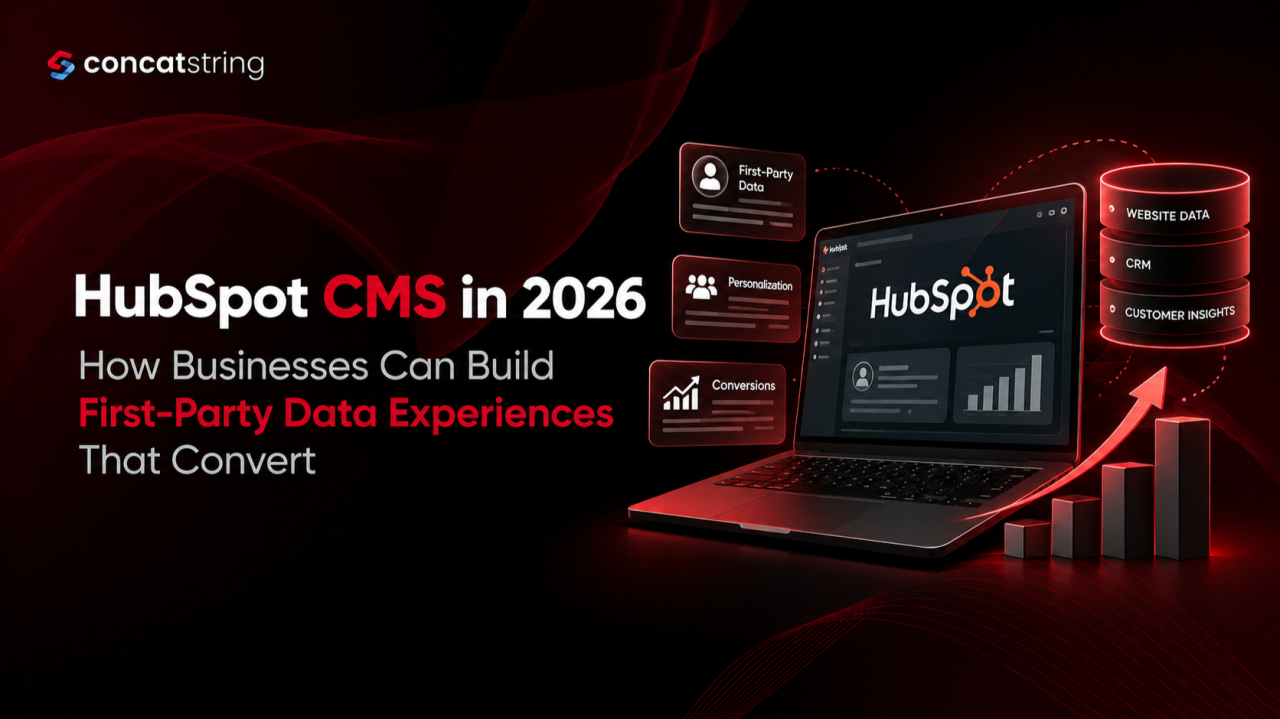
HubSpot CMS in 2026: How Businesses Can Build First-Party Data Experiences That Convert

The website is becoming more than a digital storefront. In 2026, it is increasingly a first-party data engine where every consented interaction can help a business understand intent, personalize experiences, and improve conversion. HubSpot’s 2026 State of Marketing report says 61% of marketers believe AI is creating the biggest disruption in marketing in 20 years, while 80% already use AI for content creation. At the same time, HubSpot notes that AI search can reduce direct website interactions and behavioral signals. That makes HubSpot CMS in 2026 particularly relevant for businesses looking to turn their owned digital experiences into measurable customer relationships.
Table of Contents
Use AI to summarize this article
Why First-Party Data Matters More in 2026
For years, businesses could rely heavily on third-party advertising platforms and external audience data to understand potential customers. That approach is becoming less dependable as privacy expectations increase, tracking becomes more restricted, and customers become more selective about what information they share.
First-party data changes the equation.
First-party data is information a company collects directly through interactions with its own audience. Website activity, CRM records, form submissions, purchases, email engagement, customer conversations, surveys, and product usage can all become valuable first-party signals when collected appropriately and with the necessary consent. HubSpot describes first-party data as information collected directly from an organization's audience and highlights its role in personalization, segmentation, retention, and AI-driven marketing.
The important distinction is that first-party data isn't simply about collecting more information. It is about collecting useful information in a transparent way and turning it into a better customer experience.
That is where the modern CMS becomes much more important.
A website built only to publish pages can attract traffic. A website connected to customer data can help a business understand what visitors need, respond to their intent, and create more relevant journeys.
In 2026, that difference matters.
What Is HubSpot CMS in 2026?
HubSpot CMS, now part of HubSpot's broader content and customer platform, allows businesses to create, manage, personalize, and measure digital experiences while connecting website activity with CRM data.
The underlying concept is straightforward: instead of treating the website, marketing database, sales team, and customer experience as separate systems, businesses can connect these touchpoints around customer information.
HubSpot's CMS documentation, for example, describes capabilities such as CRM-connected membership experiences and personalized content that can use Contacts, Companies, Deals, and Products data.
That creates an important opportunity for businesses.
A visitor doesn't necessarily need to see the exact same website experience as everyone else.
A returning customer might see content designed around their previous relationship with the company. A known prospect can receive messaging based on their stage in the buying journey. A logged-in user can access personalized content or account-specific information.
The website becomes responsive to context rather than remaining completely static.
This is one of the biggest reasons HubSpot CMS in 2026 is relevant to first-party data strategies.
How HubSpot CMS Turns Website Activity Into First-Party Data
The first step is understanding that not every interaction has the same value.
A pageview can tell you that someone visited. A product comparison can reveal stronger intent. A form submission can provide declared information. A pricing-page visit may indicate commercial interest. A demo request can represent a much stronger buying signal.
The goal isn't to track everything simply because technology allows it.
The goal is to identify the signals that actually help your business understand the customer.
For example, imagine a B2B software company selling three product packages.
A visitor reads a general blog article. Later, that visitor downloads a technical guide, views a product comparison page, returns to the pricing page, and submits a form asking about implementation.
Those interactions tell a much richer story than a single website visit.
When those signals can be connected to the CRM and used appropriately, marketing and sales teams can work from a shared understanding of customer intent.
That is the foundation of a first-party data experience.
First-Party Data Should Improve the Experience, Not Just Reporting
One of the biggest mistakes businesses make is treating first-party data as an analytics project.
They collect information, create dashboards, build audience segments, and then stop.
Customers don't benefit from a dashboard.
They benefit when the data improves the experience.
Suppose someone has already downloaded an introductory guide. Showing the same introductory pop-up on every subsequent visit creates unnecessary friction.
Instead, the website could move that visitor toward a more relevant resource, such as a product comparison, implementation guide, case study, or consultation.
The underlying principle is simple:
Use known customer context to remove irrelevant experiences and introduce more relevant ones.
This is where website personalization becomes commercially useful.
HubSpot's personalization capabilities are designed to use customer data and audience signals to create more targeted experiences and measure their impact on conversions and ROI.
The technology is valuable, but the strategy comes first.
Businesses need to determine which customer signals actually matter and what experience should change when those signals appear.
How to Build a First-Party Data Strategy With HubSpot CMS
Start With the Customer Journey
Before changing your website, map the journey you want customers to take.
Consider what a new visitor needs to understand, what a returning visitor may already know, what information a sales-ready prospect needs, and what an existing customer expects from the website.
This prevents personalization from becoming a collection of disconnected tricks.
A B2B company, for example, might structure its journey around awareness, consideration, evaluation, purchase, onboarding, and retention.
Each stage can require different content and different data signals.
Once those stages are clear, HubSpot CMS can become the experience layer that responds to those signals.
Identify High-Value First-Party Signals
The next step is deciding what data should influence the experience.
Useful signals can include content engagement, lifecycle stage, previous conversions, product interest, form responses, customer status, email engagement, and declared preferences.
The most valuable signals are usually those that have a clear relationship with customer intent.
A visitor repeatedly reading enterprise-focused content is more informative than simply knowing that the visitor spent three minutes on the website.
A customer explicitly stating that they prefer email communication is more actionable than guessing their preference from a few interactions.
This is also where zero-party data can complement first-party data. A preference center, onboarding questionnaire, survey, or interactive assessment can allow customers to directly tell a business what they want.
That reduces guesswork.
Personalization Without Making the Website Feel Creepy
Personalization can improve relevance, but there is a line between helpful and uncomfortable.
Customers generally don't need to be reminded that a company is watching every action they take.
Instead of saying, “We noticed you visited our pricing page three times,” a business can simply present a relevant pricing guide or comparison resource.
The difference is subtle but important.
Good personalization feels useful.
Poor personalization feels intrusive.
The strongest first-party data experiences therefore use customer information to improve relevance without unnecessarily exposing the mechanics behind the personalization.
Trust should remain part of the conversion strategy.
HubSpot's own first-party data guidance emphasizes the importance of transparency and customer trust when developing a first-party data strategy.
Consent Is Part of the Customer Experience
A first-party data strategy cannot be separated from privacy.
Businesses need to understand what information they collect, why they collect it, how it is used, and what choices customers have.
HubSpot's current consent-management documentation provides tools for cookie consent and visitor tracking preferences, including support for privacy requirements such as GDPR and CCPA. HubSpot also states that businesses should work with their legal teams for advice specific to their circumstances.
This is particularly important for companies operating across multiple markets.
Consent should not be treated as an obstacle placed between the customer and the website. It should be designed as part of the overall experience.
The wording should be clear. The choices should be understandable. The business should avoid collecting information simply because it can.
A useful question for every data field is:
“What customer experience will this information improve?”
If there is no clear answer, the field may not belong in the experience.
Connecting HubSpot CMS With CRM Data
The real strength of a connected CMS appears when website information and CRM information work together.
Without CRM context, a website knows relatively little about the relationship between the visitor and the business.
With CRM context, the business may understand whether someone is a lead, prospect, customer, partner, or existing account.
That context can influence content, calls to action, forms, resources, and journeys.
For example, an existing customer shouldn't necessarily receive the same “Book a Demo” experience as a completely new prospect.
The customer may be better served by documentation, training resources, cross-sell information, support content, or account-specific resources.
Similarly, a high-intent prospect may benefit from a more direct conversion path than someone who has just discovered the brand.
HubSpot's product ecosystem currently includes CRM-connected content personalization, personalization tokens, dynamic content, audience segments, and customer data capabilities designed to connect digital experiences with CRM information.
The strategic advantage comes from using those capabilities selectively.
How First-Party Data Can Improve Conversion Rates
Conversion optimization is often associated with changing headlines, button colors, forms, and page layouts.
Those things matter, but context can matter just as much.
Consider two visitors landing on the same service page.
The first visitor has never interacted with the brand. They may need education, proof, and an explanation of the problem.
The second visitor has already downloaded two resources and visited the pricing page. They may need a clear next step.
Showing both visitors exactly the same experience ignores valuable intent information.
A first-party data approach allows businesses to create different paths based on meaningful signals.
This can reduce friction because visitors aren't repeatedly asked to consume information they've already seen.
The objective isn't to personalize every pixel.
It is to make the next step more relevant.
Use Progressive Profiling Instead of Asking Everything at Once
Forms are one of the most obvious first-party data collection points, but they can also become a conversion barrier.
A company may want a visitor's name, company, job title, industry, company size, budget, phone number, location, role, purchase timeline, and dozens of other details.
The customer sees a wall of fields.
A better approach is progressive profiling.
Start with the information necessary for the first interaction. As the relationship develops, collect additional information when it provides a clear benefit.
For example, a first conversion might only require an email address and company name. A later interaction could ask about the visitor's goals or implementation requirements.
This creates a gradual exchange of value.
The customer provides information.
The business provides a more useful experience.
That is a much healthier foundation for first-party data collection.
First-Party Data and AI Are Becoming Closely Connected
AI can generate content quickly, but the quality and relevance of AI-powered marketing still depend heavily on the information available to the system.
Generic AI has access to broad patterns.
Your first-party data can provide context about your actual customers.
That difference matters.
HubSpot's 2026 State of Marketing report says 80% of marketers use AI for content creation and identifies AI as increasingly foundational to marketing workflows. The report also emphasizes that marketers need to maintain human-led, authentic experiences as AI-generated content becomes more widespread.
For businesses, this means the opportunity isn't simply to produce more AI-generated pages.
It is to use AI alongside proprietary customer knowledge.
A company can understand which topics customers engage with, which questions sales teams repeatedly receive, which products are associated with specific customer segments, and where users experience friction.
That information can inform content, personalization, segmentation, and customer journeys.
In other words, first-party data can become the context layer that makes AI-driven marketing more relevant.
What Changes When AI Search Reduces Website Visits?
This is one of the most important developments for marketers in 2026.
Customers increasingly use AI tools to research products, compare solutions, summarize information, and answer questions before visiting a company's website.
HubSpot's 2026 marketing research specifically highlights this challenge: when customers turn to AI search tools rather than visiting websites directly, companies may lose some of the behavioral analytics they historically relied upon.
That doesn't make the website less important.
It changes its role.
The website needs to become a destination where visitors can move from anonymous research to a meaningful relationship.
That could happen through an assessment, newsletter subscription, resource download, account creation, demo request, consultation, product interaction, or another value exchange.
The strategic question becomes:
When someone does visit our website, are we giving them a reason to engage directly with our brand?
That is where first-party data becomes especially valuable.
How to Measure a First-Party Data Experience
Businesses should avoid measuring personalization simply by the number of personalized modules they create.
Instead, measure whether the experience produces better business outcomes.
Important metrics can include conversion rate, qualified lead rate, form completion rate, returning visitor conversion, sales-cycle velocity, customer engagement, content-assisted conversions, and revenue influenced by personalized journeys.
The exact metrics depend on the business model.
For a SaaS company, demo requests and qualified pipeline may matter most.
For ecommerce, repeat purchases and revenue per visitor may be more meaningful.
For professional services, consultation requests and sales-qualified opportunities may be stronger indicators.
The key is to connect website behavior to commercial outcomes rather than treating website analytics as the final destination.
Common Mistakes Businesses Should Avoid
Collecting Too Much Data
More data does not automatically mean better personalization.
Excessive data collection creates operational complexity and can damage trust. Collect information because it serves a clear business or customer purpose.
Personalizing Everything
Not every page needs dynamic content.
Sometimes a clear, useful, well-written page will outperform a complicated personalized experience.
Start with high-impact journeys before expanding personalization across the entire website.
Ignoring Data Quality
A personalized experience built on inaccurate CRM records can be worse than a generic experience.
Duplicate contacts, outdated lifecycle stages, incomplete properties, and inconsistent segmentation can lead to irrelevant messaging.
Data hygiene should therefore be part of the CMS and CRM strategy, not an afterthought.
Treating Consent as a Checkbox
Consent is part of the relationship between the business and its audience.
Businesses should make privacy choices clear and ensure their tracking and personalization practices reflect the consent framework applicable to their audience. HubSpot's current documentation also notes that consent requirements vary by context and recommends obtaining appropriate legal guidance.
Optimizing for Clicks Instead of Customer Value
A personalized CTA might increase a click but still produce poor-quality leads.
The better question is whether the experience helps customers make better decisions and moves the right prospects toward meaningful business outcomes.
A Practical HubSpot CMS Roadmap for 2026
Businesses don't need to rebuild their entire website to begin.
A practical rollout can start with one high-value customer journey.
First, identify a conversion point where better context could make a measurable difference. This could be a product page, demo journey, pricing page, resource center, or returning-customer experience.
Next, identify the first-party signals already available in the CRM and website analytics.
Then determine what should change based on those signals.
For example, a returning visitor who has already downloaded an introductory guide could be shown a more advanced resource rather than the same introductory offer.
After implementation, measure the result against a baseline.
Only once the business understands what works should it expand personalization to additional journeys.
This approach keeps the project commercially focused instead of turning it into a large technology initiative with unclear ROI.
Why HubSpot CMS Can Become a Strategic Growth Layer
The biggest opportunity with HubSpot CMS in 2026 is not simply faster website management.
It is the ability to connect content, customer information, personalization, consent, and conversion strategy around a shared customer journey.
That matters because the modern website sits at the intersection of several business functions.
Marketing needs it to generate demand.
Sales needs it to support buying decisions.
Customer success needs it to educate and retain customers.
Leadership needs it to contribute measurable revenue.
Customers need it to provide useful answers without unnecessary friction.
A first-party data strategy can connect these requirements.
The result is a website that doesn't simply publish information. It learns from appropriate customer interactions and uses that understanding to make future experiences more relevant.
That is a fundamentally different way of thinking about a CMS.
The Future of First-Party Data Experiences
The next generation of websites will not necessarily be the ones with the most animations, the most pages, or the most personalization rules.
They will be the ones that understand context.
A new visitor should be able to understand the value proposition quickly.
A returning prospect should be able to continue where they left off.
A customer should be able to find information relevant to their relationship with the brand.
And every interaction should be governed by a clear approach to consent, privacy, data quality, and customer value.
HubSpot CMS provides the infrastructure for businesses to move in that direction, particularly when CMS capabilities are connected with CRM data, personalization, analytics, and marketing automation. HubSpot's current product ecosystem explicitly positions CRM-connected personalization and customer data as core parts of its platform.
The real advantage, however, comes from strategy.
Technology can connect the data.
Your customer experience strategy determines what that data actually does.
Conclusion
HubSpot CMS in 2026 is increasingly about much more than publishing and managing website content. It can serve as an experience layer where first-party customer data, CRM intelligence, personalization, consent, and conversion optimization come together.
As AI changes how people discover information, businesses have an even stronger reason to make every direct website interaction valuable. The goal shouldn't be to collect as much data as possible or personalize every component of a page. It should be to understand customer intent, respect privacy, remove unnecessary friction, and deliver a more useful experience.
For businesses investing in HubSpot, the opportunity is clear: build a website that doesn't just attract visitors, but turns appropriate customer interactions into better experiences, stronger relationships, and measurable business outcomes.
How Concatstring Can Help
Building a first-party data experience requires more than configuring a CMS. It requires the right combination of website strategy, HubSpot implementation, CRM structure, personalization, conversion optimization, analytics, and ongoing experimentation.
Concatstring can help businesses turn HubSpot CMS into a more connected digital experience—aligning website content with customer data, business goals, and conversion journeys. The focus should be on creating a website that is easier for customers to use, easier for teams to manage, and better positioned to turn meaningful interactions into measurable growth.
If your business is planning a HubSpot CMS implementation, migration, redesign, or personalization strategy in 2026, this is the right time to evaluate not only how your website looks, but how effectively it uses first-party data to serve the people who visit it.
FAQs