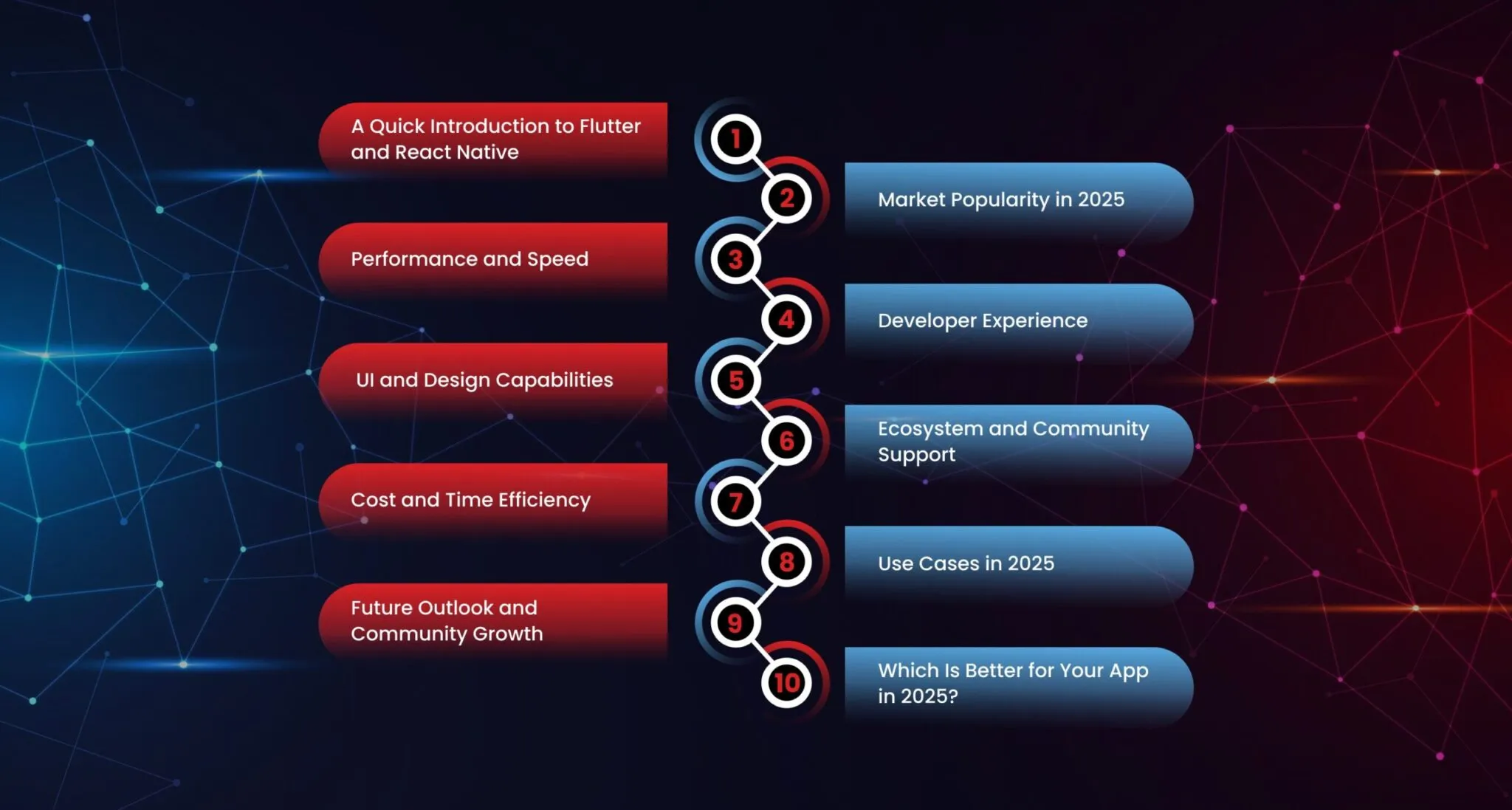
Table of Contents
Use AI to summarize this article
1. A Quick Introduction to Flutter and React Native
Flutter, developed by Google, is an open-source UI toolkit that enables developers to build natively compiled applications for mobile, web, and desktop — all from a single codebase. It uses Dart, Google’s programming language optimized for UI development.
React Native, on the other hand, is developed by Meta (Facebook) and allows developers to create mobile applications using JavaScript and React. It bridges native APIs, meaning you can reuse much of your web development knowledge for mobile apps.
Both frameworks aim to make cross-platform development faster and more cost-effective without compromising on performance or design.
References:
2. Market Popularity in 2025
According to Statista’s 2025 developer survey, Flutter leads the cross-platform space with around 48% adoption, while React Native follows closely at 38%. The rest is split among smaller frameworks like Xamarin and Ionic.
Why the shift toward Flutter? Mainly because of:
- Its faster rendering engine.
- Consistent UI across platforms.
- Growing developer community and Google support.
However, React Native remains a strong contender due to its:
- Mature ecosystem.
- Easier learning curve for JavaScript developers.
- Extensive third-party library support.
3. Performance and Speed
When it comes to performance, Flutter apps generally outperform React Native apps in 2025. Flutter compiles directly to ARM or x86 native code, which eliminates the need for a JavaScript bridge. This results in faster load times and smoother animations, especially for graphics-heavy applications.
React Native, while significantly improved thanks to the New Architecture (Fabric + TurboModules), still relies on a bridge for certain functions, which can cause minor delays in performance-critical apps.
Benchmark insights (2025 updates):
- Flutter apps start 20–25% faster than React Native on average mid-range devices.
- React Native’s new rendering engine has reduced UI lag by 40% compared to its 2022 version.
References:
4. Developer Experience
For developers, React Native still wins slightly in terms of accessibility. Its foundation in JavaScript — the most widely used programming language — makes onboarding faster for web developers.
Flutter, though, offers a highly structured and modern development experience with Hot Reload, custom widgets, and integrated design flexibility that React Native sometimes lacks.
Flutter Pros for Developers:
- Rich widget library for consistent UI.
- Smooth integration with Firebase.
- Easy to maintain due to structured architecture.
React Native Pros for Developers:
- Huge JavaScript community.
- Access to countless npm packages.
- Easier integration with existing native apps.
If your team is already skilled in JavaScript, React Native might be the easier route. But if you want more performance and pixel-perfect UI, Flutter could be worth the learning curve.
5. UI and Design Capabilities
Flutter was built with UI excellence in mind. Its widget-based approach gives developers complete control over every pixel, making it ideal for complex and custom designs.
React Native relies on native UI components, which is good for maintaining a native feel but can lead to slight inconsistencies across iOS and Android devices.
For businesses that care about brand consistency and modern visuals — Flutter usually comes out ahead.
6. Ecosystem and Community Support
By 2025, both frameworks have massive ecosystems:
- Flutter: Over 40,000 packages on pub.dev, the official package manager.
- React Native: More than 100,000 libraries on npmjs.com.
While React Native’s ecosystem is older and larger, Flutter’s ecosystem is more stable and curated. Google’s continuous backing and regular updates ensure long-term support.
Developer Communities:
- Flutter community on GitHub has crossed 175k stars.
- React Native maintains around 120k stars and an active Discord/Slack base.
7. Cost and Time Efficiency
Both Flutter and React Native save time compared to native development. However, Flutter’s “single UI across all platforms” approach typically reduces testing time and design inconsistencies.
React Native allows faster prototyping, especially for teams already familiar with React. But achieving full performance parity across platforms sometimes requires native code customization.
For startups or MVPs — React Native is slightly faster to start with.
For scalable apps with complex UIs — Flutter provides better long-term ROI.
8. Use Cases in 2025
Popular Apps Built With Flutter (2025):
- Google Ads
- eBay Motors
- BMW App
- Nubank
Popular Apps Built With React Native:
- Shopify
- Facebook Ads
- Discord (mobile version)
References:
9. Future Outlook and Community Growth
Flutter’s roadmap for 2025 focuses on AI integration, 3D rendering, and improved web compilation, making it more than just a mobile toolkit. Meanwhile, React Native continues to evolve around React Server Components and Fabric Renderer, improving performance and compatibility with future web apps.
Both are sustainable and future-proof — the decision comes down to what your business values most.
10. So, Which Is Better for Your App in 2025?
If you’re looking for performance, beautiful UI, and long-term scalability, Flutter is the better choice.
If you want faster development, JavaScript integration, and flexible libraries, React Native still shines.
In short:
- Flutter = best for apps that need smooth animations, native feel, and strong performance.
- React Native = best for teams who already use JavaScript and want faster delivery.
At Concatstring, we help businesses analyze their project goals, audience, and tech stack to pick the right framework — and we build high-performance apps using both Flutter and React Native.
Conclusion
The Flutter vs React Native debate isn’t about which one is “right” — it’s about which one fits your goals, team, and vision. Both are powerful tools shaping the future of mobile app development in 2025. The real success lies in how they’re implemented.
Get in Touch with Concatstring
If you’re planning to build a mobile app and are unsure whether Flutter or React Native is the right choice, our experts can help. At Concatstring, we specialize in end-to-end mobile app development — from ideation to deployment — ensuring your app is fast, scalable, and user-friendly.