Table of Contents
Use AI to summarize this article
What is AI in eCommerce?
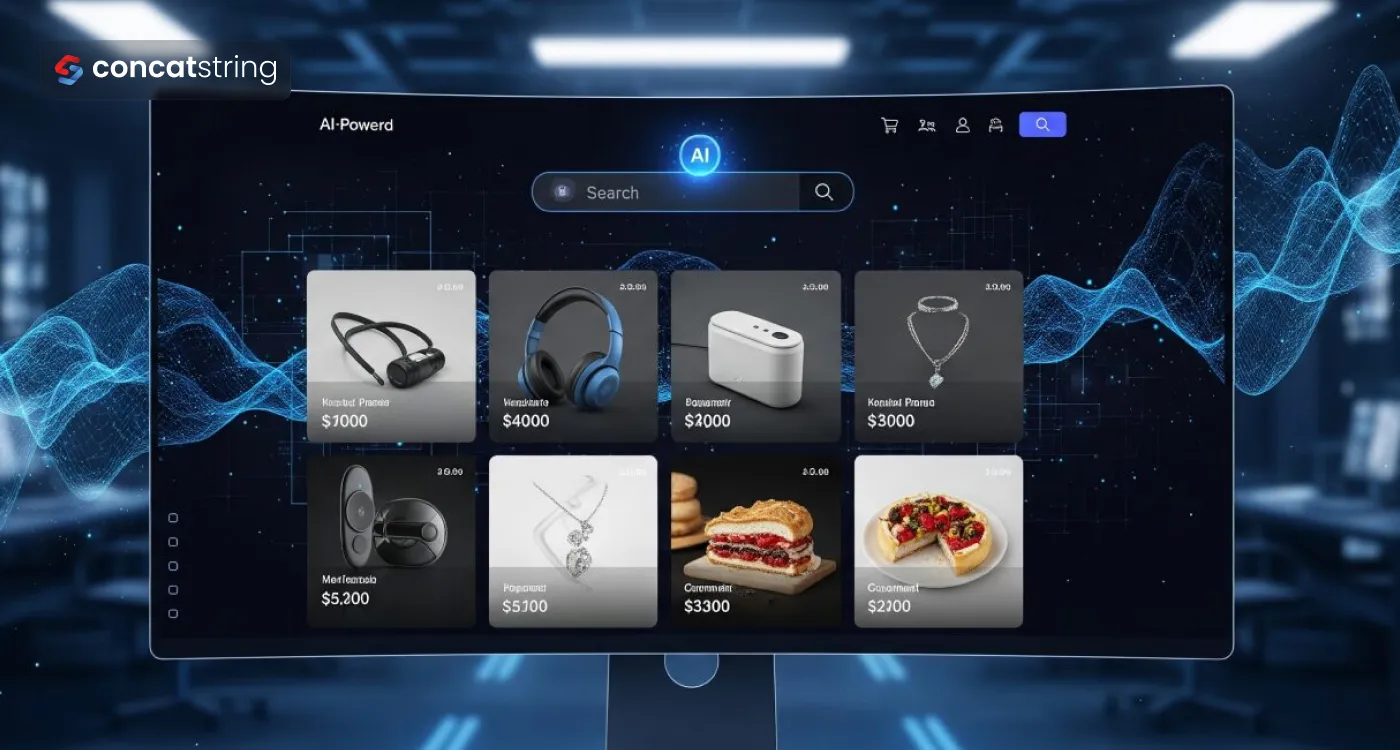
AI in eCommerce involves the use of Artificial Intelligence technologies in retail ecommerce to improve functions, processes, customer experience, and analytics for the business. This covers everything from product and service recommendations and customer service to inventory, sales forecasting, and demand analysis.
The global retail market for AI is anticipated to exceed $31 billion by 2028, according to a report by Statista. This figure, however, is not limited to predictive analytics platforms that offer chatbots to e-commerce stores. Be it a niche Shopify store or a large-scale WooCommerce platform, AI offers tailored and AI solutions that significantly boost revenue.
How AI Technology Will Change eCommerce in 2025
We will discuss the ways artificial intelligence technology is transforming shopping in business-to-business and business-to-consumer commerce.
1. Shopping Customisation at the Highest Level
AI algorithms offer highly personalized product recommendations by examining customer habits like browsing and purchase history. A product suggestion tool, such as Amazon’s recommendation engine, which uses advanced AI algorithms, is responsible for almost 35% of the company’s total sales. Recently, the same level of tailored marketing AI can offer personalization to small and medium-scale enterprises through Shopify and AI add-ons or self-developed programs.
2. Support Services Chatbots and Virtual Helpers
Through AI, eCommerce businesses are able to utilize chatbots to issue resolve, answer questions, and assist users in buying products at any time of the day, making customer service hands-free and automated. Unlike standard live chat options, AI-powered chatbots provide a personalized customer experience by learning and adapting to customer preferences, which increases interaction and improves conversion rates.
3. Voice-based Commerce and Visual Product Search
Purchase search now goes a notch higher as customers can now upload images to search for exact or similar products through visual search AI technology. ASOS and H&M are among the early adopters of this technology. Furthermore, AI-supported voice shopping powered by devices like Alexa and Google Assistant is on the rise, which allows users to search and buy using natural conversational language.
4. Automated Inventory and Demand Forecasting
E-commerce businesses utilize AI to forecast product demand several months to a year in advance based on historical data, seasonal trends, and relevant market behavior. This enhances the efficiency of supply chains by reducing overstocking and understocking issues. According to McKinsey, AI-driven forecasting has the potential to reduce supply chain discrepancies by 50%.
5. Fraud Detection and Secure Payments
AI models analyze data and identify areas of concern in real-time, making it easier to monitor potentially fraudulent activities and payments. This is especially critical in online retail, where payment security matters as much as client engagement. Businesses can decrease chargebacks and protect sensitive customer information with the application of AI-powered fraud detection systems.
Why 2025 is the Right Time to Invest in AI for eCommerce
Growing adoption of AI in mainstream platforms alongside advances in cloud computing and cost-effective AI technologies,ies makes the year 2025 ideal for investing in it. Customers expect websites to offer personalization, speed, and intelligent interaction with automated systems. If your business cannot provide that, customers will seek competitors who can.
Salesforce discovered that 57% of consumers are open to sharing private information for tailored offers and discounts. While maintaining proper data security and compliance, AI can generate personalized coupons and discounts, making customer engagement effortless.
Maximized Advantages of Integrating AI into eCommerce Websites
- Boosted Conversion Rates from enhanced engagement and interaction through dynamic, AI-enabled product discovery
- Improved Customer Retention through advanced intelligent engagement systems: personalized follow-ups and targeted loyalty initiatives
- Reduced Operational Costs through automation and predictive analytics integrated systems on intelligent algorithms
- Scalability as AI manages shifts in web traffic, expansion of products, or changes in customer purchase habits.
Concatstring Can Help You Build an AI-Ready eCommerce Store.
At Concatstring, we build AI-focused eCommerce stores that enhance user experience, such as smarter AI-driven analytics, AI recommendation engines & autonomic customer service frameworks.
Ready to future-proof your eCommerce business?
Let us implement powerful AI in eCommerce frameworks designed for your success through our consulting services. Contact us today to get started.