The way businesses build websites is changing rapidly.
For years, traditional web development was considered the default approach. Brands hired developers, waited through long production cycles, dealt with endless revisions, and relied heavily on technical teams for even the smallest website updates.
That model no longer matches how modern companies operate.
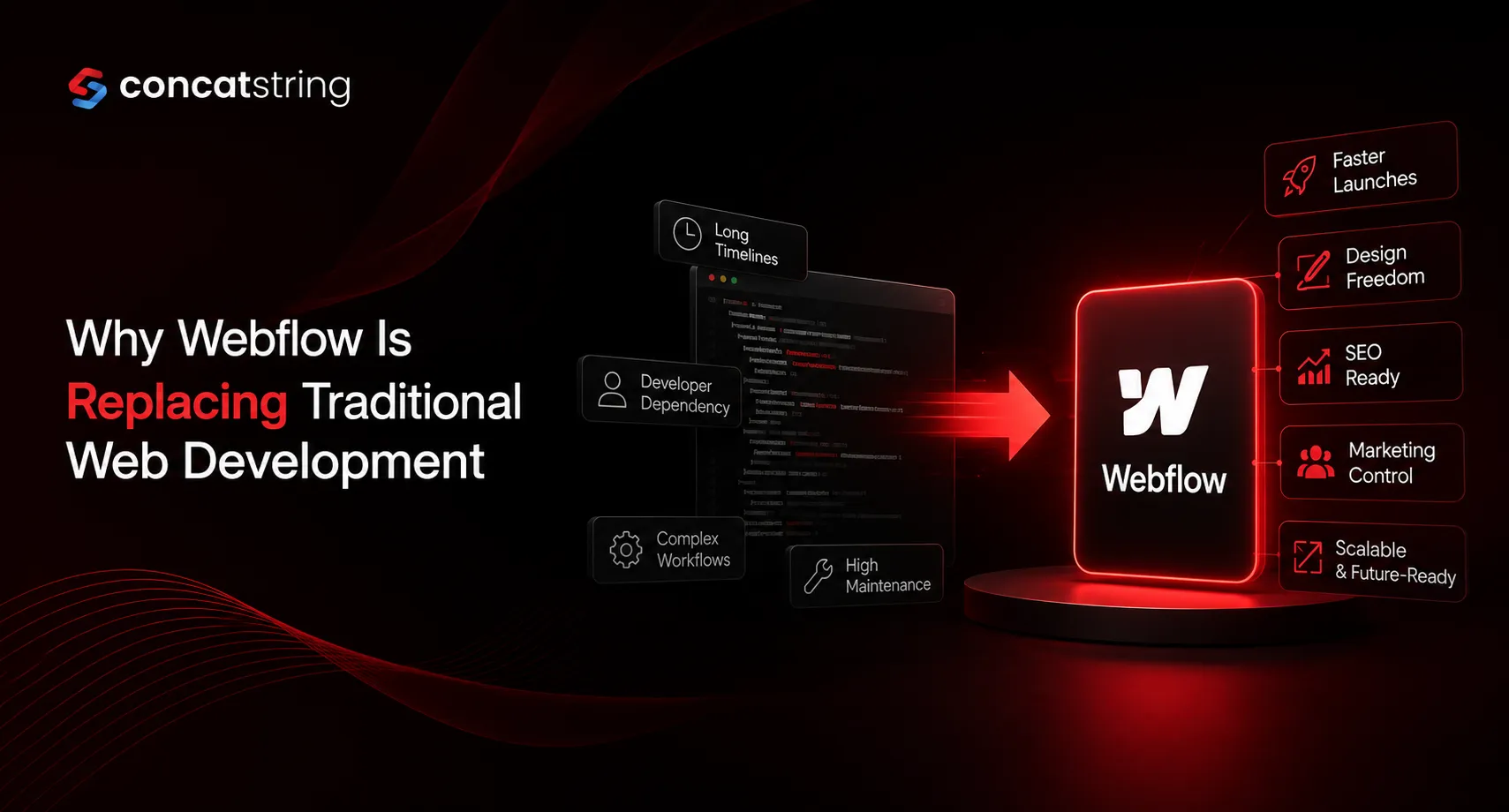
Today’s brands need speed, flexibility, scalability, and marketing control. They need websites that evolve as fast as their campaigns, products, and customer expectations. This shift is exactly why Webflow is becoming the preferred solution for startups, SaaS companies, agencies, and growing brands worldwide.
At Concatstring, we have seen firsthand how businesses are moving away from outdated development workflows and embracing visual development platforms that enable faster growth.
Table of Contents
Use AI to summarize this article
The Traditional Web Development Model Is Slowing Businesses Down
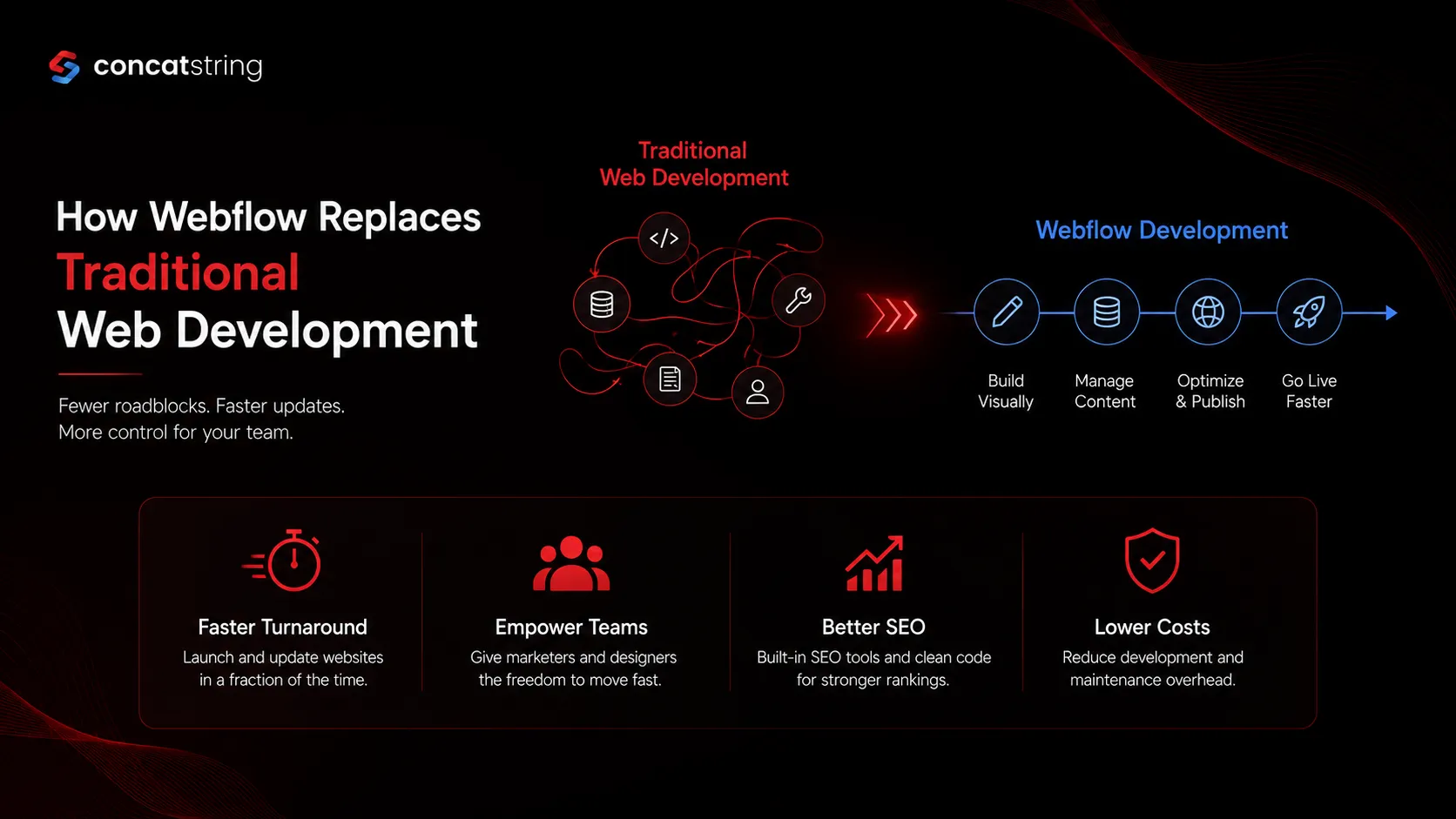
Traditional website development follows a process that often looks like this:
- Design mockups in Figma
- Developer handoff
- Frontend coding
- Backend integration
- CMS setup
- QA testing
- Deployment
- Ongoing maintenance requests
While this approach works for highly custom applications, it creates major bottlenecks for marketing websites and business platforms.
Simple changes like:
- Updating homepage content
- Launching landing pages
- Editing SEO metadata
- Publishing blogs
- Changing CTAs
- Updating visuals
often require developer involvement.
This dependency slows marketing teams, delays campaigns, and increases operational costs.
Modern businesses cannot afford to wait weeks for updates when digital competition moves daily.
Webflow Gives Marketing Teams Control
One of the biggest reasons companies are switching to Webflow is ownership.
Webflow allows marketers, designers, and content teams to manage websites without relying on developers for every change.
Instead of creating tickets for minor updates, teams can:
- Edit pages visually
- Launch campaigns faster
- Update content instantly
- Manage SEO directly
- Create scalable CMS-driven pages
- Maintain design consistency
This drastically reduces friction between marketing and development teams.
According to industry analysis, businesses adopting Webflow significantly reduce turnaround time for website changes while improving collaboration between design and marketing departments.
Speed Is Becoming a Competitive Advantage
In digital business, speed matters.
Traditional development cycles can take months before a website goes live. Every revision requires coordination between multiple stakeholders, increasing delays and costs.
Webflow changes this workflow entirely.
Because design and development happen in the same visual environment, businesses can move from concept to launch much faster.
For startups and fast-growing brands, this speed creates a real competitive advantage:
- Faster product launches
- Quicker landing page testing
- Rapid campaign deployment
- Shorter redesign cycles
- Better iteration speed
Brands today are optimizing websites continuously instead of redesigning every few years. Webflow supports this agile approach far better than traditional development pipelines.
Webflow Combines Design and Development
Traditional workflows usually separate:
- Designers
- Developers
- SEO specialists
- CMS managers
- Marketing teams
This separation often creates communication gaps, inconsistent execution, and design compromises.
Webflow bridges these gaps by combining visual design with production-ready development.
Designers can build responsive layouts directly inside Webflow while generating clean HTML, CSS, and JavaScript automatically.
This creates:
- Better design accuracy
- Faster implementation
- Fewer handoff issues
- Improved responsiveness
- Cleaner workflows
For modern brands focused on user experience, this level of design control is extremely valuable.
SEO Performance Is Better Built Into the Workflow
SEO is no longer optional.
Businesses today depend heavily on organic search visibility for growth, lead generation, and brand awareness.
Traditional development often requires multiple plugins, external tools, and developer intervention to manage technical SEO properly.
Webflow simplifies much of this process with built-in SEO functionality, including:
- Custom meta titles and descriptions
- Clean semantic code
- Fast-loading pages
- Structured CMS content
- Open Graph settings
- Automatic sitemaps
- Responsive optimization
This makes SEO implementation significantly easier for marketing teams.
At Concatstring, SEO-first website architecture is one of the major reasons clients prefer Webflow over traditional CMS platforms.
Businesses Want Fewer Tools and Less Complexity
Traditional website infrastructure usually involves:
- Separate hosting providers
- CMS plugins
- Security management
- Performance optimization tools
- External integrations
- Ongoing maintenance
Managing multiple systems increases technical overhead and operational risk.
Webflow simplifies this with an all-in-one ecosystem that combines:
- Hosting
- CMS
- Security
- Performance optimization
- Visual development
- SEO controls
This streamlined infrastructure reduces maintenance requirements while improving scalability.
For growing businesses, reducing complexity is just as important as reducing cost.
Webflow Supports Modern Brand Experiences
Today’s websites are not just informational pages.
They are:
- Sales systems
- Marketing engines
- Brand experiences
- Conversion platforms
Modern brands need websites with:
- Smooth interactions
- Advanced animations
- Responsive layouts
- Premium visual design
- Faster performance
- Conversion-focused UX
Webflow enables highly interactive and visually advanced experiences without requiring extensive frontend engineering.
This is especially important for SaaS companies, creative agencies, startups, and premium brands competing on digital experience.
The Rise of No-Code and Visual Development
The broader shift toward no-code and visual development platforms is accelerating across the tech industry.
Businesses increasingly prioritize:
- Faster deployment
- Reduced dependency on engineering
- Agile workflows
- Lower maintenance overhead
- Better collaboration
Research around modern web development trends also highlights how web technologies continue evolving toward more efficient and abstracted development systems.
Webflow represents this evolution clearly.
It allows businesses to focus more on growth, design, and user experience rather than spending excessive time managing development infrastructure.
Traditional Development Still Has a Place
Webflow is powerful, but traditional development is not disappearing completely.
Custom applications, advanced backend systems, enterprise software, and highly specialized platforms still require engineering-heavy solutions.
Traditional development remains valuable when businesses need:
- Complex backend logic
- Custom applications
- Deep database architecture
- Enterprise-grade software systems
- Advanced API ecosystems
However, for marketing websites, SaaS sites, portfolios, landing pages, and brand platforms, Webflow is increasingly becoming the smarter choice.
The key is choosing the right solution for the right business objective.
Why Brands Work With Concatstring for Webflow Development
At Concatstring, we help businesses build high-performance Webflow websites designed for growth.
Our focus goes beyond visual design.
We build websites that are:
- SEO optimized
- Conversion focused
- Fast-loading
- Scalable
- CMS-driven
- Responsive across devices
- Built for marketing flexibility
We believe modern websites should empower businesses instead of slowing them down.
That is exactly why we use Webflow to help brands launch faster, scale smarter, and maintain full control over their digital presence.
Final Thoughts
The future of web development is shifting toward speed, flexibility, and ownership.
Businesses no longer want slow development cycles, endless maintenance requests, or disconnected workflows between design, marketing, and engineering teams.
They want agile systems that allow them to move quickly and scale efficiently. That is why Webflow is replacing traditional web development for many modern brands. It is not just about building websites faster. It is about building businesses that can adapt faster in a digital-first world.
FAQs