The ecommerce industry in 2026 is evolving faster than ever because of AI. Almost every field is now being transformed by automation, intelligent tools, predictive systems, and AI-driven workflows. Tasks that previously needed separate teams for design, marketing, research, customer support, and development can now be handled by a single founder using AI tools. Businesses are launching faster, reducing operational costs, and scaling with fewer resources.
AI has significantly reduced the amount of manpower and time required to run an ecommerce business. Product research that once took weeks can now be completed within hours. Website development that previously required developers and designers can now be generated through AI website builders. Marketing creatives, ad copies, analytics, SEO, customer support, and even pricing strategies are becoming partially automated. This allows startups to focus more on growth and customer acquisition instead of spending months building systems from scratch.
Table of Contents
Use AI to summarize this article
Starting Ecommerce with the Help of AI From Scratch
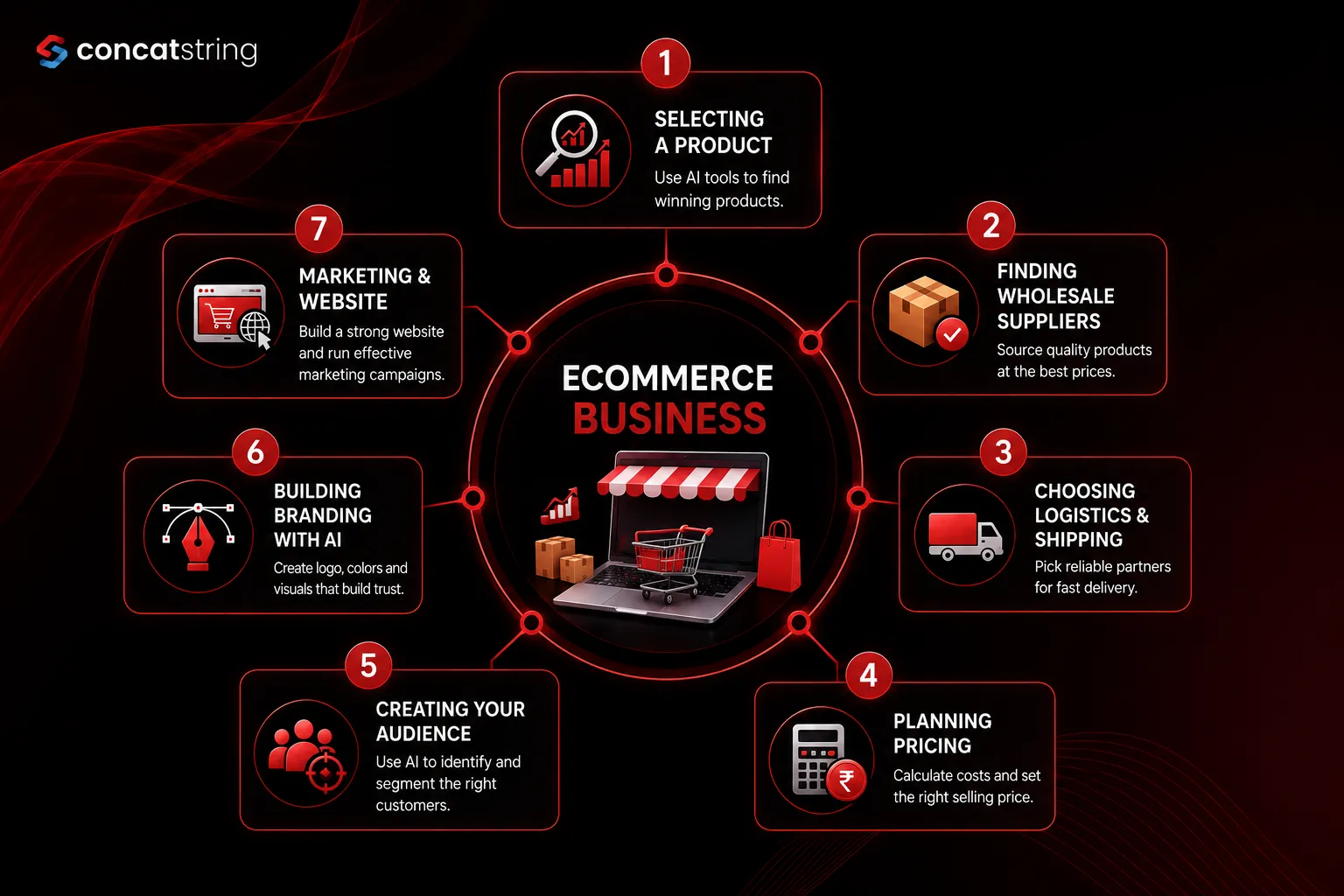
Starting an ecommerce business today is no longer only about finding products and selling them online. The real advantage comes from using AI smartly at every stage of the business. From selecting products to branding and marketing, AI can speed up the entire process while helping founders make better decisions.
1. Selecting the Right Product
The first step in ecommerce is choosing a product with demand and long-term potential. AI tools can now analyze customer trends, market demand, competition levels, and search behavior to help identify products that are more likely to succeed.
Useful tools:
These tools help identify trending products, customer demand, and profitable niches before the market becomes saturated.
2. Finding Wholesale Suppliers
After selecting a product, the next step is sourcing it from reliable suppliers at wholesale pricing. AI can help compare suppliers based on reviews, shipping speed, pricing, and product quality.
Popular supplier platforms:
Using AI-powered analysis helps reduce the chances of working with unreliable suppliers and improves sourcing efficiency.
3. Choosing Logistics & Shipping
Logistics plays a major role in customer satisfaction. Faster shipping and proper tracking improve trust and increase repeat purchases. AI tools now help optimize delivery routes, predict shipping timelines, and manage warehouse operations more efficiently.
Popular logistics providers:
4. Planning Product Pricing
Pricing is one of the most important parts of ecommerce because it directly affects profit margins and conversions. A simple pricing model includes product cost, shipping cost, marketing spend, and desired profit margin.
Selling Price = Product Cost+Shipping+Marketing Cost+Profit Margin\text{Selling Price} = \text{Product Cost} + \text{Shipping} + \text{Marketing Cost} + \text{Profit Margin}Selling Price = Product Cost+Shipping+Marketing Cost+Profit Margin
AI tools can also monitor competitors, predict customer buying behavior, and suggest better pricing strategies.
Useful tools:
5. Creating Your Target Audience
A successful ecommerce business understands exactly who it wants to sell to. AI can help segment audiences based on interests, age, behavior, location, and buying patterns. This improves ad targeting and increases conversion rates.
Useful platforms:
For example, if you sell fitness products, your audience may include people between 18–35 years old who are interested in gym content, fitness influencers, and health-related products.
6. Branding & Design Thinking With AI
Branding is what helps customers remember your business. AI tools can now generate logos, suggest color palettes, create product mockups, and even design social media creatives within minutes.
Useful branding tools:
A simple logo, consistent colors, and clean design create trust and make your store look more professional.
7. Marketing & Your Website — The Heart of Your Business
The most important part of ecommerce is marketing and your website. Your website is the center of your entire business because this is where customers judge your brand, products, and trustworthiness.
If you are starting with a very low budget, you can use AI website builders like:
These platforms can help create websites quickly, but having a website alone is not enough. Ecommerce success depends heavily on branding, SEO, conversion optimization, advertising strategy, customer experience, and marketing execution. Running campaigns without proper knowledge can lead to wasted budget and poor conversions.
This is why many startups prefer working with affordable agencies like Concatstring that understand ecommerce growth and website performance.
Benefits of working with Concatstring:
- Marketing-focused ecommerce websites
- Better conversion optimization
- Affordable branding and development
- SEO and performance improvements
- Faster launch process
A professional website combined with proper marketing creates stronger trust and increases sales potential significantly.
Conclusion
Starting an ecommerce business in 2026 has become easier because AI can automate and simplify many complex tasks. From product research and supplier sourcing to branding and pricing, AI helps businesses move faster while reducing time and operational costs. However, tools alone do not guarantee success. The real growth of an ecommerce brand still depends on how well the business markets its products and how professionally the website represents the brand. A strong website, proper branding, and effective marketing strategy remain the foundation of a successful ecommerce business, even in the AI era.
Frequently Asked Questions (FAQs)


.png)
.png)