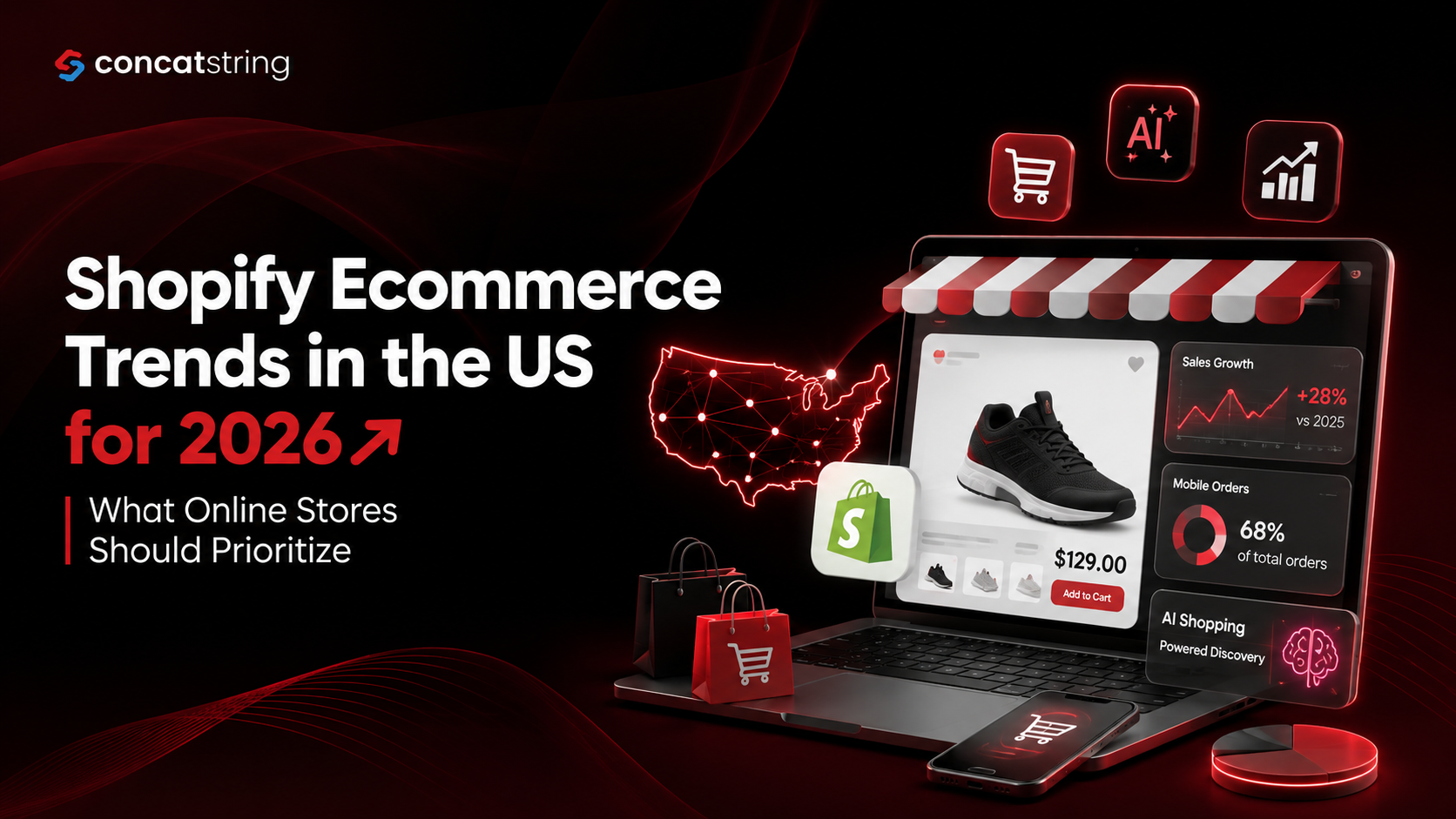
Shopify Ecommerce Trends in the US for 2026: What Online Stores Should Prioritize

US ecommerce is entering 2026 with stronger growth, higher customer expectations, and a major shift toward AI-assisted shopping. According to the U.S. Census Bureau, US retail ecommerce sales reached $340.2 billion in Q2 2026, up 12.2% year over year, with ecommerce representing 17.1% of total retail sales. At the same time, Shopify is expanding commerce into AI channels, social platforms, mobile experiences, and unified commerce. For Shopify merchants, the opportunity is significant, but simply having an online store is no longer enough. Businesses need to prioritize faster experiences, AI-ready product data, personalization, social commerce, trust, retention, and conversion-focused UX.
Source: U.S. Census Bureau – Quarterly Retail E-Commerce Sales
Table of Contents
Use AI to summarize this article
How Is Shopify Ecommerce Changing in the US in 2026?
The biggest change in Shopify ecommerce in 2026 is that the online store is no longer the only place where customers discover products.
A shopper might discover a product through TikTok, compare it through Google, ask an AI assistant for recommendations, visit a Shopify product page, read customer reviews, and finally complete the purchase on mobile. The buying journey is becoming distributed across multiple digital touchpoints.
This means Shopify merchants need to think beyond traditional ecommerce SEO and product-page optimization. The goal is now to make the brand discoverable, trustworthy, useful, and easy to purchase from wherever the customer begins their journey.
Shopify itself is investing heavily in this shift. Its 2026 product developments focus on putting merchant products across AI-powered shopping experiences and other commerce surfaces. Shopify has introduced technologies such as Agentic Storefronts, allowing eligible merchants to make products available through AI channels including ChatGPT and Microsoft Copilot.
For US online stores, this creates several important priorities for 2026.
1. AI-Powered Shopping Should Become a Core Ecommerce Priority
AI is one of the most important Shopify ecommerce trends in the US for 2026.
Consumers are increasingly using AI to research products, compare alternatives, understand features, and make purchasing decisions. Instead of typing a traditional keyword into a search engine, shoppers can now ask conversational questions such as:
“Which running shoes are best for long-distance runners?”
“What is the best moisturizer for sensitive skin under $40?”
“Compare these three coffee machines for a small apartment.”
The implications for ecommerce are substantial.
Your product information needs to be structured clearly enough for both people and AI systems to understand.
Make Your Product Catalog AI-Ready
A Shopify product page should provide much more than a product name and a short description.
Merchants should prioritize:
- Detailed product descriptions
- Accurate specifications
- Product dimensions
- Materials and ingredients
- Size and compatibility information
- Pricing and availability
- High-quality images
- Customer reviews
- Frequently asked product questions
- Clear shipping and return information
- Structured product data
This information gives search engines and AI systems more context when deciding whether a product is relevant to a shopper's question.
Shopify's 2026 commerce strategy increasingly connects product catalogs with AI shopping experiences. The company has described its Catalog and Universal Commerce Protocol (UCP) as infrastructure designed to help AI agents discover, understand, and interact with merchant products.
AI Search Does Not Replace Traditional SEO
One mistake Shopify merchants should avoid is treating AI optimization as a replacement for SEO.
It isn't.
Shopify's own Q1 2026 data found that AI-referred visitors landing on product detail pages converted at nearly 50% higher rates than organic search visitors, while AI-attributed orders had 14% higher average order values than organic search orders.
That makes AI discovery worth paying attention to, but traditional organic search remains important.
The fundamentals overlap: strong product content, technical SEO, structured data, authoritative information, reviews, and a trustworthy brand all improve your ability to appear in both traditional and AI-powered discovery.
Source: Shopify – AI-Referred Shoppers Convert Better and Spend More
2. Mobile-First Shopify Experiences Are No Longer Optional
Mobile commerce has moved from being an important channel to being the default shopping environment for many consumers.
Shopify reports that smartphones accounted for 72% of retail website traffic and 68% of orders in the US during Q1 2026.
That statistic has a direct implication for Shopify merchants: your mobile store should not simply be a smaller version of your desktop website.
It should be designed around mobile behavior.
What Should Shopify Stores Improve for Mobile?
Start with the product discovery experience.
Customers should be able to quickly understand what you sell, why the product matters, how much it costs, and whether it is right for them.
Large product images, concise descriptions, visible pricing, clear calls to action, easy navigation, and simplified checkout can reduce unnecessary friction.
Performance is equally important. A visually impressive store that takes too long to load can lose customers before they even see the product.
Shopify merchants should therefore regularly review:
- Mobile Core Web Vitals
- Page loading performance
- Navigation
- Search functionality
- Product filtering
- Cart usability
- Checkout friction
- Button placement
- Mobile product imagery
- Form complexity
The objective is simple: make the path from product discovery to purchase as effortless as possible.
Source: Shopify – 10 Online Shopping Trends Shaping 2026
3. Social Commerce Should Move From Awareness to Revenue
Social media is no longer just a marketing channel for Shopify brands.
It is becoming part of the shopping journey itself.
Consumers can discover products through short-form videos, creator recommendations, product demonstrations, customer-generated content, and social communities.
Shopify identifies social commerce as one of the major ecommerce trends shaping 2026. Its research notes that social media is among the leading product-discovery channels, while almost half of US shoppers had purchased a product directly through social media as of March 2026.
Build Content Around Products, Not Just Promotions
A common mistake is using social channels primarily to publish discount announcements.
That approach leaves significant opportunity on the table.
Instead, Shopify stores should create content that helps customers understand products before they purchase.
For example, a fashion store could publish styling videos.
A skincare brand could demonstrate how a product fits into a routine.
A furniture company could show products inside real homes.
A B2B brand could publish tutorials explaining how its products solve specific problems.
This content creates a bridge between discovery and conversion.
Combine Creator Content With Customer Reviews
Creator content and user-generated content can also reinforce trust.
Shopify's 2026 social commerce research highlights the growing importance of creator-driven commerce, short-form video, UGC, reviews, and conversational engagement.
The strongest approach is not to treat these elements independently.
A customer may discover a product through a creator, visit the Shopify store, read customer reviews, watch a demonstration, and then purchase.
Your ecommerce strategy should support that entire journey.
4. Personalization Should Become More Useful, Not More Intrusive
Personalization is another major Shopify ecommerce trend for 2026, but businesses need to approach it carefully.
Showing a customer the same generic homepage as every other visitor may no longer be enough.
At the same time, excessive personalization can feel invasive.
The better strategy is to use behavioral signals to make shopping easier.
For example, an online store can personalize:
- Product recommendations
- Recently viewed products
- Relevant categories
- Search results
- Email recommendations
- Cross-sell opportunities
- Loyalty offers
- Educational content
Shopify's 2026 ecommerce research highlights the growing importance of individualized customer experiences and personalization throughout product discovery and loyalty.
The key is relevance.
Personalization should help customers find what they need faster rather than simply displaying more advertisements.
5. Product Pages Need to Become Conversion Hubs
In 2026, the product page should do much more than describe a product.
It should answer the questions a customer would normally ask a salesperson.
A strong Shopify product page should make the customer comfortable with four things:
What is it?
Why should I buy it?
Will it work for me?
What happens if I change my mind?
Add More Decision-Making Information
Product pages should include detailed specifications, real-world imagery, reviews, FAQs, shipping information, return policies, availability, and product comparisons where appropriate.
Trust is particularly important because shoppers have more choices than ever.
Shopify's 2026 online shopping research cites Salsify research showing that 57% of shoppers consider UGC such as reviews, ratings, and customer photos among the most important product-page elements.
That makes reviews and customer-generated content more than social proof. They can be conversion assets.
A good Shopify product page should therefore be treated as a sales representative that works 24/7.
6. Faster Checkout and Lower Friction Should Be a Priority
Getting a shopper to the cart is only half the job.
The next challenge is completing the purchase.
Every unnecessary field, confusing shipping option, unexpected cost, or difficult payment step can introduce hesitation.
Shopify merchants should examine the complete checkout experience from a customer's perspective.
Ask:
Is shipping information easy to understand?
Are payment options clearly presented?
Can returning customers check out quickly?
Are taxes and delivery costs transparent?
Does the checkout work smoothly on mobile?
Can customers easily understand the return policy?
These questions matter because ecommerce competition is increasingly based on convenience.
Shopify's 2026 research identifies convenience, availability, and easy product comparison as important factors influencing online shopping behavior.
In other words, conversion optimization is not always about persuading customers harder.
Sometimes it is simply about removing the reasons they hesitate.
7. Omnichannel Commerce Should Become More Connected
Customers do not necessarily think in terms of “online” and “offline” commerce.
They simply expect a brand to work.
A customer might discover a product online, visit a physical location, purchase through a mobile device, and later contact customer support through another channel.
That creates a need for connected commerce infrastructure.
Shopify's 2026 retail research emphasizes unified commerce, where inventory, customer information, orders, and retail touchpoints work together instead of operating as isolated systems.
Create One Consistent Customer Experience
For Shopify stores selling through multiple channels, the priority should be consistency.
Product availability should be accurate.
Pricing should be clear.
Customer information should be connected where appropriate.
Returns should be easy to understand.
Marketing messages should feel consistent across channels.
This becomes particularly important as brands expand into marketplaces, social commerce, physical retail, AI channels, and international markets.
The more channels a business adds, the more important centralized data becomes.
8. First-Party Data and Customer Retention Matter More
Acquiring a new customer can be expensive.
That makes retention one of the most important areas for Shopify stores to improve in 2026.
Instead of constantly trying to replace customers through paid acquisition, brands should build systems that encourage existing customers to return.
Email marketing, loyalty programs, personalized recommendations, post-purchase education, subscriptions, and customer communities can all contribute to retention.
The objective should not simply be to collect as much customer data as possible.
It should be to understand customer needs while respecting privacy and using information responsibly.
Turn the First Purchase Into a Relationship
The customer journey should continue after checkout.
A useful post-purchase sequence might include an order update, product education, usage tips, complementary recommendations, a review request, and a relevant future offer.
This approach is more valuable than immediately sending another discount.
The first purchase gives a brand an opportunity to understand what the customer values and create a better second experience.
9. Trust, Reviews, and Transparency Will Influence Conversions
Ecommerce customers have become more cautious.
They can compare prices instantly, read reviews before purchasing, investigate competitors, and use AI tools to evaluate alternatives.
That makes trust a competitive advantage.
Shopify stores should make important information easy to find rather than hiding it in complicated pages.
Customers should be able to quickly see:
- Shipping costs
- Estimated delivery times
- Return conditions
- Product specifications
- Warranty information
- Customer reviews
- Contact options
- Business information
Trust also comes from consistency.
If an advertisement promises fast delivery but the checkout shows a much longer shipping time, customers may abandon the purchase.
If product photographs suggest something different from the actual product, reviews will expose the problem.
The strongest Shopify brands in 2026 will align marketing promises with the real customer experience.
10. Sustainability Claims Need Evidence
Sustainability continues to influence ecommerce, but vague environmental claims are becoming less effective.
Consumers increasingly expect brands to explain what sustainability actually means for a product.
Instead of simply saying “eco-friendly,” businesses should provide useful context.
For example, explain the material used, packaging approach, product lifespan, repairability, sourcing practices, or relevant certifications when applicable.
Shopify's 2026 ecommerce trends research identifies sustainability claims and the need for evidence as an important consideration for online retailers.
For brands making sustainability a major selling point, transparency is more persuasive than marketing language.
11. Analytics Should Focus on Business Outcomes
More data does not automatically create better decisions.
Shopify merchants should focus on metrics that explain business performance.
Important metrics include:
Conversion Rate
Conversion rate tells you how effectively your store turns visitors into customers.
Average Order Value
Increasing AOV can improve revenue without requiring the same increase in traffic.
Customer Acquisition Cost
CAC helps determine whether paid acquisition is economically sustainable.
Customer Lifetime Value
CLV provides a longer-term view of customer profitability.
Repeat Purchase Rate
This helps identify whether customers return after their first purchase.
Cart and Checkout Abandonment
These metrics can reveal where customers experience friction.
The goal is to connect these metrics.
For example, a traffic increase is not necessarily positive if conversion rate and profitability fall sharply.
Likewise, a higher average order value may not help if customer acquisition costs increase faster.
Shopify's own 2026 growth guidance emphasizes revenue growth, retention, and expansion as important ecommerce growth levers.
Source: Shopify – Ecommerce Growth Guide: Strategies for 2026
What Should Shopify Stores Prioritize First in 2026?
Not every ecommerce business has the budget or resources to implement every trend simultaneously.
The smartest approach is to prioritize initiatives according to their likely business impact.
Priority 1: Fix the Core Store Experience
Before experimenting with advanced AI or new sales channels, make sure the foundation is strong.
Improve mobile performance, navigation, product pages, search, checkout, shipping transparency, and trust signals.
Priority 2: Improve Product Data
Create detailed, accurate, structured product information.
This supports customers, search engines, marketplaces, and emerging AI shopping systems.
Priority 3: Strengthen Content and Social Discovery
Create useful product-focused content for social platforms and connect it to your Shopify storefront.
Priority 4: Build Retention
Develop email, loyalty, post-purchase, and personalized experiences that encourage customers to return.
Priority 5: Experiment With AI
Once your product data and ecommerce fundamentals are strong, explore AI-powered discovery, personalization, customer service, and agentic commerce opportunities.
This sequence prevents businesses from chasing technology while neglecting the fundamentals that actually drive conversions.
How Can a Shopify Store Prepare for the Future of Ecommerce?
The most future-ready Shopify stores will not necessarily be the ones using the most technology.
They will be the ones with the strongest fundamentals.
A future-ready store should have accurate product information, strong technical SEO, fast mobile performance, trustworthy reviews, useful content, simple checkout, reliable fulfillment, connected customer data, and a clear brand identity.
AI can then enhance those foundations.
This matters because Shopify's current direction shows that commerce is expanding beyond the traditional storefront. Shopify is building infrastructure for merchants to distribute products across AI-powered shopping environments, while its broader platform continues to support multiple sales channels.
The implication is clear: your Shopify store should be built not only for people visiting your website directly, but also for customers who discover your products somewhere else.
Shopify Ecommerce Trends in the US for 2026: A Practical Action Plan
For businesses that want a straightforward roadmap, the following sequence can help.
First, audit your mobile experience. Identify slow pages, confusing navigation, weak product presentation, and checkout friction.
Second, upgrade your product pages. Add comprehensive descriptions, specifications, FAQs, reviews, images, videos, shipping information, and returns information.
Third, strengthen your technical SEO. Review indexing, structured data, internal linking, page speed, canonicalization, and site architecture.
Fourth, make your catalog AI-ready. Ensure product information is accurate, detailed, consistent, and easy for machines to interpret.
Fifth, invest in social discovery. Use creators, UGC, product demonstrations, educational videos, and customer stories rather than relying entirely on promotional posts.
Sixth, build retention systems. Use email, loyalty, personalized recommendations, subscriptions, and post-purchase communication where appropriate.
Seventh, measure profitability. Track conversion rate, AOV, CAC, CLV, repeat purchases, and contribution margin instead of focusing only on traffic.
Eighth, test emerging technology carefully. AI shopping agents, conversational commerce, advanced personalization, and new commerce channels can create opportunities, but they should support a clear business objective.
The Bigger Picture for Shopify Ecommerce in 2026
The US ecommerce market is still growing, but growth alone does not guarantee success.
The latest U.S. Census Bureau data shows that ecommerce sales reached $340.2 billion in Q2 2026, representing 17.1% of total retail sales. That creates a large opportunity for online retailers, but it also means competition is becoming more sophisticated.
At the same time, Shopify is positioning its platform around a more distributed commerce environment where products can appear across websites, social platforms, physical retail, marketplaces, and AI-powered shopping experiences.
For merchants, the lesson is not to chase every new trend.
Instead, build a Shopify store that is fast, useful, trustworthy, discoverable, and easy to buy from. Then use AI, personalization, social commerce, unified commerce, and other emerging technologies to strengthen that foundation.
The brands that approach 2026 this way will be better positioned to turn changing consumer behavior into sustainable ecommerce growth.
Conclusion
The biggest Shopify ecommerce trends in the US for 2026 point toward one larger shift: online shopping is becoming more connected, intelligent, mobile, and customer-driven.
AI is changing product discovery. Social platforms are influencing purchases. Mobile devices remain central to ecommerce. Customers expect better product information and greater transparency, while businesses need stronger retention and more connected commerce operations.
For Shopify stores, the priority should therefore be clear: improve the fundamentals first, then build for the emerging commerce ecosystem.
A fast mobile experience, detailed product data, strong reviews, useful content, frictionless checkout, personalization, retention, and AI readiness can create a stronger foundation for long-term growth than simply adding another marketing channel.
The future of Shopify ecommerce is not about being everywhere just for the sake of visibility. It is about being useful and discoverable wherever customers choose to shop.
Partner With ConcatString for Shopify Ecommerce Growth
If your Shopify store needs to adapt to the changing US ecommerce landscape, ConcatString can help you turn these trends into practical improvements.
From Shopify store development and conversion-focused UX to SEO, performance optimization, AI-ready ecommerce experiences, and ongoing growth strategies, the right technical foundation can help your store compete more effectively in 2026 and beyond.
Ready to build a Shopify store designed for the next generation of ecommerce? Connect with ConcatString and turn your 2026 ecommerce priorities into a measurable growth strategy.
FAQs