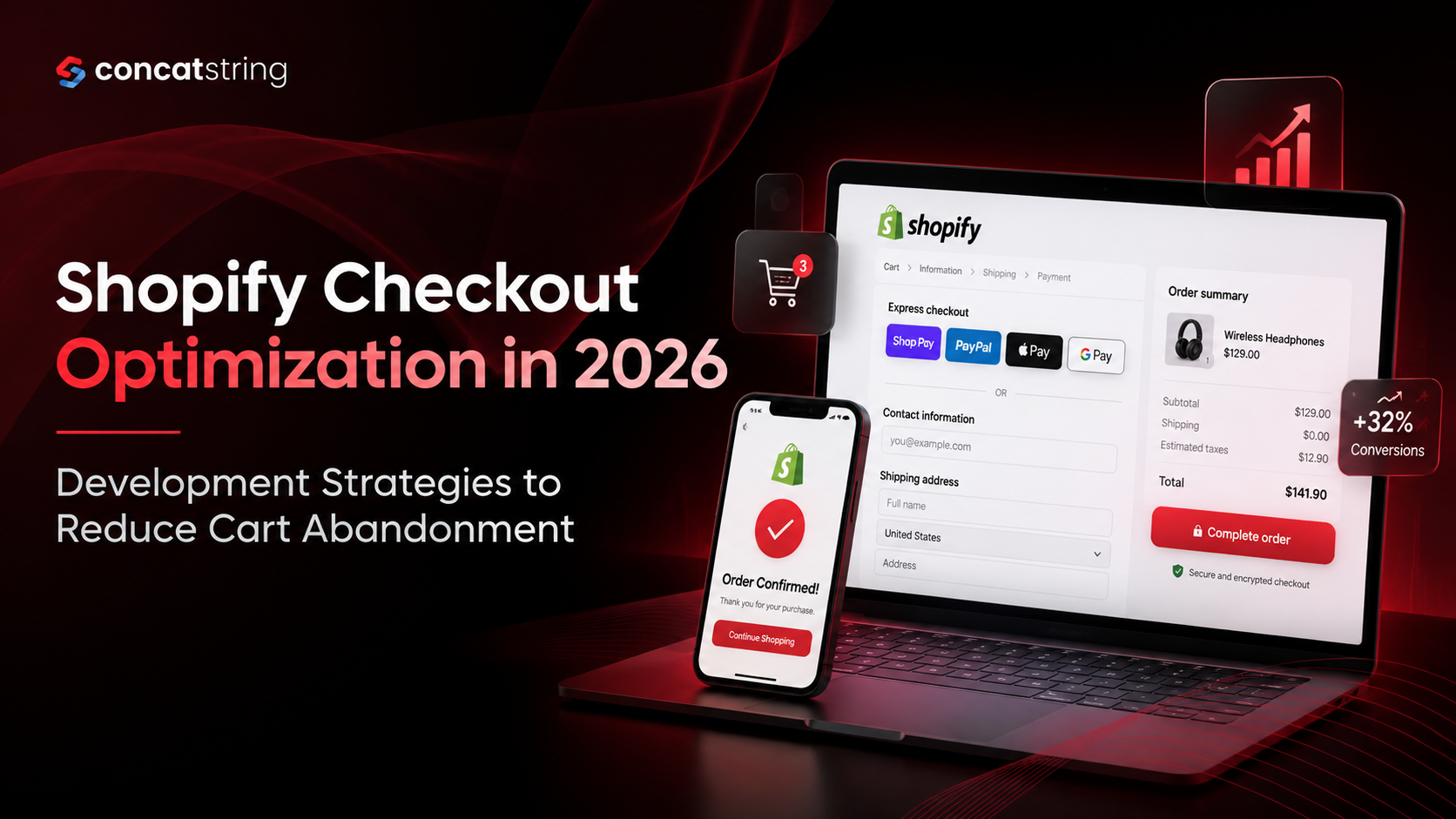
Shopify Checkout Optimization in 2026: Development Strategies to Reduce Cart Abandonment

Cart abandonment remains one of the biggest revenue leaks in ecommerce. Baymard Institute's latest research puts the average online shopping cart abandonment rate at 70.22%, while its 2026 research identifies unexpected costs, slow delivery, trust concerns, forced account creation, and complicated checkout flows among major abandonment drivers. For Shopify merchants, this makes Shopify checkout optimization more than a design exercise, it is a development, UX, performance, and conversion strategy. In 2026, businesses can use Shopify's checkout capabilities, extensibility framework, payment options, performance optimization, and data-driven testing to create faster and more trustworthy purchasing experiences.
Table of Contents
Use AI to summarize this article
What Is Shopify Checkout Optimization?
Shopify checkout optimization is the process of improving the final stages of an ecommerce purchase so customers can move from cart to completed order with as little unnecessary friction as possible.
A high-performing Shopify checkout does not simply look attractive. It should make the customer's next action obvious, communicate the total cost clearly, load quickly, support relevant payment methods, work smoothly on mobile devices, and provide enough reassurance for the shopper to complete the transaction.
This distinction matters because many stores focus heavily on product pages, advertising, SEO, and acquisition while treating checkout as a fixed part of the platform. In reality, the checkout experience can have a direct effect on conversion performance.
Baymard Institute reports an average cart abandonment rate of approximately 70%, while its research indicates that many checkout problems are connected to issues that merchants can address through better UX and design. Its research also estimates that large ecommerce sites could achieve a substantial conversion-rate improvement through checkout design improvements alone.
For Shopify businesses, therefore, checkout optimization should be viewed as an ongoing development and conversion-rate optimization process rather than a one-time design task.
Why Does Shopify Checkout Optimization Matter in 2026?
Ecommerce customers have become accustomed to fast, low-friction digital experiences. They expect websites to remember information, provide familiar payment options, calculate costs transparently, and work efficiently on smartphones.
That expectation creates a significant challenge for Shopify merchants. A customer may discover a product through Google, social media, an AI search engine, an advertisement, or an influencer recommendation and still abandon the purchase if the checkout experience introduces unexpected friction.
Baymard's 2026 research found that 40% of surveyed shoppers cited extra costs such as shipping, taxes, or fees as an abandonment reason, while 20% cited delivery that was too slow. The research also identified credit-card trust concerns, forced account creation, and checkout complexity as important abandonment factors.
These numbers demonstrate an important principle: not every abandoned cart can or should be recovered. Some shoppers are simply browsing, comparing prices, or postponing a purchase. The objective of checkout optimization is to remove the abandonment that is caused by avoidable friction.
That means Shopify development teams should distinguish between intent-related abandonment and experience-related abandonment.
If someone leaves because they were only researching a product, changing the checkout form will not necessarily solve the problem. If they leave because shipping costs appear unexpectedly at the final step, the solution may be much more straightforward.
What Are the Biggest Causes of Shopify Cart Abandonment?
Unexpected Costs at Checkout
One of the most important Shopify checkout optimization opportunities is cost transparency.
Customers should understand what they are expected to pay before they reach the final payment action. Unexpected shipping charges, taxes, service fees, or other costs can create a sharp break in purchase intent.
Instead of revealing important costs as late as possible, merchants should communicate them progressively throughout the shopping journey. Shipping thresholds, estimated delivery costs, taxes where applicable, and promotional conditions should be understandable before the customer reaches the payment stage.
This is particularly important for international Shopify stores. Currency differences, duties, taxes, and shipping rules can introduce additional uncertainty.
A technically sophisticated Shopify store should therefore connect its checkout logic with the merchant's actual pricing and fulfillment strategy rather than treating checkout as an isolated interface.
Complicated Checkout Forms
Every additional field creates another opportunity for confusion, error, or hesitation.
Baymard's research found that 17% of US online shoppers surveyed had abandoned a purchase because the checkout was too long or complicated. Its usability research also found that many checkout flows contain more form elements than are necessary.
For Shopify development, the objective should not simply be "one-page checkout." A short checkout can still be difficult if its fields are poorly organized.
Instead, developers should ask whether each field is necessary, whether the field labels are clear, whether users can autofill information, whether errors are explained immediately, and whether customers can easily correct mistakes.
A well-optimized checkout minimizes cognitive effort rather than merely minimizing the number of pages.
Mandatory Account Creation
Forcing shoppers to create an account before purchasing can introduce unnecessary friction.
A first-time customer may want to complete a transaction without committing to a long-term account relationship. If registration is mandatory, that additional decision can interrupt the buying process.
Where the business model permits it, merchants should allow customers to complete purchases without unnecessary account creation barriers. Account creation can then be encouraged after purchase when the customer has already experienced the product and brand.
The broader principle is simple: ask customers for information when it provides value, not merely because the business can collect it.
Lack of Payment Options
Payment preferences vary by customer, geography, device, order value, and demographic segment.
A Shopify store serving a single market may have a different optimal payment mix from a global ecommerce business. Customers may expect card payments, digital wallets, accelerated checkout options, or region-specific payment methods.
Shopify's 2026 checkout guidance specifically emphasizes offering payment options that match customer expectations.
The development priority should therefore be relevance rather than quantity. Adding every possible payment method can create visual clutter and operational complexity. Merchants should identify which payment methods are actually important to their customers and make those options easy to discover.
Slow or Unresponsive Checkout Experiences
Performance becomes especially important at checkout because the customer is already close to making a purchase.
If the checkout becomes slow after the shopper has demonstrated strong purchase intent, even a small technical problem can have an outsized business impact.
Shopify's developer documentation notes that checkout UI extensions can add JavaScript bundles, network requests, JavaScript execution time, and DOM nodes to checkout pages. Shopify specifically recommends identifying slow extensions and removing unused ones to improve checkout performance.
This creates an important development lesson for 2026: checkout customization should be performance-conscious by default.
A trust badge, upsell, personalization widget, loyalty message, or custom checkout component should justify the performance cost it introduces.
How Can Shopify Developers Optimize Checkout in 2026?
1. Build Around Shopify's Checkout Extensibility
Shopify's Checkout Extensibility framework is central to modern Shopify checkout development.
Instead of relying on fragile checkout modifications, developers can use Shopify's supported extension architecture to add functionality to eligible checkout surfaces.
Shopify's 2026 documentation describes Checkout UI Extensions as a way to add custom UI and logic to checkout. Depending on the use case and Shopify plan, developers can use extensions for personalized messaging, custom functionality, checkout information, and other experiences.
This approach is valuable because checkout customization should remain maintainable as Shopify evolves.
For Shopify Plus merchants, checkout UI extensions can provide additional customization opportunities across information, shipping, and payment steps. Developers should always verify the current Shopify plan and API-version requirements before planning a specific implementation.
2. Reduce the Number of Unnecessary Form Fields
A Shopify checkout audit should examine every field and ask a simple question:
Does this information need to be collected at this exact moment?
If the answer is no, the field should be reconsidered.
Developers can improve the experience by taking advantage of browser autofill, appropriate input types, clear validation, address handling, and intelligent defaults.
The goal is not to collect less information at any cost. The goal is to collect the necessary information with the least possible effort.
This is especially important for mobile shoppers, where entering long addresses, card information, or other details can be considerably more difficult than on a desktop computer.
3. Make the Total Cost Clear Before the Final Step
A customer should not have to mentally calculate whether they can afford the purchase.
The cart and checkout should make the relationship between product price, discount, shipping, tax, and final total easy to understand.
For example, if a store offers free shipping above a particular order value, the cart can communicate how close the customer is to qualifying. If shipping varies based on location, the experience should explain when the final shipping calculation will become available.
Clear pricing does more than reduce abandonment. It also creates trust.
4. Design Mobile Checkout as a Primary Experience
Mobile checkout should not be treated as a compressed version of desktop checkout.
Fields should be appropriately sized for touch interaction. Keyboard types should match the expected information. Important buttons should remain easy to locate. Error messages should appear close to the relevant field. The customer should not need to zoom, scroll excessively, or repeatedly re-enter information.
Mobile performance also deserves special attention because Shopify notes that checkout extension costs can be particularly significant on mobile CPUs.
For development teams, this means testing checkout on real mobile devices rather than relying exclusively on desktop browser simulations.
5. Audit Checkout Extensions Regularly
Installing more Shopify apps does not automatically create a better checkout.
Every additional extension should have a clear business or customer-experience purpose. Developers should monitor whether extensions introduce unnecessary JavaScript, external network requests, or rendering delays.
Shopify's developer guidance specifically recommends reducing unnecessary external network calls and using Shopify-provided data APIs where possible.
This creates a practical 2026 development workflow: measure the checkout, identify expensive extensions, remove unused functionality, and retest after every meaningful change.
6. Use Checkout Data to Identify Friction
Checkout optimization should be evidence-driven.
Instead of assuming customers dislike a particular design element, analyze where they actually leave the funnel.
A useful Shopify checkout optimization framework can examine:
- Cart-to-checkout rate
- Checkout-start-to-purchase rate
- Payment failure rate
- Mobile versus desktop conversion
- Conversion by payment method
- Conversion by traffic source
- Coupon usage and error rates
- Shipping-related abandonment
- Checkout extension performance
- Returning versus first-time customer conversion
The purpose of these metrics is not to create a larger dashboard. It is to identify specific points where customer intent is being lost.
For example, if mobile users begin checkout at a strong rate but complete purchases at a much lower rate than desktop users, the development team has a clear investigation path.
How Should Shopify Checkout UX Be Designed for Conversion?
Make the Primary Action Obvious
The checkout should have a clear visual hierarchy.
The customer should immediately understand what information is required, where they are in the purchase process, what their order costs, and how to continue.
Visual noise should be minimized around the primary conversion action.
This does not mean removing every piece of information. Trust elements, delivery details, payment information, and policies can be important. The objective is to organize them so they support the purchase rather than compete with it.
Provide Helpful Error Messages
A generic error such as "Invalid information" forces the customer to diagnose the problem themselves.
Better validation explains what went wrong and how to correct it.
For example, an address error should identify the relevant field and provide a useful correction path. Payment errors should avoid making customers wonder whether they need to retry, use another card, or contact their bank.
Good error handling protects conversion because it prevents recoverable technical problems from becoming abandoned orders.
Reduce Checkout Anxiety With Trust Signals
Customers need to feel confident before entering payment information.
Trust can be reinforced through clear policies, recognizable payment methods, secure-looking interfaces, transparent delivery information, accessible customer support, and consistent branding.
However, trust badges should not become decorative clutter.
The strongest trust signals are often practical: clear pricing, clear returns information, recognizable payment options, and predictable delivery expectations.
How Does Checkout Performance Affect Shopify SEO and User Experience?
Checkout pages generally have a different role from product and content pages in an SEO strategy, but website performance still matters to the overall customer journey.
A shopper may arrive through an organic search result, spend several minutes evaluating a product, and then reach checkout. If the final stage is slow or unstable, the investment made in SEO and acquisition can fail to translate into revenue.
That is why SEO, UX, performance, and conversion optimization should not be treated as completely separate disciplines.
Shopify developers should also consider Google's Core Web Vitals principles when optimizing the broader ecommerce experience. Performance improvements should focus on real user experience rather than simply trying to achieve a particular score.
For checkout specifically, Shopify's own developer documentation recommends auditing checkout extensions and reducing unnecessary JavaScript and network activity.
How Can A/B Testing Improve Shopify Checkout Conversion?
Checkout optimization should be treated as an iterative process.
Rather than making several major changes simultaneously and assuming conversion improved because of one particular change, merchants should establish a measurable hypothesis and test changes systematically where their traffic volume and analytics setup support reliable experimentation.
For example, a store might test whether clearer shipping messaging improves checkout completion. Another test could evaluate whether a different presentation of payment options reduces payment-stage abandonment.
The most useful tests are connected to a specific user problem.
"Change the button color" is a weak optimization hypothesis.
"Customers are abandoning after discovering shipping costs; showing an estimated shipping cost earlier may reduce checkout exits" is a stronger hypothesis because it connects observed behavior with a measurable intervention.
What Is a Practical Shopify Checkout Optimization Process?
A reliable Shopify checkout optimization strategy can begin with a structured audit.
First, establish the baseline. Measure how many users add products to their cart, begin checkout, enter payment information, and complete their purchase.
Next, segment the data. Desktop and mobile users may behave differently. New and returning customers may also demonstrate different levels of friction.
Then conduct a UX review. Walk through the checkout as a customer would, including successful purchases, incorrect information, unavailable payment methods, discount codes, shipping restrictions, and failed payments.
After that, review the technical implementation. Identify unnecessary apps and checkout extensions, external requests, JavaScript costs, API dependencies, and potential sources of latency.
The next step is prioritization. Focus first on problems that affect a meaningful portion of customers and have a clear connection to lost conversions.
Finally, implement, measure, and repeat.
This process turns checkout optimization from subjective design work into a continuous improvement program.
Common Shopify Checkout Optimization Mistakes to Avoid
One common mistake is trying to fix cart abandonment by adding more incentives.
Discounts, urgency messages, pop-ups, and promotional banners can sometimes encourage conversion, but they cannot reliably compensate for a checkout that is confusing or slow.
Another mistake is copying another ecommerce brand's checkout without understanding the underlying customer journey. A checkout optimized for a fashion retailer may not be appropriate for a B2B store, subscription business, luxury brand, or international merchant.
Over-customization is another risk. Shopify provides extensive functionality, but every customization introduces maintenance and performance considerations.
Finally, merchants should avoid treating the overall cart abandonment rate as a single problem. Baymard's research makes an important distinction between shoppers who are simply browsing and shoppers who abandon because the purchasing experience creates avoidable friction.
The goal is not to eliminate every abandoned cart. The goal is to make the path to purchase as clear and efficient as possible for customers who are ready to buy.
Why Shopify Checkout Optimization Is a Development Strategy, Not Just a UX Task
The most effective Shopify checkout improvements sit at the intersection of design, development, analytics, payments, performance, merchandising, and operations.
A designer may identify unnecessary form complexity. A developer may discover an inefficient extension. A marketing team may identify a mismatch between promotional messaging and checkout pricing. An operations team may discover that delivery expectations are unclear.
Each of these issues can affect conversion.
That is why successful Shopify checkout optimization requires cross-functional thinking.
For development agencies such as concatstring, this also creates an opportunity to move beyond simply building Shopify stores. A technically strong ecommerce implementation should be designed around measurable customer behavior, business objectives, maintainability, and long-term performance.
The best checkout is rarely the one with the most features. It is the one that removes the right obstacles without introducing new ones.
The Future of Shopify Checkout Optimization in 2026 and Beyond
Shopify checkout optimization is moving toward a more modular, data-driven, and performance-conscious model.
As merchants adopt more personalization, AI-assisted experiences, payment options, loyalty functionality, and third-party integrations, the challenge will not simply be adding more capabilities. It will be deciding which capabilities genuinely improve the customer journey.
Performance will remain important because every additional component has a potential cost.
Personalization will become more useful when it reduces customer effort rather than simply displaying more content.
Analytics will become more valuable as merchants connect checkout behavior with acquisition sources, customer segments, product categories, and lifetime value.
And AI-driven search will make clear, trustworthy ecommerce experiences increasingly important. Customers may discover products through conversational search systems rather than traditional search alone, but the final purchase still depends on whether the merchant can provide a reliable transaction experience.
For Shopify merchants, the practical takeaway is clear: checkout should be treated as a continuously optimized revenue system.
Conclusion
Reducing Shopify cart abandonment in 2026 is not about finding one universal checkout trick. It is about systematically removing the friction that prevents ready-to-buy customers from completing their orders.
The strongest Shopify checkout optimization strategies focus on transparent pricing, fewer unnecessary fields, relevant payment methods, mobile usability, fast performance, reliable error handling, effective checkout extensibility, and continuous measurement.
Baymard's research shows that a significant share of ecommerce abandonment is connected to issues merchants can address. Shopify's current checkout development ecosystem gives businesses additional tools to improve these experiences while maintaining a more structured and maintainable implementation.
For ecommerce brands, the opportunity is to stop treating checkout as the final technical step and start treating it as one of the most important conversion surfaces in the entire customer journey.
Build a Higher-Converting Shopify Checkout With concatstring
If your Shopify store is generating traffic and adding products to carts but losing customers before purchase, the problem may be closer to the checkout than you think.
concatstring can help businesses evaluate Shopify checkout UX, identify technical and conversion friction, improve checkout performance, and build scalable ecommerce experiences designed around real customer behavior.
Whether you need a Shopify checkout audit, checkout customization, performance optimization, or broader Shopify development support, the right strategy starts with understanding where customers are dropping off, and why.
Ready to turn more Shopify carts into completed orders? Connect with concatstring to plan your next checkout optimization initiative.
FAQs