Table of Contents
Use AI to summarize this article
Why SEO Matters More Than Ever in 2026
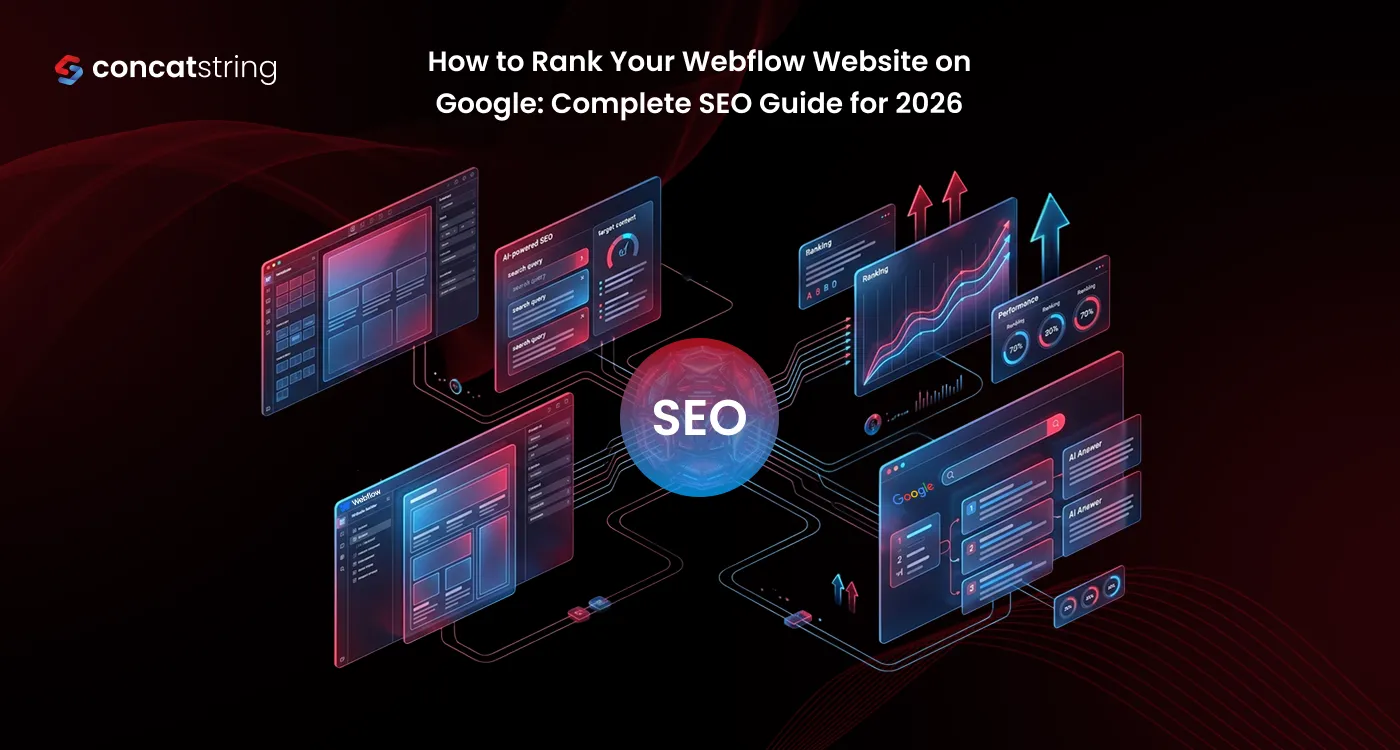
This is where Webflow creates a major advantage. Webflow gives businesses a modern website infrastructure that is naturally aligned with current search engine expectations. Its clean code structure, fast hosting, responsive design system, and built-in SEO controls make it easier to build websites that are optimized from both a technical and content perspective. Instead of relying heavily on plugins and external tools, Webflow provides a streamlined environment where SEO can be implemented more efficiently and with fewer technical barriers.
The Key Ways Webflow Helps Improve Your Google Rankings Faster
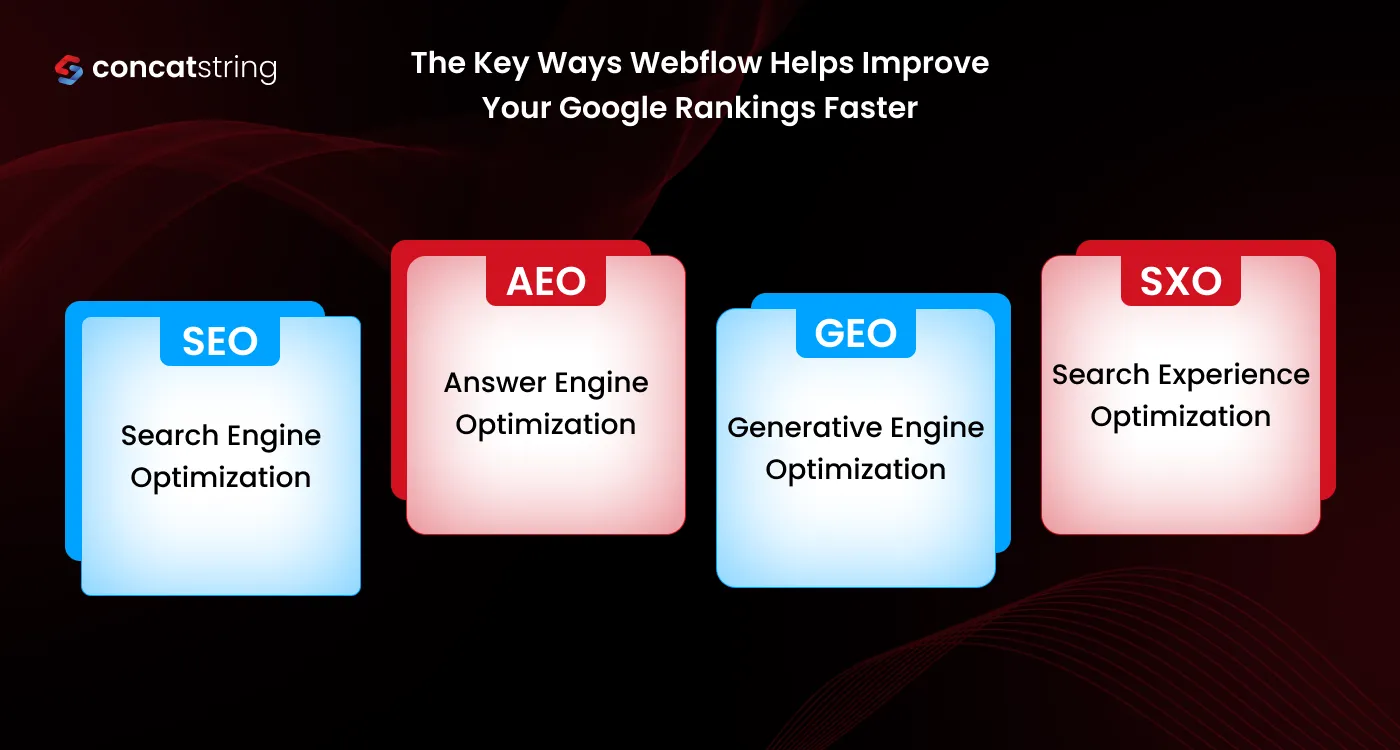
Webflow has become one of the strongest platforms for SEO because it combines technical efficiency with complete design flexibility. Unlike many traditional website builders that depend heavily on plugins, Webflow offers native control over SEO-critical elements, allowing businesses to optimize faster and with fewer complications.
In 2026, businesses must optimize beyond traditional SEO and focus on four major search pillars:
SEO (Search Engine Optimization)
This remains the foundation of online visibility and includes keyword targeting, metadata optimization, backlinks, crawlability, and indexability. Webflow makes these easier to manage because users can directly edit page titles, meta descriptions, alt text, canonical tags, and URL structures without relying on external plugins.
AEO (Answer Engine Optimization)
Search engines now prioritize direct answers for voice search, featured snippets, and AI summary boxes. Webflow helps structure content clearly through semantic headings, organized page layouts, and schema-friendly formatting, making it easier for Google to pull answers from your site.
GEO (Generative Engine Optimization)
AI-powered search engines generate responses by extracting trusted information from websites. Webflow’s clean code and structured CMS architecture improve machine readability, increasing the likelihood that your content will appear in AI-generated search responses.
SXO (Search Experience Optimization)
Rankings now depend heavily on user experience after the click. Webflow supports fast page speeds, responsive design, intuitive navigation, and reduced bounce rates, all of which improve engagement signals that influence rankings.
Because Webflow naturally supports these four pillars, it gives businesses a future-proof SEO advantage that many older CMS platforms struggle to match.
Why Website Language Matters for SEO
The language used on your website plays a bigger role in SEO today than ever before. Search engines no longer simply scan for exact keywords; they analyze context, topic relevance, semantic meaning, and how clearly your content answers user intent. This means that well-structured, natural, and meaningful website language can directly improve rankings.
Webflow enhances this process by allowing websites to maintain cleaner semantic structures. When headings, paragraphs, and page sections are logically arranged, search engines understand your content more effectively.
- Clear heading hierarchy improves topic understanding: Proper use of H1, H2, and H3 tags helps Google identify your page structure and understand content relationships, improving indexing accuracy.
- Semantic HTML strengthens machine readability: Webflow generates cleaner markup that helps both search crawlers and AI models interpret your website content faster and with fewer errors.
- Context-rich content supports LLM visibility: Large Language Models prefer websites where language is natural, structured, and informative. Clear writing increases your chances of being cited in AI-generated search results.
A website written with strong semantic clarity becomes easier for both search engines and AI systems to trust and rank.
Technical Benefits of Webflow That Improve Search Rankings
One of Webflow’s biggest strengths lies in its technical infrastructure. Strong technical SEO creates the foundation for visibility, and Webflow simplifies many of the complex backend elements that affect rankings.
- Clean and lightweight code output improves crawl efficiency: Unlike bloated page builders that generate unnecessary code, Webflow produces streamlined HTML, CSS, and JavaScript that search engines can process faster.
- Fast hosting through global CDN improves speed signals: Webflow’s built-in hosting infrastructure ensures quick loading times worldwide, which directly supports better Core Web Vitals performance and ranking stability.
- Automatic sitemap generation speeds up indexing: Every time you update your site, Webflow helps search engines discover new content quickly through automatically updated XML sitemaps.
- Schema markup support enhances rich search results: Structured data helps your pages qualify for rich snippets, FAQs, product listings, and enhanced AI answer extraction.
These technical features not only improve Google rankings but also make Webflow websites easier for AI search systems and generative engines to analyze.
How Webflow Helps Websites Perform Better in LLM Search
As AI-generated search grows, websites need to become more understandable to Large Language Models. LLMs rely heavily on structured content, page clarity, metadata consistency, and semantic accuracy when selecting reliable sources.
Webflow helps websites perform better in this environment because its structure is naturally aligned with machine interpretation.
- Structured CMS collections create predictable data patterns: This helps AI engines identify relationships between blogs, services, products, and category pages more effectively.
- Consistent metadata improves source trustworthiness: Webflow allows precise control over titles, descriptions, and structured page elements, helping LLMs assess page relevance more accurately.
- Logical page architecture improves AI extraction: When content is organized cleanly, AI systems can summarize and cite it more efficiently in generative search answers.
In 2026, appearing in AI-generated responses is becoming just as valuable as ranking on page one of Google, and Webflow helps businesses compete in both spaces.
Why Ecommerce Products Get Better SEO Push in Webflow
Ecommerce SEO has become more competitive because product visibility now depends on both search engine optimization and structured AI discoverability. Webflow gives ecommerce businesses a strong edge by making product pages easier to optimize and faster to load.
- Custom product metadata improves ranking precision: Each product page can have unique titles, descriptions, schema tags, and URLs, helping Google understand and rank products more accurately.
- Structured product data boosts rich snippet visibility: Webflow supports schema for price, availability, ratings, and inventory status, improving chances of appearing in enhanced search results.
- Faster product page performance improves conversion signals: Search engines reward ecommerce sites that load quickly because speed affects bounce rates and shopping completion rates.
- Better design flexibility increases engagement time: Webflow allows brands to create richer product experiences that keep users on pages longer, sending stronger behavioral ranking signals.
As AI shopping assistants become more common, structured and technically optimized product pages will become even more important, making Webflow a strong ecommerce SEO platform for the future.
Final Thoughts
Ranking your Webflow website on Google in 2026 requires a broader approach than traditional SEO alone. Businesses must now optimize for search engines, answer engines, generative AI systems, and user experience simultaneously. This shift has made technical website foundations more important than ever.
Webflow stands out because it provides a complete ecosystem for modern search success. Its clean architecture, strong technical SEO capabilities, AI-friendly structure, and flexible design tools make it one of the most future-ready platforms available today. For businesses aiming to grow visibility across Google and AI-driven discovery systems, Webflow is no longer just a website builder, it is a competitive SEO advantage.
FAQs