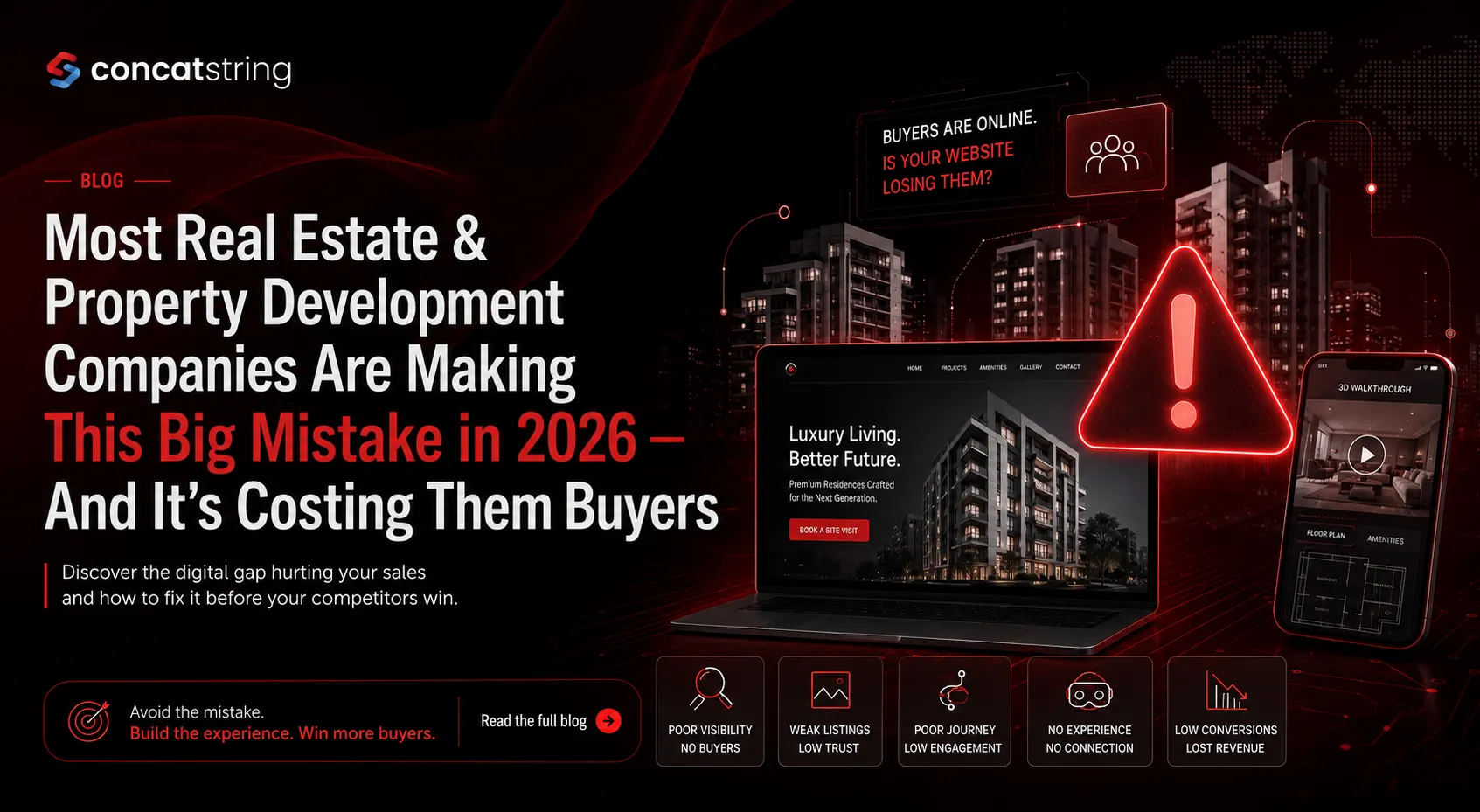
Most Real Estate & Property Development Companies Are Making This Big Mistake in 2026 — And It’s Costing Them, Buyers

The Real Estate Industry Has Changed Completely
The real estate industry has evolved rapidly over the last few years, and in 2026, the buying journey begins long before a customer visits a property site. Today’s buyers first interact with a project online, compare multiple options digitally, and build trust through what they experience on a company’s website. This shift has changed how property development companies generate leads, build credibility, and convert interest into sales.
A significant percentage of property buyers now depend on digital research before speaking with a sales team. Whether someone is looking for a luxury apartment, a commercial office, or a residential investment, they search online first to compare locations, pricing, amenities, lifestyle benefits, and builder credibility. Because of this, a company’s website has become one of the most important sales assets in the real estate industry.
Table of Contents
Use AI to summarize this article
The Biggest Mistake Most Developers Are Making
Despite this massive digital shift, many real estate and property development companies are still making one major mistake — they focus heavily on selling the property but ignore the complete online buyer journey.
Most developers invest crores into creating premium projects, but their websites fail to deliver the experience modern buyers expect. In many cases, the website looks outdated, lacks clarity, loads slowly, or simply displays a few images with basic details. This creates a disconnect between the value of the project and the experience shown online.
A real estate website should not feel like a digital brochure. It should feel like an experience that guides users toward taking action.
Why Buyers Leave Most Real Estate Websites
The biggest issue is that property listings are often incomplete and fail to emotionally connect with the customer. Buyers today do not just want to see a building; they want to imagine their future lifestyle there. They want to understand the surroundings, nearby locations, amenities, accessibility, interiors, and overall living experience before they even consider booking a visit.
A poorly structured website instantly reduces trust. When visitors cannot easily find information, navigate the project pages, or understand the property details, they quickly move to another developer. In 2026, attention spans are shorter, competition is stronger, and users expect a seamless digital experience.
SEO Is No Longer Optional in Real Estate
Another major mistake many companies make is ignoring SEO. A visually attractive website alone is not enough if people cannot find it on Google. Buyers continuously search for properties using location-based keywords and project-related searches. If a real estate company is not ranking properly on search engines, it loses visibility to competitors who have invested in SEO-driven websites and content strategies.
SEO helps property developers generate long-term organic traffic and reach users who are actively looking to buy or invest. Instead of depending only on paid advertising, SEO creates consistent visibility and helps establish authority in the market.
In 2026, companies without strong SEO strategies will struggle to compete digitally.
Modern Buyers Want More Than Property Listings
Real estate businesses also underestimate the importance of visual storytelling. Modern consumers are highly influenced by visuals, videos, and immersive experiences. Basic images and simple brochures no longer create excitement. Buyers expect cinematic project videos, drone shots, interactive galleries, and detailed walkthroughs that help them understand the property better.
Today’s buyers want to feel emotionally connected with a property before they ever step onto the site. The better the presentation and storytelling, the higher the engagement and conversion potential.
How 3D Models & VR Experiences Are Changing Real Estate
This is why 3D models and VR experiences are becoming extremely important in 2026. Instead of asking users to imagine the property, developers can now allow them to virtually experience it. A customer should be able to explore layouts, amenities, interiors, and project surroundings directly from their mobile or laptop.
These technologies help buyers build stronger emotional connections with a property and increase the chances of them scheduling a physical visit. Immersive experiences also help developers stand out in a highly competitive market where many projects look similar on paper.
The future of real estate marketing is not just visual — it is interactive.
A Real Estate Website Should Guide the Complete Buyer Journey
The core problem is that many websites are built like static portfolios instead of conversion-focused sales platforms. A modern real estate website should guide visitors through a complete journey — from discovery and interest to trust, engagement, and inquiry.
Every section of the website should encourage the user to stay longer, explore deeper, and take action. From homepage messaging and project pages to videos, testimonials, and inquiry forms, everything should work together to improve the buyer experience.
The website should not simply display projects. It should actively help convert visitors into serious buyers.
What Winning Real Estate Companies Are Doing Differently in 2026
In 2026, the companies growing fastest are not always the ones spending the most on advertisements. The companies winning the market are the ones creating better digital experiences. They understand customer psychology, use SEO effectively, present properties visually, and build trust through transparency and technology.
A powerful real estate website should include detailed project pages, high-quality visuals, videos, location insights, mobile optimization, lead generation systems, strong SEO foundations, and immersive technologies like 3D and VR. More importantly, it should make the customer curious enough to book a site visit.
The website is no longer just an online presence. It has become a major part of the sales process itself.
Conclusion
Most real estate and property development companies are still underestimating the importance of digital experience, and that is becoming one of the biggest mistakes in 2026. Buyers today expect more than just property listings — they expect clarity, trust, visual engagement, and a seamless journey before they make a decision.
A well-structured website with proper SEO, strong storytelling, professional visuals, videos, and immersive experiences can dramatically improve lead quality and conversions. Developers who invest in creating a better digital experience will stand out in a highly competitive market and build stronger relationships with modern buyers.
The future of real estate sales is not just about building better properties. It is about building better experiences online.
Transform Your Real Estate Website with Concatstring
At Concatstring, we help real estate and property development companies create high-converting digital platforms designed for modern buyers. From SEO optimization and UI/UX strategy to immersive property experiences, performance-focused development, and lead generation systems, we build websites that help brands grow faster in the digital era.
If your current website is not generating the quality of leads or engagement you expect, this is the right time to upgrade your digital presence for 2026.
Book a consultation with Concatstring and build a real estate website designed to convert visitors into buyers.
FAQs