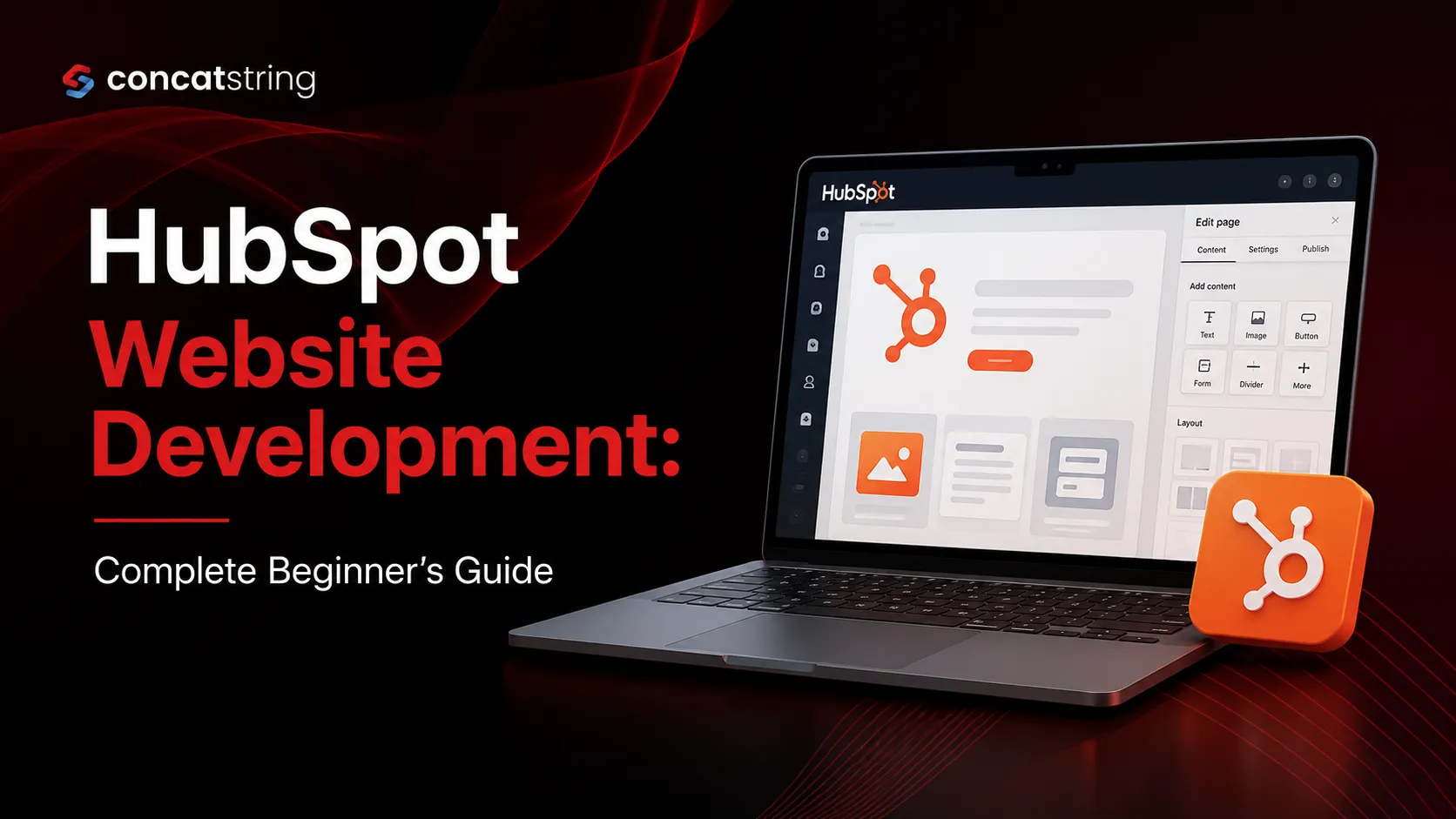
Businesses today need more than just a visually appealing website—they need a platform that connects marketing, sales, customer service, and content management into one seamless ecosystem. That's where HubSpot website development stands out. According to HubSpot's State of Marketing report, companies using integrated CRM and marketing platforms achieve significantly better lead generation and customer engagement than businesses relying on disconnected tools. For beginners, HubSpot provides an intuitive CMS, built-in CRM, and powerful automation capabilities that simplify website management while supporting long-term growth. This guide explains everything you need to know before building your first HubSpot website.
Table of Contents
Use AI to summarize this article
What Is HubSpot Website Development?
HubSpot website development is the process of creating, customizing, and managing websites using HubSpot CMS Hub, HubSpot's content management system designed specifically for marketers and businesses.
Unlike traditional CMS platforms where you often need multiple third-party plugins, HubSpot combines website management with CRM, marketing automation, analytics, forms, email marketing, and customer service tools in one platform.
This unified ecosystem allows businesses to create websites that not only look professional but also generate leads, personalize user experiences, and provide measurable business outcomes. Because every interaction is connected to the HubSpot CRM, marketing and sales teams gain valuable insights into visitor behavior without relying on multiple disconnected systems.
For beginners, this integration reduces technical complexity while making it easier to launch and manage high-performing websites.
Source: https://www.hubspot.com/products/cms
Why Businesses Choose HubSpot for Website Development
Choosing a website platform is about much more than design flexibility. Modern businesses need websites that contribute directly to revenue growth, customer engagement, and operational efficiency.
HubSpot addresses these needs by combining website management with marketing and CRM capabilities under a single login. This eliminates the need to integrate numerous external tools, reducing maintenance costs and simplifying day-to-day operations.
Businesses also appreciate HubSpot because marketers can update pages, publish blogs, create landing pages, and optimize SEO without depending heavily on developers for every small change. At the same time, developers retain the flexibility to build fully customized templates, modules, and integrations whenever required.
Another significant advantage is security. Unlike many self-hosted platforms, HubSpot manages hosting, software updates, security patches, SSL certificates, and performance optimization automatically. This allows organizations to focus on growing their business rather than maintaining infrastructure.
Understanding the HubSpot CMS
At the center of HubSpot website development is CMS Hub, a cloud-based content management system built for both marketers and developers.
For content creators, CMS Hub offers an intuitive drag-and-drop editor that makes updating pages straightforward without writing code. Teams can edit content, publish landing pages, manage blogs, and create campaigns using a visual interface.
Developers, however, are not limited by the visual editor. HubSpot supports custom themes, reusable modules, serverless functions, APIs, dynamic content, and HubL, HubSpot's proprietary templating language. This balance between usability and customization makes the platform suitable for businesses ranging from startups to enterprise organizations.
Since everything operates on HubSpot's managed infrastructure, businesses also benefit from optimized page performance, global CDN delivery, built-in SSL, and enterprise-grade security.
Source: https://developers.hubspot.com/docs/cms
Key Features of HubSpot Website Development
One reason HubSpot continues gaining popularity is its comprehensive feature set.
The drag-and-drop page builder allows non-technical users to create professional pages quickly without sacrificing design consistency. Developers can simultaneously create custom themes and components that marketers can reuse across multiple pages.
Built-in SEO recommendations help optimize titles, meta descriptions, internal linking, and page structure directly within the editing interface. Rather than switching between multiple SEO tools, users receive practical suggestions while creating content.
Personalization is another standout feature. Since every visitor can be associated with CRM data, businesses can display customized content based on lifecycle stage, location, previous interactions, or customer status. This creates more relevant experiences that often improve conversion rates.
HubSpot also provides advanced analytics, enabling businesses to understand traffic sources, visitor behavior, conversions, and campaign performance from one dashboard.
How HubSpot Website Development Works
Building a website with HubSpot typically follows a structured process.
The journey starts by defining business objectives, identifying the target audience, and planning website architecture. Rather than focusing only on design, successful HubSpot websites are built around customer journeys and conversion goals.
Developers then create or customize themes, templates, navigation structures, landing pages, blog layouts, and reusable modules. Once the design foundation is complete, marketers can independently update content through HubSpot's visual editor.
Lead generation tools such as forms, live chat, CTAs, email subscriptions, and CRM integration are added during development so every visitor interaction becomes measurable.
Finally, the website undergoes SEO optimization, testing, performance improvements, and quality assurance before launch.
Because HubSpot hosts the website, deployment is significantly simpler than traditional self-managed hosting environments.
Benefits of HubSpot Website Development for Beginners
For someone building their first business website, HubSpot removes many of the technical barriers commonly associated with website management.
One of its biggest advantages is simplicity. Beginners don't need to worry about installing plugins, configuring hosting servers, updating software versions, or handling security patches. These responsibilities are managed automatically by HubSpot.
The platform also makes collaboration easier. Marketing teams can publish content without waiting for developers, while developers retain complete control over custom functionality and design systems.
Since CRM integration is native, every form submission, page visit, and customer interaction is automatically recorded, making lead nurturing considerably more efficient from day one.
Perhaps most importantly, beginners can continue expanding their websites without migrating to another platform as their business grows.
HubSpot vs Traditional CMS Platforms
Many businesses compare HubSpot with platforms such as WordPress before making a decision.
WordPress offers tremendous flexibility and an enormous plugin ecosystem, making it attractive for businesses comfortable managing hosting, updates, plugin compatibility, and security independently.
HubSpot, on the other hand, focuses on providing an integrated business platform rather than simply a content management system. Website management, CRM, marketing automation, analytics, customer service tools, forms, and reporting all work together without requiring multiple third-party integrations.
This integrated approach generally reduces maintenance overhead while improving consistency across marketing and sales operations.
Businesses prioritizing operational simplicity, scalability, and marketing efficiency often find HubSpot particularly valuable.
Best Practices for HubSpot Website Development
Successful HubSpot websites begin with a clear strategy rather than simply selecting attractive templates.
Developers should build reusable modules that marketers can easily update without modifying code. This reduces maintenance costs while ensuring brand consistency across every page.
Performance should also remain a priority throughout development. Optimized images, streamlined page structures, and efficient coding practices contribute to faster loading times and improved user experiences.
SEO should be incorporated from the beginning instead of being treated as a final checklist. Well-structured headings, descriptive URLs, internal linking, schema markup, and keyword-focused content create stronger long-term search visibility.
Finally, businesses should continuously monitor analytics after launch. Website optimization is an ongoing process, and small improvements in conversion rates often produce significant long-term business results.
Common Mistakes Beginners Should Avoid
Many first-time HubSpot users focus heavily on design while overlooking business objectives.
A visually impressive website delivers little value if visitors cannot easily understand services, locate important information, or complete desired actions. Every page should guide users toward meaningful conversions.
Another common mistake is neglecting CRM setup. Since HubSpot's greatest strength lies in its integrated ecosystem, businesses should properly configure contact properties, lifecycle stages, forms, and automation from the beginning.
Ignoring SEO fundamentals can also reduce visibility. Even with HubSpot's built-in optimization tools, businesses still need quality content, keyword research, logical site architecture, and ongoing publishing efforts.
Lastly, beginners sometimes over-customize templates unnecessarily. Using HubSpot's native features whenever possible generally results in easier maintenance and better long-term scalability.
Is HubSpot Website Development Right for Your Business?
HubSpot website development is an excellent option for businesses looking to combine website management with marketing, CRM, automation, and customer engagement within a single platform.
It is particularly well suited for B2B companies, SaaS businesses, agencies, professional service providers, healthcare organizations, educational institutions, and growing companies that prioritize lead generation.
While the platform may require a higher initial investment than some traditional CMS solutions, many organizations find that reduced maintenance costs, improved productivity, and stronger marketing performance justify the investment over time.
For businesses planning sustainable digital growth, HubSpot offers a scalable foundation capable of supporting both current requirements and future expansion.
Conclusion
HubSpot website development goes far beyond building attractive web pages. It creates a centralized digital ecosystem where websites, CRM, marketing automation, customer service, and analytics work together to support measurable business growth. For beginners, the platform simplifies many technical challenges while providing enterprise-level capabilities that can scale alongside the business. Whether your goal is generating more qualified leads, improving customer experiences, or simplifying website management, investing in HubSpot development can provide long-term value and a solid foundation for digital success.
If you're planning to build a scalable, conversion-focused HubSpot website, ConcatString can help. Our team specializes in custom HubSpot website development, migration, CMS customization, theme development, and CRM integration, ensuring your website is optimized for performance, user experience, and business growth from day one.
FAQs