HubSpot Lead Scoring and Website Behavior: Turning Visitor Activity Into Better Sales Opportunities

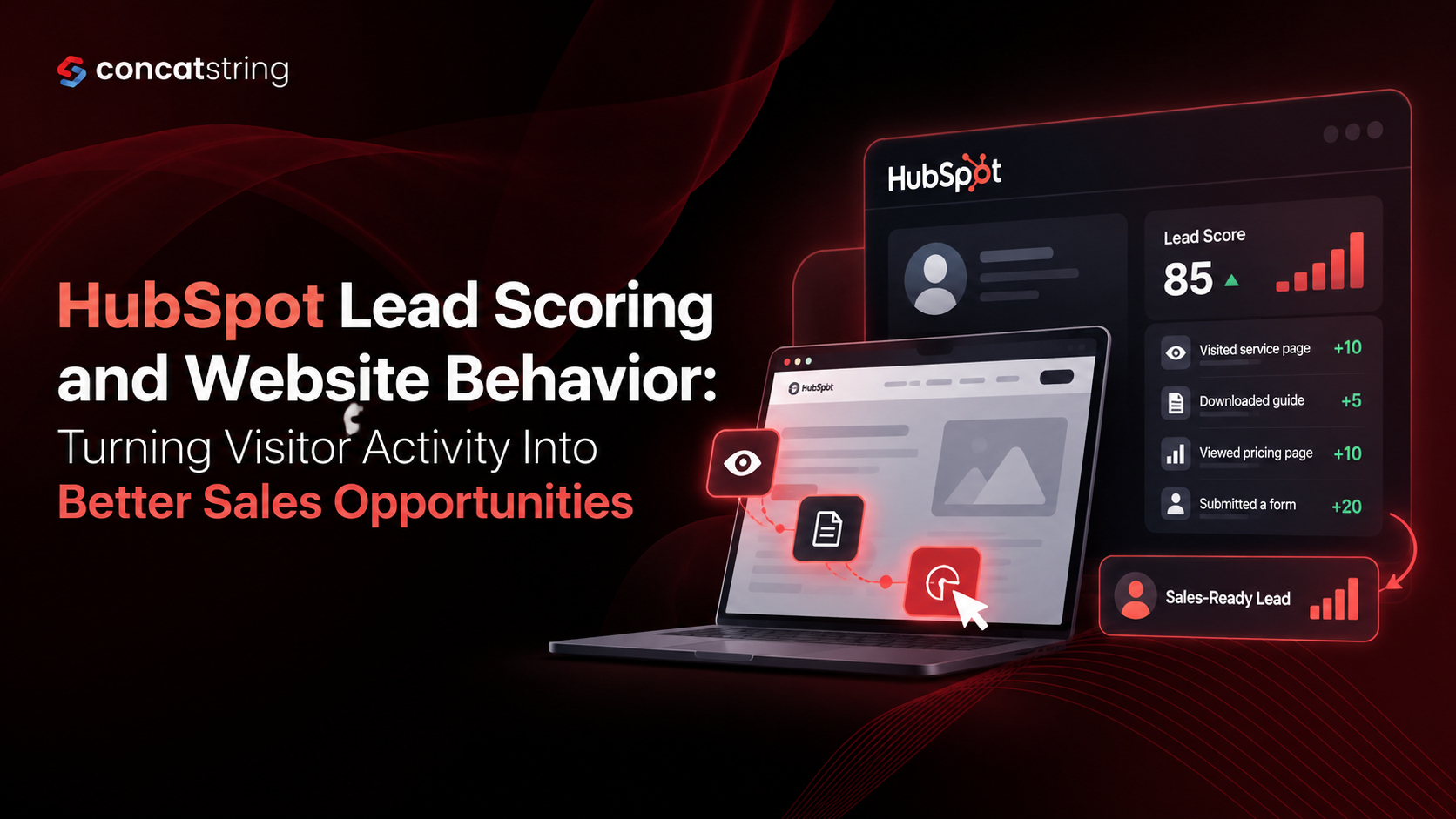
Not every website visitor is ready to buy, but their behavior can reveal how close they are to making a decision. HubSpot lead scoring combines contact information, engagement signals, and website activity to help marketing and sales teams prioritize promising prospects. Instead of treating every form submission as an equally valuable opportunity, businesses can identify visitors who repeatedly explore service pages, review pricing, download resources, or return to important product pages. When implemented correctly, this approach makes lead qualification more consistent, improves sales follow-ups, and helps businesses use their marketing resources more effectively.
Table of Contents
Use AI to summarize this article
What Is HubSpot Lead Scoring?
HubSpot lead scoring is a method of assigning scores to contacts based on characteristics and behaviors that indicate their likelihood of becoming customers. These scores help marketing and sales teams distinguish between contacts who are simply exploring a business and those who demonstrate stronger buying intent.
In HubSpot, scoring can incorporate information such as a contact's job title, company size, industry, engagement with marketing emails, form submissions, and tracked website interactions, depending on the available tools and configuration. Businesses can use these signals to prioritize follow-ups, create segmented marketing campaigns, and identify contacts that meet their sales qualification criteria.
For example, consider a business that provides website development services. One visitor reads a general blog post about website design, while another repeatedly visits the company's Shopify development page, reviews its portfolio, and submits a project inquiry. Although both visitors have engaged with the website, the second visitor demonstrates more direct commercial intent.
Lead scoring helps translate these differences into a structured qualification process. Rather than relying entirely on intuition or manually reviewing every contact, sales teams can use scoring rules to identify which opportunities deserve attention first.
However, a lead score is not a guarantee that someone will purchase. It is a decision-support tool that becomes more reliable when its scoring criteria reflect actual customer behavior and are regularly reviewed against sales outcomes.
Why Does Website Behavior Matter for Lead Scoring?
A website is more than a digital brochure. It is a source of behavioral information that can help businesses understand what potential customers are researching, which problems they want to solve, and whether they are moving closer to a purchase decision.
Website behavior becomes especially useful when it is interpreted in context. A visitor reading an educational article may be researching a general problem, while someone visiting a pricing page, comparing service options, or completing a consultation form may be evaluating potential suppliers.
Neither action should be interpreted in isolation. The value comes from understanding how different interactions combine over time.
Understanding the Difference Between Engagement and Buying Intent
Engagement measures whether a visitor interacts with a brand. Buying intent estimates whether those interactions indicate a realistic possibility of making a purchase. The two are related, but they are not interchangeable.
For example, someone who reads five blog articles may be highly engaged without having a budget or an immediate need. Another visitor may read only one service page before requesting a quotation. The second visitor could represent a stronger sales opportunity despite having fewer recorded interactions.
This distinction matters because assigning excessive points to low-intent activities can produce inflated scores. Sales representatives may spend hours contacting contacts who are interested in learning but are not ready to buy.
A practical scoring model therefore considers the purpose of each page, the nature of the interaction, the visitor's fit with the target customer profile, and the sequence of activities. A service inquiry combined with relevant company information is generally more meaningful than a single blog visit.
Which Website Activities Should Businesses Track?
The most useful website activities depend on the company's sales process and the decisions visitors typically make before converting. For a B2B service provider, viewing service pages, reviewing case studies, exploring pricing information, and submitting a consultation request may be particularly relevant.
For an ecommerce business, product views, repeated visits to product categories, interactions with product comparison pages, and checkout activity may provide more meaningful signals.
The key is to assign value according to the activity's relationship with a business outcome, not simply because the activity is easy to track.
Website behavior should also be interpreted cautiously. Multiple visits may indicate interest, but they can also result from research, internal team discussions, automated traffic, or accidental revisits. A useful lead scoring system accounts for these possibilities rather than assuming every interaction signals a future sale.
Source: HubSpot's official lead scoring documentation.
How Does HubSpot Track Website Behavior?
HubSpot uses its tracking code and associated analytics capabilities to collect website activity data. When configured correctly, this helps businesses understand traffic patterns and connect certain activities with CRM records when HubSpot can identify and associate those interactions with a contact.
For websites built outside HubSpot, the tracking code generally needs to be installed separately. Businesses should also configure their website domains and relevant integrations appropriately so that analytics and contact activity can be interpreted correctly. Tracking does not mean every anonymous visitor can automatically be identified by name or email address.
Source: HubSpot's guide to installing the tracking code.
First-Time Visitors vs. Known Contacts
When someone visits a website without submitting a form or otherwise becoming associated with a known contact record, the business may have access to aggregate or browser-level activity without knowing the person's identity. If the visitor later submits a form, HubSpot may be able to associate eligible activity with the contact, subject to the tracking setup, browser conditions, consent requirements, and available data.
This distinction is important for accurate lead qualification. Businesses should not treat every page view as a named prospect's activity, nor should they assume that every visit across different devices or browsers will be linked to the same person.
For example, a prospective customer might research a service on a mobile phone and submit an inquiry from a work computer. Without an appropriate identification or association mechanism, those interactions may not appear as one continuous journey. Recognizing such limitations helps marketing teams avoid overestimating the completeness of their tracking data.
Connecting Website Activity With CRM Data
The real value of website tracking emerges when behavioral information becomes useful inside the CRM. A contact's record can help sales representatives understand relevant interactions, review submitted information, and assess whether the prospect has expressed a specific business need.
Imagine a company offering HubSpot implementation services. A contact visits an article about CRM automation, downloads a workflow checklist, and later submits a request for implementation support. When these interactions are available and associated correctly, the sales team can approach the conversation with more context instead of beginning with a generic sales pitch.
This context also helps marketing teams build more relevant follow-up journeys. Someone researching CRM fundamentals may benefit from educational content, while someone requesting implementation support may need a consultation or a technical discussion.
How to Build an Effective HubSpot Lead Scoring Model
A successful lead scoring model starts with a clear definition of a qualified lead. Before assigning points, marketing and sales teams should agree on what makes a prospect valuable, which behaviors indicate purchase intent, and when a lead should be passed to the sales team.
HubSpot supports engagement scores, fit scores, and combined scores for supported records and subscriptions. The precise options available depend on the HubSpot products and subscription tier being used.
Source: HubSpot's lead scoring overview.
Step 1: Define Your Ideal Customer Profile
The first step is identifying the characteristics of businesses and people who are most likely to benefit from your offering. For a B2B agency, relevant criteria may include company size, industry, business model, geographic market, budget range, and the type of service required.
These characteristics form the foundation of a fit score. A visitor who works for a business within your target market may be a better potential customer than someone whose needs fall outside your services, even if the second visitor spends more time browsing your website.
For instance, a company specializing in ecommerce development might prioritize businesses planning to launch a Shopify store or migrate an existing ecommerce platform. A visitor researching a small personal blog may be engaged, but may not fit the agency's commercial objectives.
The ideal customer profile should be based on historical customer data, sales feedback, and the organization's actual capabilities rather than assumptions about which leads look promising.
Step 2: Assign Points to Meaningful Website Activities
Once the target audience is defined, determine which website interactions provide useful evidence of interest. Assign higher values to activities that closely align with a sales conversation and lower values to actions that demonstrate general awareness.
The following is an illustrative scoring framework, not a universal HubSpot template.
Website activity
Example score
Reason
Reads a general blog post
+2
Indicates early-stage interest
Downloads a relevant guide
+5
Shows interest in a specific topic
Visits a service page
+8
Suggests consideration of a solution
Returns to a pricing or project page
+10
May indicate stronger commercial intent
Requests a consultation
+20
Explicitly signals interest in speaking with sales
These values should be adjusted to match your own sales process. A pricing-page visit, for example, does not always mean someone is ready to purchase, and a consultation request should not automatically be treated as a qualified opportunity without reviewing the prospect's requirements.
It is also important to avoid double-counting related actions. If someone visits the same page repeatedly, the scoring model should not allow a large number of low-value visits to outweigh stronger evidence of poor customer fit.
HubSpot's scoring tool provides options for setting point values and limits for score groups, helping businesses control how different criteria contribute to a total score.
Source: HubSpot's guide to building lead scores.
Step 3: Combine Behavioral Scores With Customer Fit
Website activity tells you how a person interacts with your business, while customer fit helps establish whether that person is a suitable prospect. Combining these dimensions creates a more useful picture than either one provides alone.
Consider two contacts with similar engagement levels. One represents a company with an appropriate budget, a relevant business need, and authority to evaluate vendors. The other is a student researching the subject for an assignment. Their website activity may be similar, but their likelihood of becoming a customer is different.
A combined score helps separate these situations. It allows a business to prioritize contacts who both match its target customer profile and demonstrate meaningful engagement.
For example, a company could use fit criteria to identify businesses within its target market and engagement criteria to recognize contacts who request consultations or revisit relevant service pages. The resulting scores can help sales representatives decide where to focus their time.
This model should remain flexible. A lead who is a strong fit but has shown little engagement may need educational nurturing, while a highly engaged contact with poor fit may not deserve immediate sales attention.
Step 4: Set Qualification Thresholds and Follow-Up Rules
A lead scoring model becomes useful when its scores lead to consistent actions. Marketing and sales teams should agree on what happens when a contact reaches a particular threshold, rather than treating the score as an isolated number in the CRM.
For example, a business might initially classify scores below 30 as early-stage leads, scores from 30 to 59 as leads requiring further nurturing, and scores of 60 or above as candidates for sales review. These are illustrative thresholds; they should be calibrated using the company's own data.
A high score could trigger an internal notification, create a task for a sales representative, or enroll a suitable contact in a relevant workflow, depending on the available HubSpot functionality and configuration. A lower-scoring contact might receive educational content until stronger buying signals appear.
The handoff should also consider explicit actions. A direct request for a sales call may warrant prompt attention even when a contact's accumulated score remains relatively low. Businesses should ensure that important inquiries are not overlooked simply because a scoring threshold has not been reached.
How Website Behavior Improves Sales Opportunities
The purpose of lead scoring is not merely to rank contacts. Its real business value comes from helping teams make better decisions about timing, messaging, and the allocation of sales resources.
Prioritizing Leads With Stronger Buying Signals
Sales representatives often work with a mixture of new inquiries, existing opportunities, and contacts who are still exploring their options. Without a clear qualification process, teams may spend too much time on low-priority leads while more promising prospects wait for a response.
Website behavior can help establish a more informed order of priority. Someone who has requested a consultation and reviewed relevant service information may deserve a different follow-up from someone who has only read an introductory article.
This does not mean sales teams should ignore low-scoring contacts. It means they can match their effort to the available evidence, while still responding appropriately to direct inquiries and other time-sensitive requests.
Personalizing Follow-Ups Based on Visitor Interests
A contact's browsing behavior can also inform the content of a follow-up. If someone repeatedly explores ecommerce development services, a representative can focus on platform requirements, integrations, migration challenges, and project timelines rather than discussing unrelated offerings.
Similarly, a prospect who engages with content about CRM automation may benefit from a practical explanation of how workflows can reduce manual work, improve lead routing, or support more consistent follow-ups.
This approach makes outreach more relevant because it connects the conversation to a potential business need. However, personalization should be handled professionally. Sales representatives should avoid making visitors feel that their every browsing action is being monitored. It is often better to reference the topic or service they expressed interest in than to recite a detailed history of their website activity.
Aligning Marketing and Sales Teams
Lead scoring also provides a common framework for marketing and sales teams to discuss lead quality. Marketing can evaluate whether its campaigns are attracting suitable prospects, while sales can share feedback about whether high-scoring contacts are becoming genuine opportunities.
For example, if a campaign generates many contacts with high engagement scores but few qualified sales conversations, the problem may be the targeting, scoring rules, or content attracting the wrong audience. If qualified leads are consistently reaching sales but not progressing, the team may need to investigate pricing, timing, service fit, or the sales process.
This feedback loop helps businesses improve lead quality rather than focusing exclusively on the volume of form submissions.
Practical Example: Using HubSpot Lead Scoring to Qualify Website Visitors
Consider a digital agency such as Concatstring that provides website development, ecommerce solutions, and digital marketing services. The agency receives inquiries from different sources, including organic search, paid advertising, service pages, and educational blog content.
Some visitors are researching solutions for future projects, while others are actively looking for a development partner. A structured lead scoring system can help the agency distinguish between these situations.
How a Visitor Becomes a Sales-Ready Lead
Imagine a marketing manager visits an agency's website after searching for Shopify development services. The visitor reads a blog about ecommerce optimization, explores the Shopify development page, reviews relevant project examples, and submits a consultation request.
Each interaction provides a different piece of information. The blog visit indicates general interest, the service-page visit suggests consideration, the portfolio review provides evidence of evaluation, and the consultation request signals an explicit desire to discuss a project.
When this activity is correctly tracked and associated with a CRM contact, HubSpot can use configured engagement criteria to contribute to the contact's score. If the contact also represents a suitable company with a relevant project and realistic requirements, the combined fit and engagement information may justify a sales follow-up.
The sales representative can then start with a more relevant conversation about the project's goals, existing technology, integrations, budget, and timeline.
By contrast, a visitor who reads several introductory articles but does not match the agency's target customer profile may be better suited to an educational email sequence. Both contacts remain valuable, but they require different next steps.
The important lesson is that lead scoring helps connect website activity with sales decisions. It does not replace qualification conversations or guarantee a conversion.
Common Lead Scoring Mistakes Businesses Should Avoid
Even a well-designed CRM can produce misleading results when scoring rules are poorly planned. Businesses should pay attention to how points are assigned, how visitor activity is interpreted, and how scores influence sales workflows.
Giving Too Many Points to Every Page Visit
One common mistake is treating every page view as a strong buying signal. A visitor who reads ten blog posts may be researching a topic rather than looking for a service provider. If each visit adds substantial points, the resulting score can exaggerate the contact's commercial intent.
A better approach is to distinguish between educational content and pages associated with evaluation or conversion. Businesses should also use appropriate scoring limits, where available, to prevent repetitive low-intent interactions from dominating the score.
Ignoring Negative Signals and Changing Intent
Lead quality can change over time. A contact may no longer be interested, may unsubscribe from marketing communications, or may turn out to be outside the target market. A scoring model that only adds points can continue to prioritize contacts whose original activity is no longer relevant.
Businesses should consider suitable negative criteria, score decay or recency rules where supported, and clear exclusion conditions. For example, a contact who no longer matches the target market may need a lower fit score, while a long period without meaningful engagement may justify reducing the priority of a sales follow-up.
Not every negative interaction should reduce a score automatically. Unsubscribes, privacy preferences, and other communication restrictions must be respected independently of the contact's commercial value.
Failing to Review Scoring Accuracy
A scoring model should evolve as the business learns more about its customers. If high-scoring contacts consistently fail to become qualified opportunities, the team should investigate whether certain activities receive too many points or whether important qualification criteria are missing.
Reviewing won deals, lost opportunities, sales feedback, and conversion patterns helps identify which signals actually correlate with commercial outcomes.
Rather than making frequent changes based on a handful of contacts, businesses should review a meaningful sample of leads over an appropriate period. They should also document changes to scoring rules so that improvements can be evaluated consistently.
How to Measure the Effectiveness of HubSpot Lead Scoring
A lead scoring system is only useful if it helps improve the sales process. Businesses should measure outcomes beyond the number of contacts reaching a particular score.
The first important metric is the percentage of marketing-qualified leads that sales accepts for further evaluation. If this improves after a scoring model is introduced, the model may be helping marketing identify more relevant prospects.
Another useful measure is the conversion rate from qualified lead to sales opportunity. This indicates whether prioritized contacts are progressing into genuine commercial discussions. Businesses can also track time to first sales follow-up, the percentage of qualified leads that become customers, and the revenue associated with different lead segments.
For example, suppose a company evaluates 100 leads and discovers that contacts above its high-priority threshold are consistently accepted by sales and progress to opportunities more frequently than lower-scoring contacts. That pattern would support the usefulness of the model, although the company should still consider differences in lead source, customer segment, and sales treatment.
HubSpot's score properties can be used in supported reports, segments, and workflows. Businesses should verify that their reporting setup captures the outcomes they want to measure and that the same qualification definitions are used across marketing and sales.
The goal is to establish a feedback loop: score leads, observe what happens next, compare results, and improve the criteria based on evidence.
Best Practices for HubSpot Website Tracking and Lead Scoring
An effective implementation requires more than creating a numerical score. The website, tracking configuration, CRM records, and sales processes need to work together.
First, verify that the HubSpot tracking code is correctly installed on all relevant website pages, particularly if the website is hosted outside HubSpot. Check for duplicate installations, domain configuration issues, and tracking limitations caused by browser settings or consent preferences.
Second, use clear and consistent naming conventions for lead scores, lifecycle stages, and qualification thresholds. When sales and marketing teams understand what a score represents, they are more likely to use it correctly.
Third, keep the scoring model focused on activities that support business decisions. A small number of well-chosen criteria is often easier to maintain and evaluate than a complicated model with dozens of overlapping rules.
Finally, establish appropriate data governance. Website tracking and CRM data should be collected and used in accordance with applicable privacy laws, consent requirements, and the organization's privacy policy. Access to contact data should also be limited to appropriate team members.
These practices improve the reliability of lead scoring while helping businesses maintain a transparent and responsible approach to customer data.
Conclusion
HubSpot lead scoring and website behavior work best when they are treated as connected parts of a broader lead qualification strategy. Website activity reveals potential interest, customer-fit data helps identify relevant prospects, and scoring rules translate those signals into practical sales priorities.
The most effective systems do not simply reward visitors for spending more time on a website. They distinguish between general engagement and meaningful buying intent, support timely follow-ups, and improve through continuous evaluation of actual sales outcomes.
For businesses looking to generate better sales opportunities, the priority should be to establish reliable tracking, define clear qualification criteria, align marketing and sales teams, and measure whether the resulting scores lead to better conversations and stronger pipeline quality.
With the right strategy and technical implementation, HubSpot can help transform website interactions into actionable insights that support more informed sales decisions.
Improve Your Lead Qualification Strategy With Concatstring
Want to turn more of your website traffic into qualified sales opportunities? Concatstring can help your business strengthen its digital presence through website development, marketing-focused digital experiences, and solutions designed around your business objectives.
Whether you need a better-performing website, clearer conversion journeys, or a more effective approach to generating and qualifying leads, our team can help you identify opportunities to improve your digital strategy.
Ready to build a website and marketing strategy that supports better business growth? Contact Concatstring to discuss your goals.
FAQs