How to Reduce Shopify App Dependency With Custom Ecommerce Development

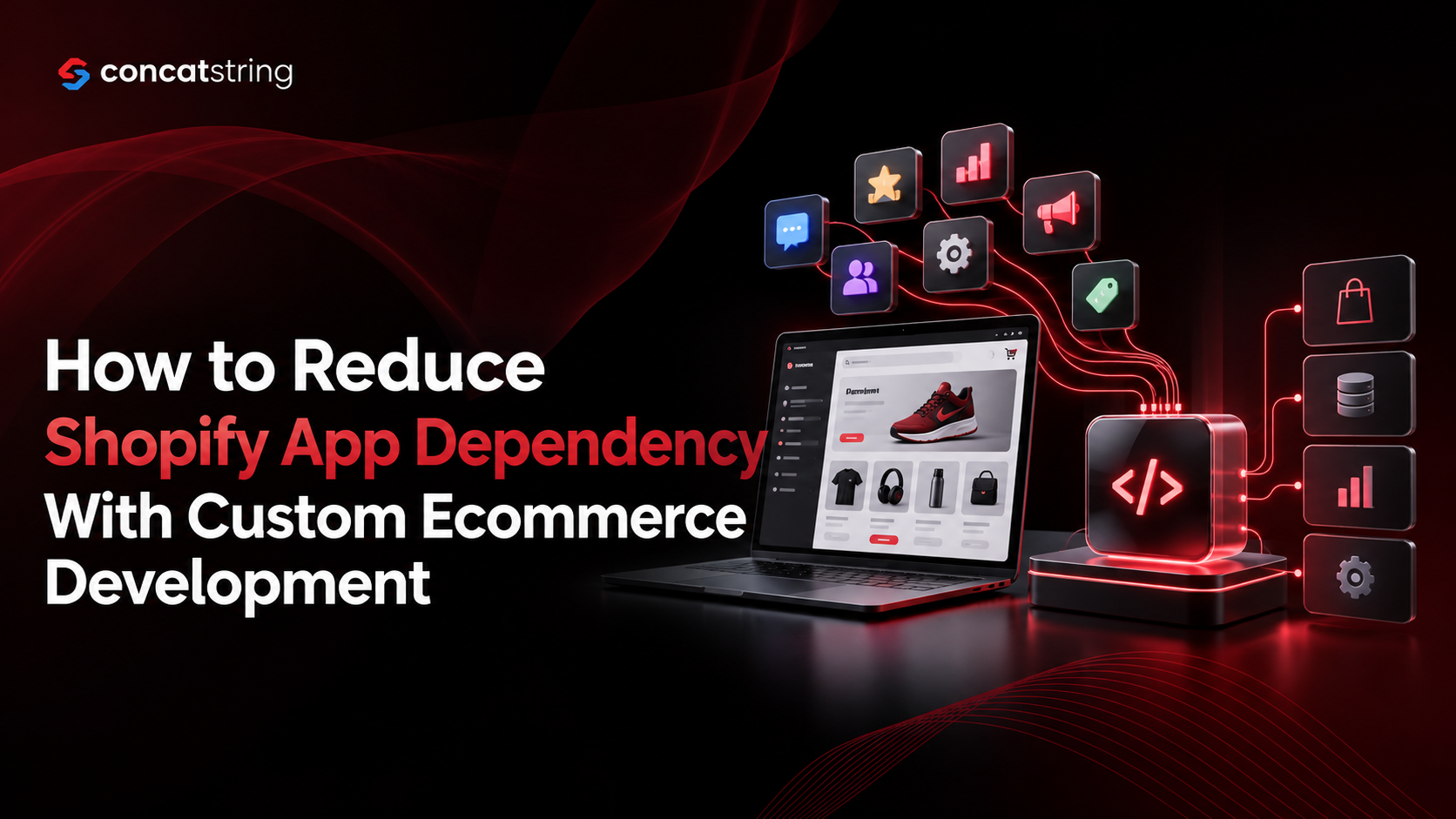
Shopify apps make it easy to launch an online store, but relying on too many third-party tools can introduce recurring costs, performance issues, integration challenges, and limited customization. According to the Baymard Institute's ecommerce checkout research, the average cart abandonment rate is 70.19%, highlighting the importance of a smooth purchasing experience. While app dependency alone does not cause cart abandonment, unnecessary scripts and disconnected customer journeys can create avoidable friction. Custom ecommerce development offers a more strategic approach by consolidating essential functionality, improving integration, and giving businesses greater control over their storefront. For growing brands, reducing Shopify app dependency is not about eliminating every app; it is about building a faster, more manageable, and scalable ecommerce ecosystem.
Table of Contents
Use AI to summarize this article
Why Shopify App Dependency Becomes a Business Challenge
Shopify has become a popular ecommerce platform because it allows businesses to launch and manage online stores without building every feature from scratch. Merchants can install applications for email marketing, product reviews, subscriptions, loyalty programs, product bundles, inventory management, and customer support. This flexibility helps businesses respond quickly to changing requirements.
However, the same convenience can create a complicated technology stack as an ecommerce business grows. A store that initially needs only a few applications may eventually depend on numerous tools to manage its everyday operations. Each application introduces its own configuration requirements, subscription fees, data flows, and maintenance considerations.
The problem becomes more noticeable when applications overlap or fail to communicate efficiently. A loyalty application may need customer purchase information from another system, while a subscription tool may require additional logic for discounts and order management. When these workflows are handled through disconnected applications, the business can end up maintaining several solutions for processes that could be managed through a more integrated architecture.
This is where custom ecommerce development becomes valuable. Instead of continuously adding applications to solve individual problems, businesses can assess their actual requirements and build tailored functionality around their Shopify store.
For ConcatString, the opportunity is to help ecommerce businesses approach technology as a long-term growth investment rather than a growing collection of disconnected tools.
What Is Shopify App Dependency?
Shopify app dependency occurs when an online store relies heavily on third-party applications to operate essential business functions. These applications may support storefront design, product discovery, marketing automation, checkout experiences, customer retention, reporting, or order management.
Using third-party applications is not inherently problematic. In fact, established applications can provide sophisticated functionality that would be expensive or unnecessary to develop internally. Dependency becomes a concern when critical operations rely on multiple overlapping tools, when recurring costs become difficult to justify, or when the business cannot easily change a workflow without disrupting other systems.
How Shopify App Dependency Develops
Consider a growing direct-to-consumer brand that installs one application for product reviews, another for customer loyalty, a third for product bundles, and additional applications for upselling, subscriptions, and marketing automation.
Initially, every application solves a specific problem. Over time, however, the brand may discover that several applications load scripts on product pages, multiple tools store overlapping customer information, and discount logic behaves differently across promotions.
The team must also learn different dashboards, monitor separate billing cycles, and coordinate support requests with multiple vendors.
This creates operational complexity even when every application works as intended.
The objective of Shopify custom development is to identify which functions genuinely need dedicated applications and which can be implemented more efficiently through custom functionality, native Shopify features, or well-designed integrations.
Why Reducing Shopify App Dependency Matters
1. Improve Storefront Performance
Website performance affects how customers experience an ecommerce store. Slow-loading product pages, delayed interactive elements, and unexpected layout shifts can make browsing less convenient, particularly on mobile devices.
Shopify identifies themes, installed applications, and additional third-party code as important factors affecting storefront performance. Its documentation also explains how excessive scripts can contribute to poor responsiveness.
Proof: Shopify's official guidance on improving online store performance recommends evaluating installed applications and third-party code to ensure their business value justifies their potential performance impact.
Custom ecommerce development can help address these problems by consolidating redundant features, reducing unnecessary JavaScript, and loading functionality only where it is needed.
For example, if multiple applications add separate scripts to product pages for promotional banners, related products, and product badges, a custom implementation may consolidate these elements into a single, coordinated experience.
However, custom development does not automatically make a website faster. Poorly written custom code can create the same problems as an excessive application stack. The objective is to reduce unnecessary work and measure the performance impact of every implementation.
2. Reduce Recurring Software Costs
Many Shopify applications charge monthly fees based on usage, order volume, feature access, or the number of customers. A small number of subscriptions may seem affordable, but costs can increase as sales and operational requirements expand.
For example, imagine a store spending $40 per month on a reviews application, $60 on loyalty functionality, $50 on product bundles, and $80 on additional promotional features. These illustrative subscriptions total $230 per month, or $2,760 annually.
That amount does not include integration services, additional usage charges, staff training, or the time spent managing the tools.
Custom ecommerce development introduces a different cost structure. Businesses pay for discovery, implementation, testing, hosting where applicable, and ongoing maintenance rather than depending entirely on multiple feature-specific subscriptions.
The financial advantage depends on the cost of development, the functionality involved, maintenance requirements, and the time horizon. A custom solution is not always cheaper in the first year, particularly when an existing application already meets the business requirements.
The sensible approach is to compare the total cost of ownership over two or three years instead of judging the decision solely by monthly subscription prices.
3. Gain Greater Control Over Ecommerce Functionality
Third-party applications are designed to serve a broad range of merchants. That makes them useful for standard requirements but can limit businesses with specialized workflows.
A manufacturer selling through a Shopify store, for instance, may need customer-specific pricing, minimum order quantities, product configuration rules, or approval workflows. An off-the-shelf application may support some of these requirements but not the complete process.
Custom Shopify development allows the business to define functionality around its actual operating model.
Instead of adapting every internal process to an application's limitations, developers can design a workflow that reflects the company's pricing rules, customer segments, product relationships, and operational requirements.
This flexibility becomes especially important when an ecommerce business has complex products, B2B customers, subscription models, or multiple sales channels.
4. Simplify Integrations and Data Management
Disconnected applications can create inconsistencies between customer profiles, inventory information, discounts, order records, and marketing data.
For example, a customer might receive a promotional email based on outdated purchase information because the marketing platform has not synchronized correctly with the order management system.
Custom integrations can establish clearer data flows between Shopify and the systems that support the business. Shopify provides APIs for accessing resources such as products, orders, customers, inventory, and metafields.
Proof: Shopify's official API documentation explains how developers can use platform APIs and extensions to build functionality across Shopify's administrative and customer-facing environments.
A well-designed integration can reduce duplicate data handling and make business rules more consistent. It should also include appropriate authentication, error handling, monitoring, and recovery mechanisms so that temporary synchronization failures do not silently affect operations.
Which Shopify Apps Should You Replace With Custom Development?
The right approach begins with evaluating functionality, not counting installed applications. Some applications provide valuable capabilities that would be costly to reproduce, while others may duplicate existing Shopify features or address narrow requirements that can be handled more efficiently.
Product Bundles and Upselling
Product bundle applications often support frequently bought together products, volume discounts, complementary items, and promotional offers.
If a store uses only a few straightforward bundling rules, custom development may provide a simpler implementation. Developers can create product relationships, display bundle options, and implement appropriate discount logic using supported Shopify capabilities.
Complex bundles involving inventory dependencies, subscriptions, advanced pricing, or extensive merchandising rules may still justify a specialized application.
The decision should depend on how frequently the feature is used, how important it is to revenue, and how difficult it would be to maintain custom logic as the catalog changes.
Customer Loyalty and Rewards
Loyalty programs can involve points, referral rewards, customer tiers, redemption rules, and purchase history.
A brand with a simple rewards model may benefit from a custom customer experience connected to Shopify's customer and order data. More sophisticated programs may need dedicated loyalty infrastructure, especially when they involve multiple channels or extensive customer engagement features.
The important distinction is between building the customer-facing experience and rebuilding the entire loyalty platform. Custom storefront components can sometimes coexist with a specialized backend service.
Product Reviews and User-Generated Content
Product reviews influence purchasing decisions by helping customers evaluate quality, fit, reliability, and expected product performance.
A custom review interface may be appropriate when the main requirement is displaying approved reviews in a particular design. However, collecting verified reviews, sending review requests, moderating submissions, detecting spam, and managing review syndication require additional infrastructure.
For that reason, replacing an entire reviews application is not always the best decision. A hybrid implementation may preserve a reliable review-management service while reducing unnecessary storefront scripts and customizing how reviews appear.
Marketing Pop-Ups and Promotional Widgets
Promotional banners, announcement bars, lead-capture forms, and exit-intent experiences are often implemented through third-party applications.
If a store needs only a few lightweight promotional components, custom Shopify theme development can provide greater design control and eliminate functionality that is not being used.
Developers can also control when promotional scripts load and avoid displaying irrelevant offers on pages where they distract from the purchasing journey.
Advanced Search and Filtering
Basic search and collection filtering may be supported by Shopify's existing capabilities or theme features. In these cases, additional applications may introduce unnecessary complexity.
However, stores with large catalogs, typo tolerance requirements, complex faceted search, personalized results, or specialized merchandising rules may benefit from a dedicated search solution.
Custom development should be considered when the requirements are distinctive and measurable. Rebuilding sophisticated search infrastructure simply to reduce the number of applications can increase maintenance costs without delivering meaningful business value.
How to Reduce Shopify App Dependency With Custom Ecommerce Development
Reducing app dependency works best as a planned engineering project rather than a sudden removal of applications.
Step 1: Conduct a Complete Shopify App Audit
Start by documenting every installed application, its purpose, subscription cost, business owner, and connection to other systems.
The audit should distinguish applications that support essential business operations from those that provide optional enhancements. It should also identify overlapping functionality, unused features, applications that inject storefront scripts, and tools that rely on manual data transfers.
Review application usage alongside business performance. If a tool supports a feature that customers rarely use, its value may not justify its cost or technical complexity.
The outcome should be a prioritized list of applications to retain, optimize, consolidate, or replace.
Step 2: Measure the Existing Storefront Experience
Before changing the technology stack, establish a performance baseline.
Test representative homepage, product, collection, and cart experiences using Google PageSpeed Insights and Shopify's Web Performance reports. Pay attention to Core Web Vitals, particularly Largest Contentful Paint (LCP), Interaction to Next Paint (INP), and Cumulative Layout Shift (CLS).
Run tests on mobile as well as desktop, and compare results across multiple runs. Record which applications load scripts, how those scripts affect rendering, and whether the same functionality is available elsewhere.
Shopify's storefront performance documentation explains how application impact can be assessed by comparing performance before and after installation.
This baseline helps the development team distinguish genuine performance bottlenecks from assumptions about application count.
Step 3: Identify Opportunities for Custom Functionality
Once the audit is complete, map each application to the business process it supports.
For example, an application might be responsible for displaying custom product information, while another manages discount rules. The team should determine whether those requirements can be addressed through theme customization, Shopify-native functionality, a custom app, or a focused integration.
This distinction is important because not every requirement needs a standalone application. Simple presentation changes may belong in the theme, while workflows that access sensitive data or require scheduled processing may need a backend service.
The architecture should be selected according to the complexity, security requirements, and expected future development of the feature.
Step 4: Build Custom Shopify Features Around Business Requirements
Custom ecommerce development should begin with clear acceptance criteria rather than a broad goal to replace applications.
Suppose a retailer wants to replace a product-bundle application. The requirements might include selecting eligible products, displaying bundle prices, checking inventory, applying valid discounts, and ensuring that the cart reflects the correct products and quantities.
Developers can then determine which parts are supported by Shopify's native functionality and which require custom logic.
Shopify supports custom applications and extension-based approaches through its developer platform. Depending on the requirement, developers may use theme sections, app extensions, APIs, webhooks, or Shopify Functions.
The implementation should follow Shopify's current platform limitations and supported integration patterns, particularly for checkout and discount functionality.
Step 5: Consolidate Redundant Integrations
When several applications perform similar tasks, consider whether their responsibilities can be coordinated through a smaller number of well-defined systems.
For example, customer segmentation, order events, and promotional eligibility may be distributed across several applications. A custom integration layer can help standardize how these systems exchange data and apply business rules.
However, consolidation should not mean building a single oversized application that becomes difficult to maintain. Independent components, documented interfaces, clear ownership, and reliable error handling are often more sustainable.
The goal is to simplify the overall architecture while preserving the flexibility to change individual components when business needs evolve.
Step 6: Test Before Removing Existing Applications
Never assume that a new custom feature is ready simply because it works in a development environment.
Test its behavior across relevant devices, customer accounts, product variants, discount combinations, inventory conditions, and checkout scenarios. Verify that analytics events, customer communications, and connected systems continue to function correctly.
Where possible, implement the replacement in a development store or controlled staging environment. Compare the new functionality with the existing application and document any differences before switching over.
Only remove the original application after confirming that its essential responsibilities have been replaced and that the business can recover if a problem occurs.
Step 7: Monitor Performance and Total Cost of Ownership
After deployment, measure the impact of the changes against the original baseline.
Review storefront performance, conversion rate, cart abandonment, error rates, application costs, and maintenance effort. Compare similar traffic periods where possible and account for changes in promotions, seasonality, and traffic sources.
Custom development should be judged by its business outcomes, not by the number of applications removed.
A solution that eliminates three inexpensive applications but creates substantial engineering overhead may not be worthwhile. Conversely, consolidating several expensive and overlapping tools may create meaningful savings and improve operational control.
Custom Ecommerce Development vs. Third-Party Shopify Apps
The choice between custom development and existing applications depends on the complexity of the requirement and the value of owning the implementation.
Third-party applications are often the better option when a business needs a standard feature quickly, requires a mature service, or cannot justify the cost of ongoing custom maintenance.
Custom ecommerce development is more attractive when the feature is strategically important, existing tools impose significant limitations, or the business requires workflows that closely match its operations.
A hybrid approach is often the most practical solution. Businesses can retain specialized services for complex capabilities while building custom storefront components and integrations around them.
This approach avoids unnecessary reinvention without allowing the technology stack to grow unchecked.
Common Mistakes to Avoid When Reducing Shopify App Dependency
Replacing Every App With Custom Code
Building everything internally can create a new dependency on developers, internal documentation, and maintenance budgets. A custom solution still needs testing, security updates, platform compatibility checks, and ongoing ownership.
Replace applications only when there is a clear technical or commercial reason to do so.
Ignoring Shopify's Native Capabilities
Before commissioning custom development, check whether Shopify already supports the required functionality. Recreating an existing platform capability can increase cost and introduce unnecessary complexity.
The development team should understand the current Shopify platform, available APIs, and extension options before proposing a new architecture.
Measuring Success Only Through PageSpeed Scores
A higher performance score can be encouraging, but it does not automatically translate into higher revenue. Conversion rates are also influenced by product pricing, trust, delivery expectations, merchandising, and checkout usability.
Use performance metrics alongside business KPIs to understand whether the changes improve the customer experience.
Removing Apps Without Cleaning Up Their Code
Uninstalling an application does not necessarily remove all code that it previously added to a theme. Shopify explicitly notes this in its store performance troubleshooting guidance.
After removal, review theme files, app embeds, tracking scripts, and other leftover integrations. Test the storefront again to ensure that obsolete code is not continuing to affect performance or functionality.
How ConcatString Can Help With Shopify Custom Ecommerce Development
Reducing Shopify app dependency requires a balance of technical expertise, business understanding, and disciplined prioritization.
ConcatString can position its custom ecommerce development services around helping businesses assess their existing Shopify architecture, identify opportunities for consolidation, and develop functionality that fits their specific operational needs.
The process begins with understanding the store's current challenges. These may include recurring application costs, storefront performance concerns, disconnected customer data, complex product requirements, or workflows that no longer fit the business as it grows.
From there, a development strategy can prioritize the changes with the clearest potential benefits. Depending on the project, this may involve custom Shopify theme development, tailored application functionality, API integrations, or performance optimization.
The most sustainable solution is not necessarily the one with the fewest applications. It is the one that provides the right capabilities with manageable costs, reliable integrations, measurable performance, and a clear path for future development.
For growing ecommerce brands, this creates a stronger foundation for improving customer experience without allowing technical complexity to grow faster than the business itself.
Conclusion
Shopify apps provide a convenient way to expand an ecommerce store, but an unmanaged collection of applications can increase recurring expenses, complicate integrations, and make performance optimization more difficult.
Reducing Shopify app dependency through custom ecommerce development gives businesses an opportunity to simplify workflows, improve control over essential features, and align their technology with long-term goals.
The process should begin with a thorough app audit, followed by performance measurement, careful architectural planning, and controlled implementation. Some applications should be replaced, others should be optimized, and many should remain in place because they provide valuable specialized capabilities.
For ecommerce businesses looking to scale sustainably, the priority is to build a technology stack that is purposeful, measurable, and maintainable.
ConcatString can help businesses explore custom ecommerce development opportunities that support a more flexible and efficient Shopify experience.
Build a More Efficient Shopify Store With ConcatString
Is your Shopify store becoming harder to manage as application costs and technical complexity increase? ConcatString can help you evaluate your existing ecommerce setup and identify opportunities for custom development, integration improvements, and storefront optimization.
Build an ecommerce experience around your business requirements instead of forcing your workflows to fit an ever-growing collection of applications. Connect with ConcatString to discuss a custom Shopify development strategy designed for performance, flexibility, and sustainable growth.
FAQs