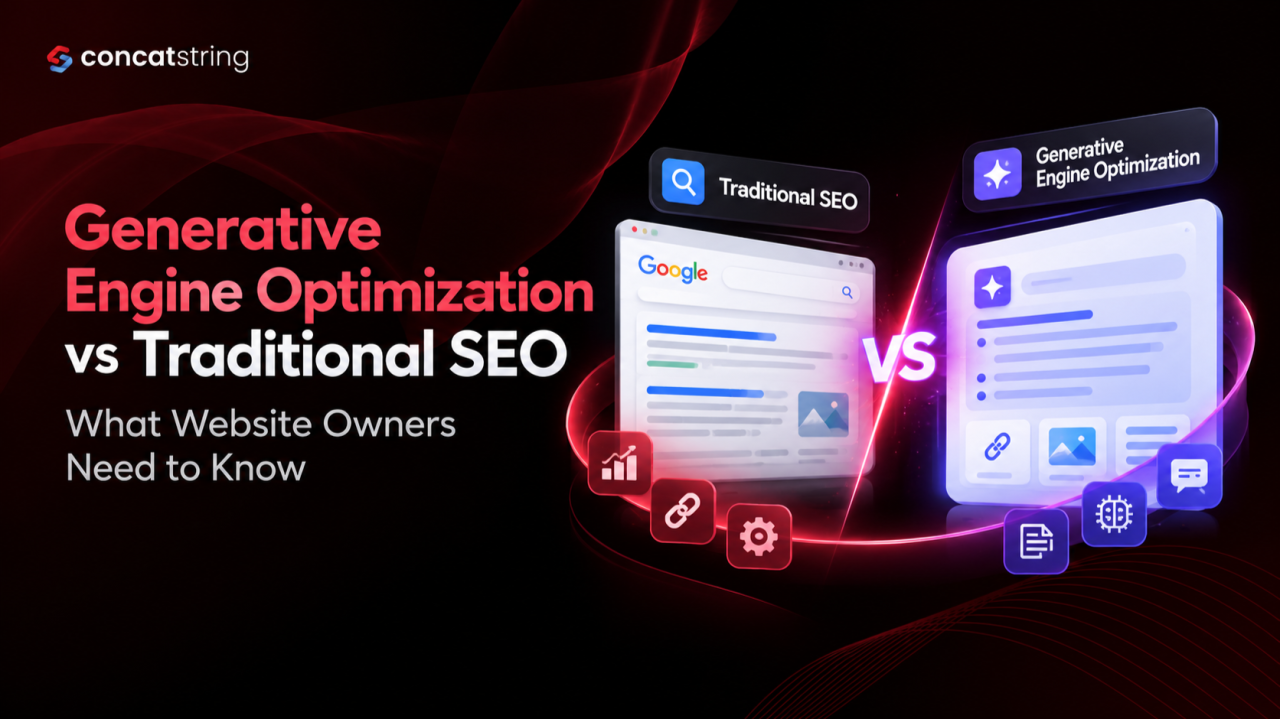
Generative Engine Optimization vs Traditional SEO: What Website Owners Need to Know

Search is changing, but that does not mean traditional SEO is going anywhere. People still use Google to discover businesses, compare services, and make purchasing decisions. At the same time, they are increasingly asking AI tools to explain options, recommend solutions, and summarize information. For website owners, this creates a new opportunity: getting discovered not only through search results but also through AI generated answers. Understanding Generative Engine Optimization vs Traditional SEO can help businesses build a smarter search strategy without abandoning the SEO practices that already work.
Table of Contents
Use AI to summarize this article
What Is Generative Engine Optimization?
Generative Engine Optimization, commonly called GEO, is the practice of improving a website’s chances of being discovered, understood, and referenced by generative AI search experiences. These include tools that create answers from information gathered across multiple sources.
Traditional search engines typically present a list of links, although modern search results can also include summaries, maps, videos, and other features. Generative search experiences can go a step further by combining information into a conversational answer and directing users to relevant sources.
For example, someone searching for a reliable ecommerce development company might receive a list of agencies on Google. When asking an AI search tool the same question, they may receive a summarized comparison based on available information.
GEO aims to make your website useful and understandable in these environments. That means publishing trustworthy information, explaining your expertise clearly, answering relevant questions, and maintaining a website that search systems can access.
Research published at the ACM SIGKDD conference introduced GEO as a framework for improving the visibility of content in generative engine responses.
Source: GEO: Generative Engine Optimization, Princeton University and ACM research
Generative Engine Optimization vs Traditional SEO: What Is the Difference?
The main difference between GEO and traditional SEO is the visibility opportunity each approach emphasizes. Traditional SEO focuses on improving a website’s presence in search results, while GEO focuses on making its information more useful and discoverable within AI generated responses.
However, these are not competing disciplines. Both depend on useful content, accessibility, relevance, and trust.
1. Search Rankings vs AI Generated Answers
Traditional SEO helps a website appear for relevant searches through organic listings, featured snippets, local results, and other search features. Its performance can be evaluated using rankings, organic traffic, impressions, clicks, and conversions.
GEO focuses on whether a business’s information is surfaced or referenced when an AI system answers a relevant question. Visibility may come through a citation, a linked source, or a brand mention, depending on the platform.
For a web development agency, traditional SEO might target searches such as “WordPress development company.” GEO also considers questions like “Which development agency can build a scalable WordPress website for a growing business?”
The underlying goal remains the same: connect the right audience with useful information.
2. Keyword Targeting vs Complete Answers
Keywords remain important in traditional SEO because they help website owners understand what people are searching for. But simply repeating a keyword throughout a page does not make the content valuable.
GEO places particular emphasis on providing clear, context rich answers that can be understood independently. A page should explain what a service does, who needs it, what problems it solves, and what factors influence the decision.
For example, a page about Shopify development should not merely repeat “Shopify development services.” It should explain store functionality, integrations, performance, scalability, and the business situations in which custom development makes sense.
This approach supports traditional SEO while making the information easier for people and AI systems to interpret.
3. Backlinks and Authority vs Broader Trust Signals
Backlinks remain useful for traditional SEO because links can help search engines discover pages and understand relationships between websites. Relevant links from credible sources can also bring qualified visitors.
GEO introduces another consideration: whether the wider information ecosystem consistently identifies a business with its expertise. Clear service pages, original research, credible mentions, expert contributions, and consistent company information can help establish that understanding.
This does not mean backlinks are obsolete or that brand mentions automatically lead to AI citations. Neither approach offers guaranteed visibility. Website owners should focus on earning genuine recognition and publishing information worth referencing.
4. Rankings and Traffic vs Citations and Business Outcomes
Traditional SEO reporting commonly measures organic clicks, impressions, keyword visibility, engagement, and leads. GEO adds questions about how often a brand appears in relevant AI responses, whether those responses cite its website, and whether that exposure generates meaningful visits or enquiries.
AI visibility can be difficult to measure consistently because answers may vary by platform, query, location, and time. A mention alone also does not prove that the strategy is generating revenue.
For a complete picture, combine search performance with referral traffic, qualified enquiries, conversions, and brand visibility checks.
Does GEO Replace Traditional SEO?
No. GEO should complement traditional SEO, not replace it.
Google’s official guidance explains that its AI search features rely on established Search systems and that the fundamentals of SEO remain relevant. Google does not require a separate set of special optimizations for a page to appear in AI Overviews or AI Mode.
That means website owners should not abandon technical SEO, useful content, internal linking, or established measurement practices in pursuit of AI visibility.
Source: Google Search Central: Optimizing your website for generative AI features
Think of GEO as an extension of a strong search strategy. If your website is difficult to crawl, contains thin content, or fails to explain what your business actually offers, adding a few AI focused elements will not solve the underlying problem.
The better approach is to build a website that works for both traditional discovery and newer search experiences.
How Can Website Owners Optimize for Both SEO and GEO?
The most effective strategy starts with the fundamentals and improves how clearly your website communicates its value.
Create Content That Answers Real Questions
Start by understanding the questions potential customers ask before choosing a service or product. Your content should address their concerns directly instead of forcing them to navigate several pages to find a simple answer.
For a development agency, this could include explaining the difference between a template based website and custom development, the factors that affect project timelines, or how to choose the right ecommerce platform.
Use descriptive headings, concise explanations, and supporting detail where it adds value. Include examples, limitations, and decision making advice rather than publishing another generic overview.
Google recommends creating helpful, reliable, people first content that demonstrates original value.
Source: Google Search Central: Creating helpful, reliable, people first content
Demonstrate Experience, Expertise, Authority, and Trust
Strong content needs more than polished writing. Readers should have reasons to trust the information and the business publishing it.
Explain who created the content and why they are qualified to discuss the subject. Use accurate author biographies, link to relevant research, describe your services honestly, and support claims with evidence.
For example, a website development agency can demonstrate expertise by explaining its development process, discussing real implementation challenges, and sharing verified project outcomes when permission allows.
Avoid fabricated testimonials, unsupported performance claims, and invented case studies. Trust is built through evidence, not impressive sounding statements.
Google describes these principles through E E A T: Experience, Expertise, Authoritativeness, and Trustworthiness. E E A T is a quality framework, not a single ranking factor.
Strengthen Your Technical SEO
A useful article cannot perform well if search systems struggle to discover or interpret it. Make sure important pages are crawlable, internal links work, page titles describe the content, and canonical tags are configured correctly.
Use structured data where it accurately describes visible page content and qualifies for the relevant search feature. For example, appropriate Organization, Article, and BreadcrumbList markup may help clarify information about your business and pages.
Structured data does not guarantee rankings or AI citations. Similarly, there is no need to add special markup simply because a page is intended for AI search.
Review your mobile experience, loading performance, redirects, indexing status, and XML sitemap as part of regular technical maintenance.
Build Clear Website Architecture
Organize your website around the way customers understand your business. Each service should have a dedicated page that clearly explains its purpose, benefits, process, and intended audience.
Connect related service pages with useful internal links and support them with relevant educational content. A company offering WordPress, Shopify, and Webflow development, for example, can create separate service pages and publish comparison guides that help readers choose the right solution.
This structure makes navigation easier for visitors and gives search systems clearer context about the relationship between your services and expertise.
Earn Relevant Mentions and Quality Backlinks
Publish information that other websites have a genuine reason to reference. Original research, practical guides, expert commentary, detailed case studies, and useful industry resources can support this effort.
Contribute to relevant publications and participate in industry communities where your expertise adds value. Keep business information accurate across your website and legitimate company profiles.
Do not buy artificial mentions or publish low quality guest articles simply to manipulate search visibility. There is no reliable shortcut that guarantees an AI system will cite your brand.
Common GEO Mistakes Website Owners Should Avoid
One common mistake is treating GEO as a collection of technical tricks. Adding unnecessary files, repeating questions across dozens of pages, or inserting keywords into every paragraph will not automatically improve visibility.
Another mistake is publishing large volumes of generic AI generated content without meaningful review or original insight. Google’s guidance emphasizes quality, accuracy, relevance, and value rather than the mere production of content.
Website owners should also avoid measuring success through AI mentions alone. A brand appearing in an answer may be encouraging, but it is not equivalent to a qualified lead or sale.
Finally, do not neglect traditional SEO while experimenting with GEO. Technical issues, poor service pages, weak internal linking, and unclear business information can undermine the entire strategy.
The goal is not to optimize for every possible platform at once. It is to make your website genuinely useful to the people you want to reach.
How Should You Measure GEO and SEO Performance?
A combined measurement framework helps you understand whether your search strategy is improving visibility and business results.
For traditional SEO, use Google Search Console to review impressions, clicks, click through rate, and average search position. Use your analytics platform to evaluate organic sessions, engagement, lead submissions, and conversions.
For GEO, establish a repeatable set of relevant customer questions and check how major AI search experiences respond. Record whether your company appears, whether your website is cited, which competitors are mentioned, and whether the information is accurate. Repeat the checks periodically because responses can change.
Where available, use platform reporting and referral analytics to supplement these observations. Keep in mind that AI referral data may not capture every instance of exposure.
The most important metric is business impact. More visibility is useful when it helps the right people discover your expertise, understand your offering, and take the next step.
Conclusion: The Future Belongs to Websites That Deserve to Be Found
The conversation around Generative Engine Optimization vs Traditional SEO is not about choosing one approach and abandoning the other. It is about understanding how people discover information and ensuring your website remains useful across changing search experiences.
Traditional SEO provides the foundation through technical accessibility, relevant content, and strong website structure. GEO builds on that foundation by emphasizing clear explanations, credible information, and content that can be meaningfully referenced in AI generated answers.
For website owners, the next step is practical: audit your existing pages, identify unanswered customer questions, strengthen your evidence of expertise, and measure results consistently. You do not need to chase every new AI search trend. You need a website that gives people a compelling reason to trust your business.
Want to Improve Your Website’s Search Visibility?
At Concatstring, we help businesses build and improve websites with a focus on usability, technical performance, search visibility, and business goals. Whether you need a stronger SEO foundation, a better structured service website, or a development partner to support your digital growth, our team can help you identify the right next steps.
Ready to make your website work harder for your business? Visit Concatstring to explore our services and discuss your website goals with our team.
FAQs