Table of Contents
Use AI to summarize this article
This isn’t a technology problem. It’s a decision-making problem.
In today’s world, building a website or digital product is no longer difficult. Tools, platforms, and developers are easily available. What’s difficult, and what most businesses get wrong, is deciding what to build and when to build it.
Every founder, product owner, or business leader has dozens of ideas. You know your domain. You understand your vision. You can imagine features that could improve your platform. But without proper prioritization, even great ideas can turn into expensive mistakes.
The difference between a successful product and a failing one is rarely about effort, it’s about focus.
The Silent Killer: Building Without Prioritization
Most businesses don’t consciously decide to ignore prioritization. It happens subtly.
A feature is added because it “feels right.” Another is built because a competitor has it. Some decisions are driven by assumptions, others by internal opinions. Very rarely are they driven by structured research or user insights.
Over time, this creates a product that is:
- Overloaded with features
- Difficult to navigate
- Expensive to maintain
- Misaligned with user needs
What follows is predictable: low engagement, poor conversions, and wasted investment.
Many businesses believe they have a marketing problem or a sales problem when in reality, they have a product clarity problem.
What Feature Prioritization Really Means
Feature prioritization is not just about ranking features. It is about making strategic decisions that align your product with real-world needs.
It answers three critical questions:
- What should we build first?
- Why does it matter?
- What outcome will it drive?
When done correctly, prioritization ensures that every feature you build contributes to either user value or business growth, ideally, both.
It shifts your mindset from “adding more” to “building better.”
Why Feature Prioritization Matters More Than Ever
Users today are not patient. They don’t explore, they scan. They don’t adapt, they leave.
A product overloaded with unnecessary features creates friction. And in a competitive digital landscape, friction leads directly to drop-offs.
Simplicity, clarity, and relevance have become core competitive advantages. Businesses that win are not the ones with the most features, but the ones with the right features.
Prioritization allows you to stay focused on what truly matters, instead of getting distracted by everything that could be built.
The Real Benefits of Feature Prioritization
When you start prioritizing features effectively, the first noticeable change is clarity. Instead of confusion and scattered execution, your team begins to work with purpose. You know exactly what needs to be built and why.
This clarity naturally leads to a deeper understanding of your audience. Because prioritization requires research, you begin to uncover real user problems, behaviors, and expectations. You stop guessing and start building based on insight.
Another major benefit is improved time management. Not every feature deserves equal effort. Prioritization helps you allocate time and resources where they create the most impact, avoiding unnecessary delays and inefficiencies.
From a business perspective, it significantly improves ROI. Every feature becomes an investment decision rather than just a development task. You can measure outcomes, track performance, and ensure that your resources are generating value.
Most importantly, it gives you a competitive edge. While others are busy building everything, you are focused on building what actually works.
How to Actually Prioritize Features
Feature prioritization is not a one-time activity. It’s a structured process that evolves with your product.
It begins with defining your business goals. Without clarity on what you want to achieve, whether it’s generating leads, increasing sales, or improving user engagement, you cannot make effective decisions about features. Every feature must connect back to a clear objective.
The next step is understanding your users. This is where most businesses fail. Instead of relying on assumptions, you need to gather real insights through user feedback, analytics, and behavioral data. When you understand what your users are struggling with, prioritization becomes significantly easier.
Once you have clarity on goals and users, you can start listing potential features. At this stage, it’s important not to filter too early. Capture all ideas—big or small—so you have a complete picture.
The real decision-making begins when you evaluate these features. You need to assess them based on factors like impact, effort, user value, and business value. This is where structured frameworks become extremely useful.
Frameworks That Make Prioritization Easier
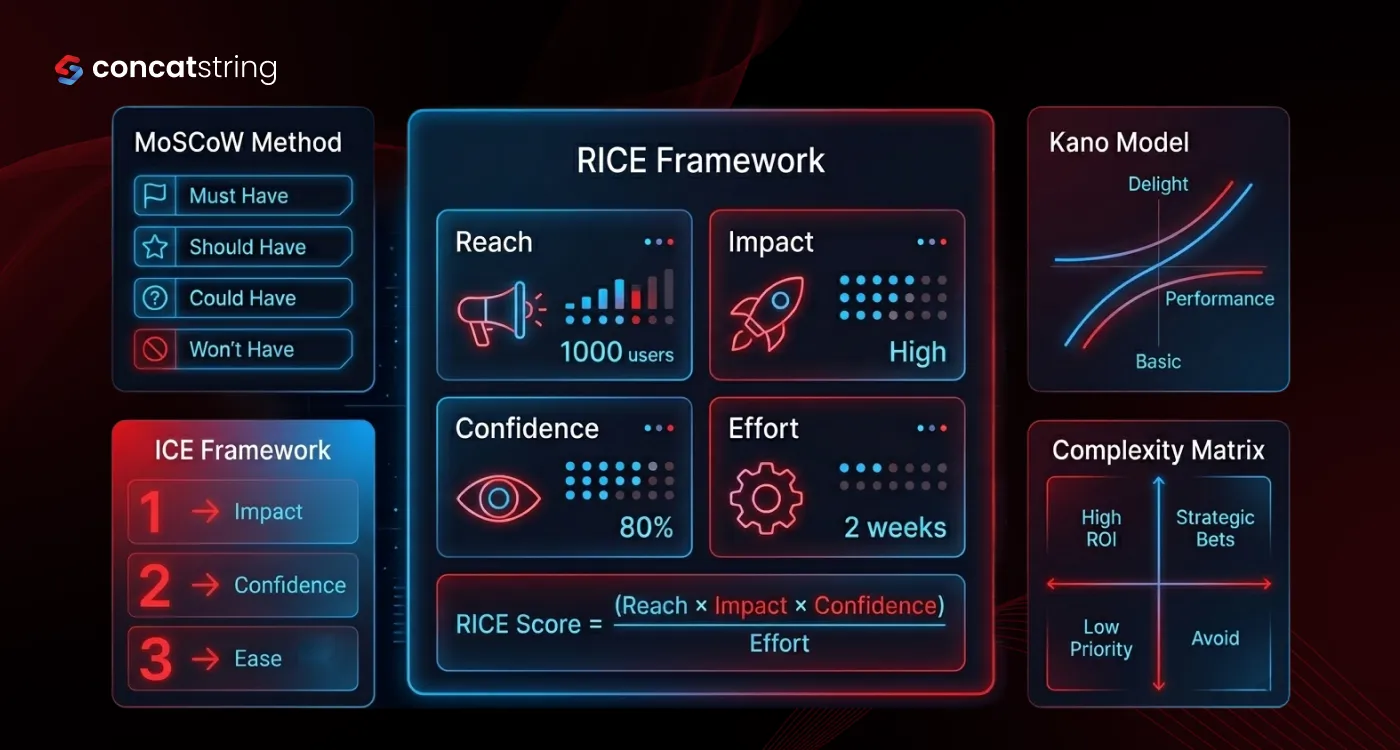
Instead of relying on instinct, successful teams use proven frameworks to make objective decisions.
- The MoSCoW method is one of the simplest and most practical approaches. It categorizes features into Must Have, Should Have, Could Have, and Won’t Have. This helps teams focus on essentials first, especially when time and resources are limited.
- The Kano model takes a different approach by focusing on customer satisfaction. It highlights that not all features are equal, some are basic expectations, some improve satisfaction, and some create delight. This framework is especially useful when you want to enhance user experience.
- The RICE framework introduces a more data-driven approach. Evaluating features based on Reach, Impact, Confidence, and Effort, it allows you to compare different ideas objectively. It’s particularly useful when you have multiple competing features.
- For quicker decisions, the ICE framework simplifies things by focusing on Impact, Confidence, and Ease. It’s less detailed than RICE but faster to apply.
- Finally, the Value vs Complexity matrix helps you visualize priorities. It clearly shows which features are quick wins and which ones are likely to consume time without delivering enough value.
A Simple Real-World Perspective
Imagine you are building a travel platform. You might have ideas like AI-based itinerary planning, chat support, multi-language options, and price comparison tools.
Without prioritization, you might try to build everything at once. But with the right approach, you would focus first on core functionalities like booking and price comparison—features that directly impact user decisions. Enhancements like AI recommendations or multi-language support can follow later.
This approach not only reduces risk but also ensures faster delivery of value.
Common Mistakes You Should Avoid
Even with the right frameworks, mistakes can happen.
One of the biggest errors is building based on personal preference rather than user need. What you think is valuable may not align with what your users actually want.
Another common issue is overloading the product. Adding too many features can dilute the user experience instead of enhancing it.
Ignoring data is another critical mistake. Decisions without data are just assumptions, and assumptions are risky.
Finally, the lack of clear metrics makes it impossible to measure success. Without defined outcomes, you won’t know whether a feature is working or not.
Do You Need to Do This Yourself?
In theory, yes. In practice, not necessarily.
Feature prioritization requires a combination of research, strategy, and experience. It involves understanding markets, analyzing data, and making informed trade-offs. This is why many businesses rely on product strategists, UX experts, and experienced development teams.
However, even if you don’t execute it yourself, understanding the process helps you make better decisions and choose the right partners.
Final Thoughts
Feature prioritization is not about limiting ideas, it’s about maximizing impact.
It helps you move from chaos to clarity, from assumptions to insights, and from effort to outcomes.
In a world where most websites fail to deliver value, the ones that succeed are not the ones that build the most, they are the ones that build with intention.
Let’s Help You Build What Actually Works
Reading gives you awareness, but real growth comes from the right execution.
If you want clarity on:
- What features does your product actually need
- How to improve ROI
- How to build a scalable, high-performing platform
Then it’s better to have a direct conversation with experts.
Book your free consultation here:
https://concatstring.com/contact-us
Let’s build something that works, not just something that exists.
FAQs