Table of Contents
Use AI to summarize this article
Key Factors to Consider
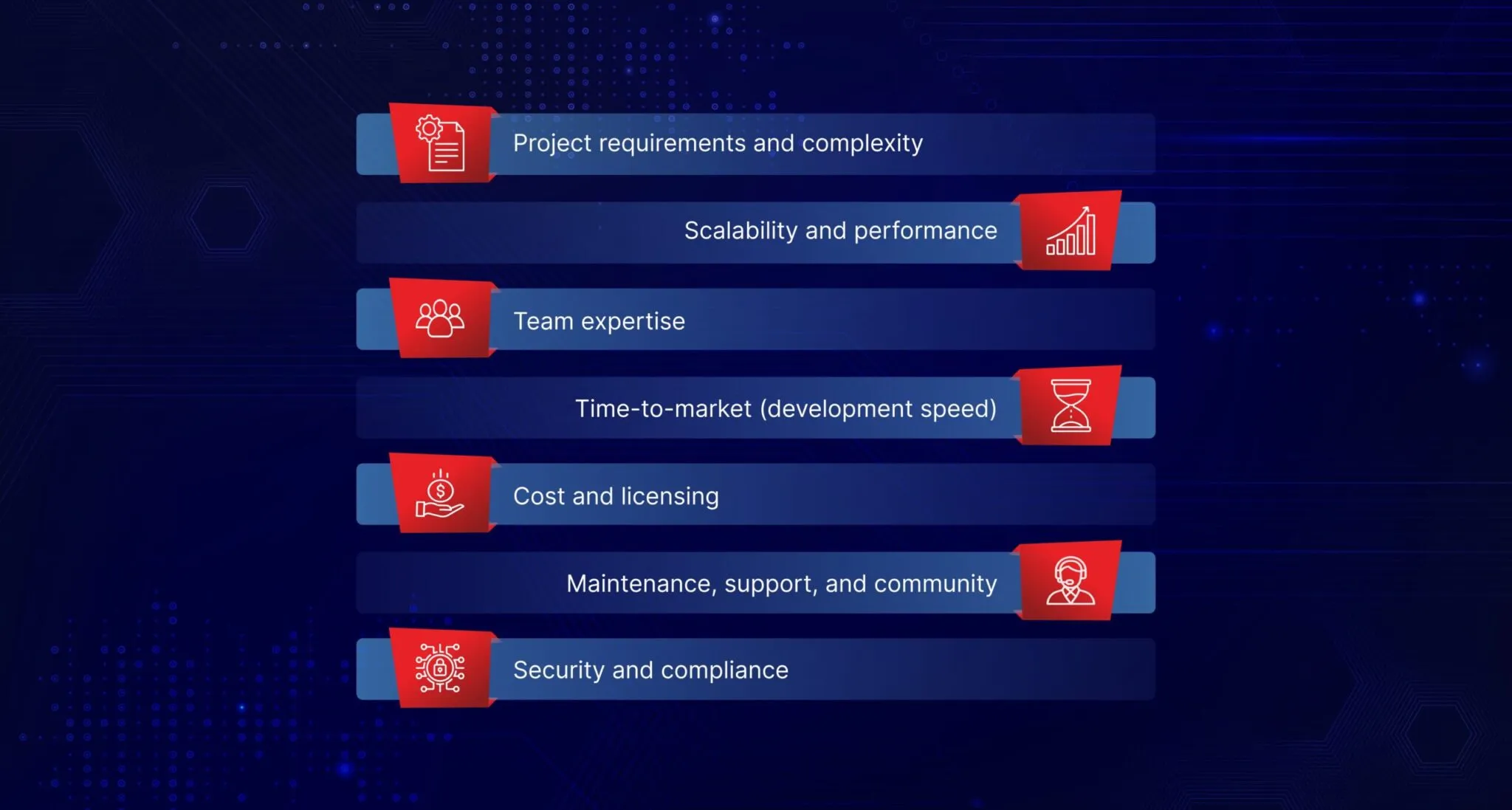
When selecting a tech stack, weigh the following factors:
- Project requirements and complexity: Identify the app’s core features (user interfaces, real-time needs, data processing) and security requirements. The stack must support all necessary functionality and regulatory constraints.
- Scalability and performance: Choose technologies that can grow with your user base and handle expected traffic. Consider both vertical scaling (powerful servers) and horizontal scaling (distributed systems) from the start.
- Team expertise: Leverage your developers’ existing skills. Familiar languages and frameworks shorten the learning curve and speed up development. Ensure you can hire or train talent for the chosen stack.
- Time-to-market (development speed): Some frameworks (like Ruby on Rails or Django) and libraries offer rapid development (batteries included), which can be crucial for tight deadlines. Check framework maturity and available libraries/plugins to avoid reinventing the wheel.
- Cost and licensing: Evaluate budget constraints. Open-source stacks (like LAMP or MERN) have no licensing fees, while proprietary platforms (like some Microsoft technologies) may incur costs. Also consider hosting, scaling, and maintenance costs as the app grows.
- Maintenance, support, and community: A strong community and good documentation make it easier to get help and updates. Stacks with active ecosystems (e.g., JavaScript and Python communities) offer more libraries and support. Also consider vendor support if using commercial software.
- Security and compliance: For apps handling sensitive data (healthcare, finance), choose stacks with robust security features and established compliance support. Check how easily you can implement encryption, authentication, and audit logging.
Tech Stack Components
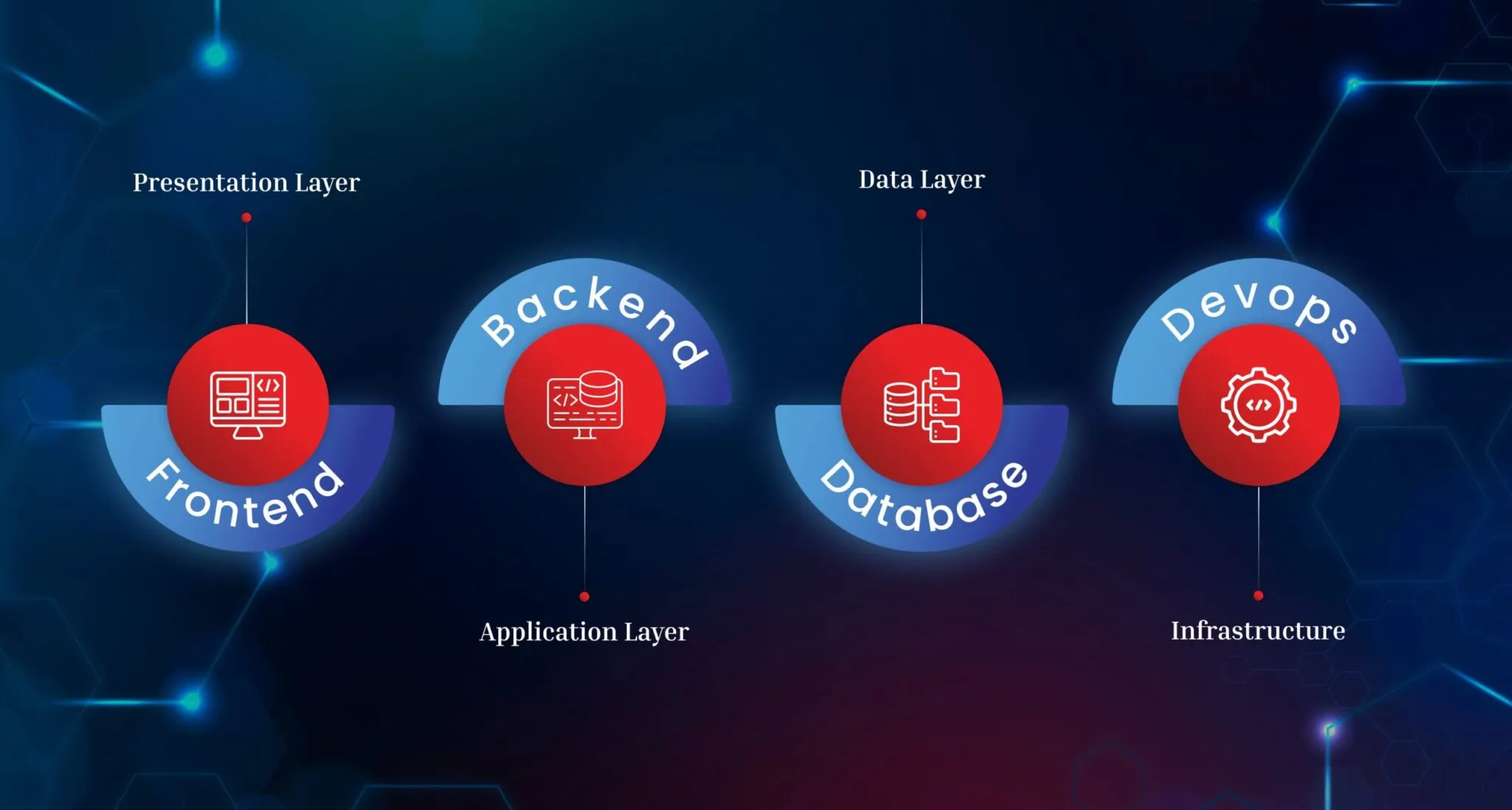
A typical application stack consists of several layers:
- Frontend (Presentation Layer): This is the user interface. For web apps, it includes HTML, CSS, and JavaScript (or TypeScript), often using frameworks like React, Angular, or Vue.js. Mobile frontends use platform-specific UI frameworks (e.g., SwiftUI for iOS, Jetpack Compose for Android) or cross-platform toolkits (e.g., Flutter’s widgets, React Native). The frontend layer must deliver a responsive, intuitive UX and run in the browser or on the device screen.
- Backend (Application Layer): The server-side logic lives here. Common backend languages and frameworks include Node.js (JavaScript/TypeScript), Python (Django/Flask), Ruby (Ruby on Rails), Java (Spring), PHP (Laravel), and C#/.NET. This layer handles data processing, business rules, and API endpoints. For example, Django (Python) or Rails (Ruby) provide full-stack solutions, while Node.js with Express is popular for lightweight, event-driven servers.
- Database (Data Layer): Databases store and retrieve application data. Options include relational databases (MySQL, PostgreSQL, SQL Server) and NoSQL stores (MongoDB, Redis, Cassandra). The choice depends on data structure (tabular vs. document/JSON), consistency needs, and scale. For instance, MongoDB is often used in JavaScript stacks (MEAN/MERN) for its JSON-friendly schema, while PostgreSQL is chosen for complex queries and data integrity.
- DevOps & Infrastructure: This encompasses hosting, deployment, and operational tooling. Modern stacks rely on cloud platforms (AWS, Azure, GCP), containerization (Docker), orchestration (Kubernetes), CI/CD pipelines (Jenkins, GitHub Actions), and monitoring/logging (Prometheus, ELK). These ensure your app is deployed smoothly and runs reliably. For example, FullScale notes that a tech stack includes infrastructure like servers and deployment tools. Choosing the right DevOps tools (CI/CD, automated testing, load balancers) is crucial to support your stack’s deployment and maintenance.
Popular Web App Tech Stacks
Below is a comparison of common web development stacks:
StackComponentsUse Cases / StrengthsNotes / Limitations
Each stack has trade-offs. For example, LAMP (Linux/Apache/MySQL/PHP) is cost-effective and proven, but may not shine for high-concurrency real-time apps. In contrast, MEAN/MERN leverage a single language (JavaScript) for both front and back, enabling fast development. ASP.NET (Microsoft) is favored by large enterprises for its robustness and compliance features. Other options include Ruby on Rails (convention-driven rapid dev) or JAMstack approaches (static front-end + APIs), depending on project needs.
Popular Mobile App Tech Stacks
For mobile development, choices broadly split between native and cross-platform:
Write one JavaScript codebase for both iOS and Android. Large ecosystem and plugins browserstack.com. Fast development (hot reload) and extensive community support.Slight performance overhead vs pure native. Bridging required for some native features.
ApproachLanguages / FrameworksPros / Use CasesCons / Considerations
According to industry sources, Flutter and React Native are the leading cross-platform frameworks in 2025, while the best performance is achieved with fully native tech (Swift for iOS, Kotlin for Android). For example, BrowserStack notes that React Native (JavaScript) allows rapid, JS-friendly development with a wide plugin ecosystem, whereas Flutter (Dart) offers faster UI rendering and high performance. The table above summarizes the trade-offs: native apps offer maximum speed and full API access, while cross-platform frameworks maximize code reuse and faster time-to-market.
Startups vs. Enterprises
Startups and small teams often prioritize speed and cost. They typically choose stacks that enable rapid iteration (like Node.js/MEAN or Ruby on Rails) and leverage open-source tools. For example, FullScale recommends LAMP or Node.js-based stacks for budget-conscious projects. These stacks have large talent pools and quick development cycles, helping startups launch Minimum Viable Products quickly. Cross-platform mobile frameworks (React Native, Flutter) are also popular in startups to reach both iOS and Android with one team.
Enterprises and large projects value stability, security, and scalability. They often adopt proven, enterprise-grade stacks (such as ASP.NET, Java/Spring, or managed cloud services) that offer long-term support and compliance. FullScale notes that .NET/ASP.NET is ideal for regulated industries (finance, healthcare) due to its advanced security and support. Enterprises may invest in robust DevOps infrastructure (Kubernetes clusters, CI/CD pipelines, containerization) to ensure high availability and easier maintenance over time.
Case Studies and Examples
- Airbnb: The popular accommodation marketplace was originally built on Ruby on Rails for its backend. Rails gave Airbnb rapid development and the ability to scale (supporting millions of listings) thanks to its scalability and flexibility.
- GitHub: This code-hosting platform uses Ruby on Rails at its core. Rails helps GitHub handle a huge number of projects and web requests efficiently, leveraging Rails’ strong testing tools and APIs.
- Facebook/Instagram (mobile apps): Both of these apps use fully native technology stacks on iOS and Android. Each platform’s code is written in Objective-C/Swift (iOS) or Java/Kotlin (Android) to maximize performance. (Facebook also uses React Native for some parts, but its main apps are native).
- Uber/Twitter: These companies maintain separate native codebases for iOS and Android as well. For instance, Uber’s apps use Java/Kotlin on Android (with libraries like RxJava) and Swift/Obj-C on iOS. This approach ensures the fastest possible performance and smooth user experience at scale.
These examples illustrate that tech stack choices vary: many web startups favor Rails or JavaScript stacks, while high-performance mobile apps often opt for native code.
Conclusion
There is no one-size-fits-all tech stack. The best choice depends on your application’s goals, constraints, and your team’s context. By carefully evaluating requirements, scalability, team skills, and budget – and by learning from real-world examples – you can select a stack that balances short-term speed with long-term viability. Remember that technology choices can evolve: start with what fits your current needs and be prepared to adapt as your app grows. The right tech stack is the one that aligns with your project’s vision and helps deliver a robust, maintainable product.